

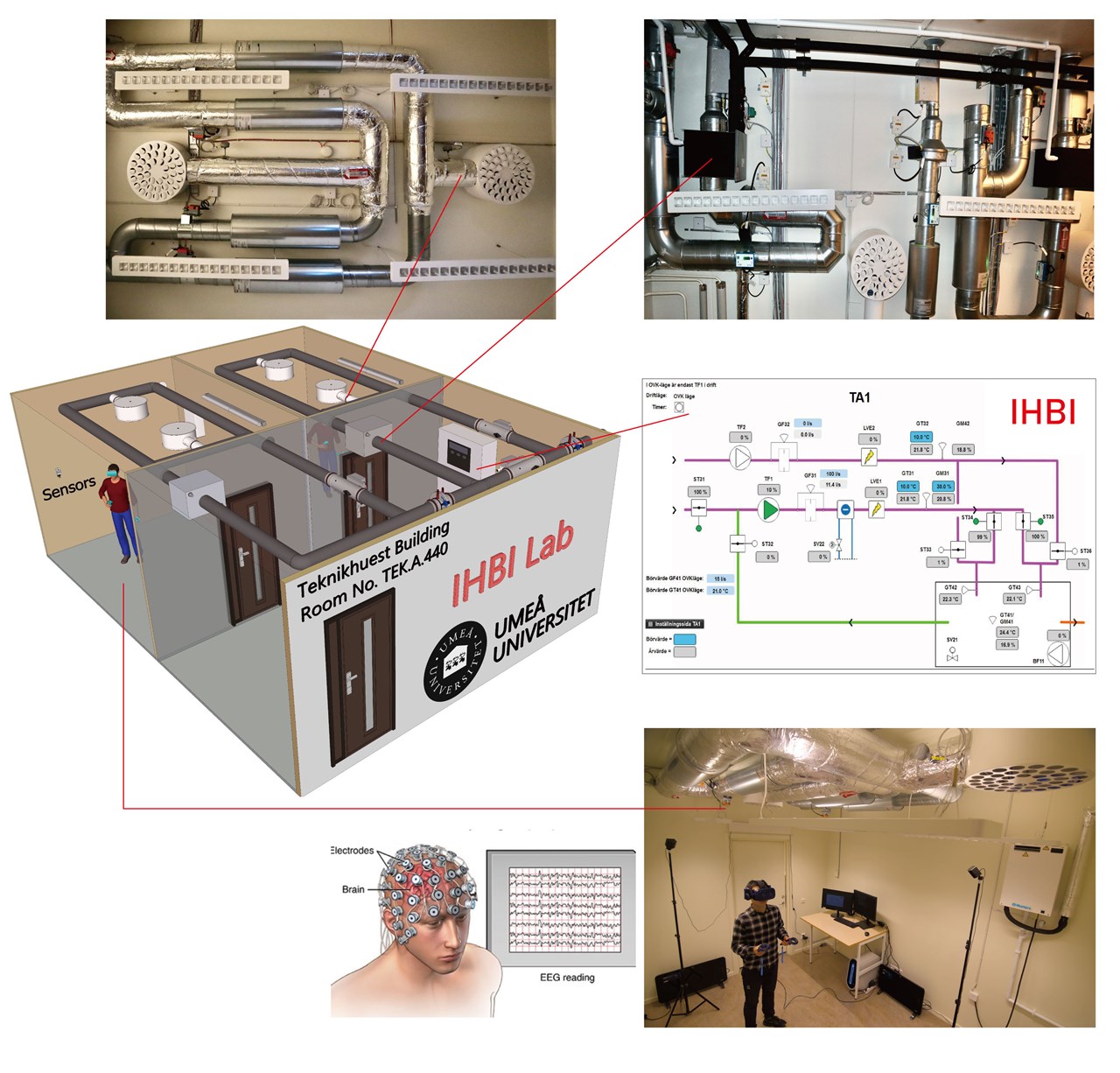
Research group The Intelligent Human-Buildings Interaction (IHBI) Lab at Umeå University, Sweden, is an interdisciplinary research hub pioneering novel methods to study interactions between humans and the built environment. The lab provides a cutting-edge experimental platform that integrates immersive virtual environments with a state-of-the-art climate chamber (as shown in the figure), enabling realistic scenarios to be tested under controlled and repeatable conditions.
Leveraging this platform, one of IHBI’s main research directions—occupant-centric energy transitions—examines how people from diverse social groups, including older adults and marginalized communities, experience and respond to energy-efficiency measures and dynamic pricing schemes in practice. Advanced sensors continuously monitor participants’ behavioral, perceptual, and physiological responses, providing a detailed understanding of how different occupants adapt during energy transitions. The resulting evidence supports the design of occupant-centric and inclusive buildings and helps ensure that energy interventions and policies are equitable, effective, and responsive to diverse needs.
IHBI’s second major research thrust addresses climate resilience in the built environment. Using the lab’s climate chamber, researchers simulate extreme weather events—such as heatwaves—to directly observe their impacts on building performance and occupant well-being. During these simulations, participants equipped with biometric sensors (including EEG monitors) provide real-time data on stress, comfort, and adaptive behaviors. This experimental work is complemented by comprehensive survey data collected over the past year from communities in northern Sweden, enabling IHBI to examine how different population groups are affected by climate extremes and to develop targeted strategies that strengthen the resilience of both buildings and communities.
Publications
Feng, K., Penaka, S. R., Yu, H., Chen, S., & Lu, W. (2026). Projecting climate resilience of urban building stocks: A data-augmented archetype approach for future Nordic climates. Energy and Buildings, 359, 117260. https://doi.org/10.1016/j.enbuild.2026.117260.
Liu, P., Chokwitthaya, C., Olofsson, T., & Lu, W. (2026). Demand response optimization incorporating thermal comfort in single-family houses with on-site generation: a systematic review. Applied Energy, 406, 127305.
Penaka, S. R., Feng, K., Olofsson, T., & Lu, W. (2025). Diverse occupant behaviour and urban building heterogeneity to enhance urban building energy modelling. Energy and Buildings, 116721.
Feng, K., Chokwitthaya, C., & Lu, W. (2024). Exploring occupant behaviors and interactions in buildings with energy-efficient renovations: A hybrid virtual-physical experimental approach. Building and Environment, 265, 111991.
Penaka, S. R., Feng, K., Olofsson, T., Rebbling, A., & Lu, W. (2024). Improved energy retrofit decision making through enhanced bottom-up building stock modelling. Energy and Buildings, 318, 114492.
Man, Q., Yu, H., Feng, K., Olofsson, T., & Lu, W. (2024). Transfer of building retrofitting evaluations for data-scarce conditions: An empirical study for Sweden to China. Energy and Buildings, 310, 114041.
Liu, B., Penaka, S. R., Lu, W., Feng, K., Rebbling, A., & Olofsson, T. (2023). Data-driven quantitative analysis of an integrated open digital ecosystems platform for user-centric energy retrofits: A case study in northern Sweden. Technology in Society, 75, 102347.
Lu, C., Gu, J., & Lu, W. (2023). An improved attention-based deep learning approach for robust cooling load prediction: Public building cases under diverse occupancy schedules. Sustainable Cities and Society, 96, 104679.
Chokwitthaya, C., Zhu, Y., & Lu, W. (2023). Ontology for experimentation of human-building interactions using virtual reality. Advanced engineering informatics, 55, 101903.

Eco-friendly light sources and climate-smart buildings recognized by Swedish academy.