
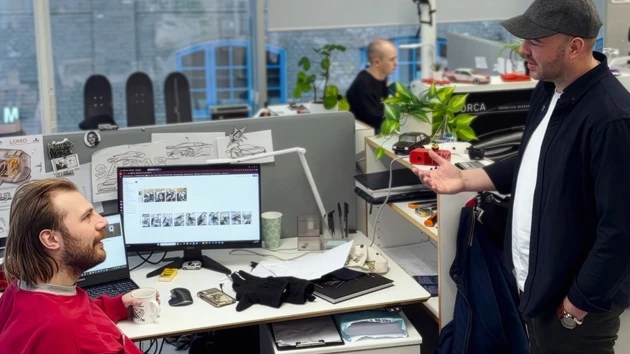
Andy Shaw reconnects with students in the TD studio, discussing design approaches and offering insights shaped by nearly two decades in the field.
Publication date: 2026-02-05
Collaboration over competition: Andy Shaw on UID’s culture and craft
Nearly two decades after graduating from UID’s MFA in Transportation Design, the automotive designer returns to Umeå to mentor students. He talks about the lessons that lasted, why community matters, and a new project that aims to bring feeling back to driving.
Text: Jens Persson

Andy Shaw pictured at UID during his February 2026 visit, reflecting on the experiences that shaped his early development as a designer and his continued connection to the school.
Image:Jens PerssonThe snow is falling again in Umeå when Andy Shaw steps back into the studios where he learned to be a designer. “My name is Andy Shaw and I graduated from UID in 2007,” he begins, before tracing a line from student days to a career built on habits formed here. Almost twenty years on, it is not a single workshop or studio class he cites first, but the way of thinking that took root here. “The connections that I made and the approach to design in general, how to nurture design intent and how to edit and manage the process,” he explains. “I learned when to put your foot on the gas and when to take it off.”
The skill that stayed
Shaw speaks with a soft, measured clarity that comes from years of moving between concept and production. When asked for the one skill he still leans on, he does not hesitate. “How to audit and edit a challenge,” he says, then expands the phrase into a design ethic: navigating technology, designing with empathy, and, crucially, “emotional durability within design.”
Emotional durability is a thread that runs through the conversation. It is about creating products that people want to live with for years, not just seasons, and it underpins his view of what good designers do. For Shaw, it begins with careful listening and continues with disciplined editing, the often overlooked craft of knowing what to leave out.
‘The winters bring you together’
Culture comes up repeatedly, and with it a sense of place. “The part of the culture that stayed with me is the sense of community within design,” he says. UID’s environment, he suggests, is built on respect for different backgrounds and the spark that comes when disciplines meet. “It is really exciting when you get to work with people from completely different backgrounds to yourself.”
the part of the culture that stayed with me is the sense of community
He smiles at a memory many alumni will recognise. “The snow and the long winter brings everybody closer together. There is this shared sense of community within the school, which stays with you.” That community is tangible in small, human moments too. “The facilities here are amazing, so having things like a kitchen that the students can use and that you can cook together and eat together is something that I’ve tried to implement in workplaces that I’ve been, so that people feel like they are at home when they are at work.”
Another phrase that recurs is “collaboration over competition.” It is something current students often emphasise when comparing UID with other schools, and Shaw recognises it as a tradition that has been earned rather than assumed. “Cultures are always quite fragile, and you have to earn them and work for them, you cannot just demand a culture,” he says. “The fact that UID has this strong sense of community and collaboration over many years is quite a testament to the school.”
What he misses
Asked what he misses about UID, Shaw pauses. “The ability to just pick up a project and to contribute to something with no other commercial burden,” he says. “You are almost designing for fun.”
He also misses the feeling of being surrounded by people who share a “dream” and a set of ambitions. Leaving that environment, he admits, can be a shock. “It is a little bit of a surprise when you go into the workplace and not everybody has the same shared kind of dreams and ambitions that you have.”
Advice to today’s students
His counsel is direct. Start with your values and let them guide decisions. Then build a workflow you truly own. He urges students to keep adapting their tools and processes, noting that employers are increasingly open to different software in different contexts.
“Finding your own way of navigating tools is critical,” he says. “If you can do that, you will stay relevant as technology and workplaces change. Pair that fluency with a clear set of values you can measure in your work and you will be in a really good place.”
Fifteen years in cars, and a project called Friday
Shaw has spent the past fifteen years in the automotive world, the last ten growing a company that collaborates with multiple OEMs on design programmes and prototyping. Recently he felt the pull to rekindle the energy he remembers from his UID days. “I decided that I should find something which reignites the spark,” he says.
it feels like a good time to look at the essence of driving
The result is Friday, a design project rooted in a simple question: what made cars feel alive in the first place. “Vehicles used to have a sense of feeling and passion that was inherent in the design due to the architecture and the technology,” he says. In an era when electric power has commoditised performance, “it feels like a good time to look at the essence of driving and really try and work on a project that can bring some of that back.”
Back in the studio, back with students
Shaw’s return to UID is not just nostalgic. He is here to mentor, spending time with first and second year Transportation Design students. “I am looking at the major degree projects for the second year students, evaluating their briefs and seeing if I can offer guidance on how to navigate the project,” he says. With first years, the focus is on fundamentals, talking through “areas in their workflow that I can maybe help them with or help them to learn or to grow.”
It is a full circle moment, one that threads together his emphasis on community, collaboration and care. The message he brings is straightforward but resonant. Know what you stand for. Learn to edit. Build shared spaces, from kitchens to studios, where people can work side by side. And keep the spark alive, whether that is in a degree project or a project called Friday.