
From user journey mock-ups to final designed objects, the process traces how early ideas were translated into tangible forms through testing, iteration, and refinement.
Publication date: 2026-06-04
Objects of resistance: Designing communication beyond control
When Coco Pauli began shaping her graduation project, she did not start with a product category. She started with a discomfort. In industrial design, she felt, we can become fluent in “problems and solutions” while leaving some of the biggest problems largely untouched, including political inequality and systems that move towards oppression.
Text: Jens Persson

Coco Pauli has designed a decentralised communication system intended to help communities stay connected when conventional infrastructure is restricted, surveilled, or shut down.
Image:Benjamin FodorThat realisation became the starting point for lora & leo, her MFA Advanced Product Design degree project, which investigates what it means to design for connection when communication itself becomes a site of control. Inspired by a century of resistance objects, the project asks how communities might stay connected when communication infrastructures are surveilled, restricted, or shut down.
“One of the most important things for resistance is actually communicating, being able to work together.”
When communication becomes a lever of power
Across many parts of the world, access to communication is increasingly restricted through authoritarian tendencies, surveillance, and internet shutdowns. Those disruptions do not only block information. They fracture trust, visibility, coordination, safety, and the basic human reassurance of knowing others are still there.
Coco’s project frames this as a design question with real consequences: if people are pushed offline, or pushed into platforms that can be switched off, monitored, or manipulated, what kinds of tools could help communities stay connected with dignity and agency?
Coco Pauli shares the motivations behind lora & leo, a project shaped by questions of communication, resistance, and the need to stay connected under pressure.
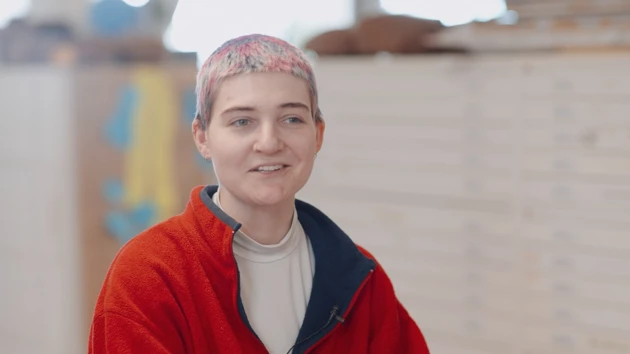
Looking back to move forward
Coco’s research begins with a historical lens. As a German designer, she chose to start with the Second World War, not as a distant reference point, but as a reminder that design and technology have always been entangled with power, resistance, and moral responsibility.
From there, she traced a line through everyday media that became lifelines. She studied “objects of resistance” that helped people communicate under constraint, from clandestine radios to more recent workarounds. In her interview, she points to examples such as cassette players used in Iran in the 1980s, VHS tapes, and USB drives used to move media and messages into and around North Korea.
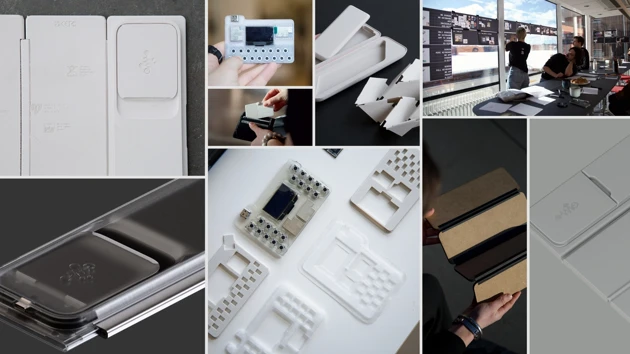
What connects these examples is not nostalgia. It is a pattern: when systems become restrictive, people adapt what is available, often using low-resource technologies in inventive ways, because the need to communicate does not disappear.
A device that keeps communities connected
The outcome is lora & leo, two complementary devices, or nodes, that form a decentralised, end-to-end encrypted mesh network designed to support communication beyond centralised control. It is not presented as a single fixed solution. Instead, Coco frames it as an adaptable object whose meaning can shift across contexts, from everyday use to crisis situations.
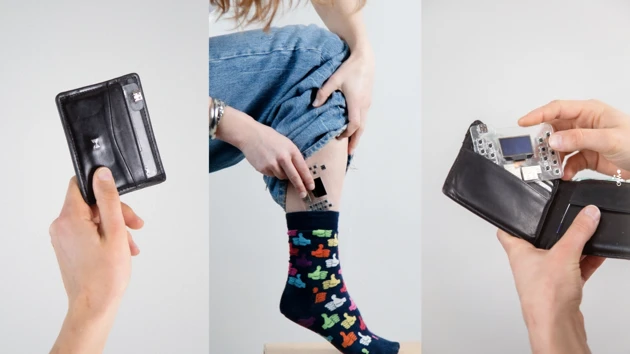
The lora card is designed to be carried, concealed, and moved with ease, supporting communication in contexts where portability, discretion, and adaptability are essential.
At the heart of the proposal is the lora card, a credit-card-sized, low-power messenger that enables local peer-to-peer messaging without any other infrastructure needed. The leo node provides satellite backhaul for global connectivity, widening bandwidth and making low-latency internet and data upload and download possible. The point is resilience: together, the nodes operate without central servers and are sustained by the community that uses them.
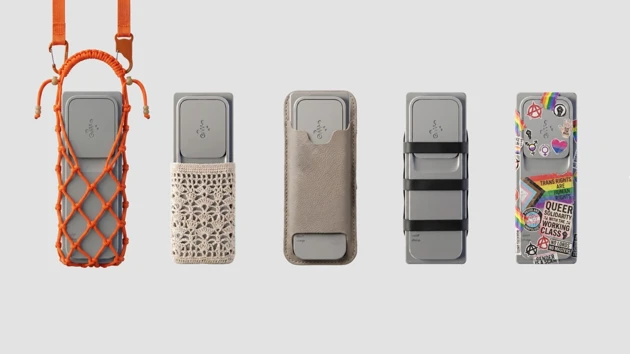
The leo node is designed to be appropriated, individualised, and adapted over time, allowing communities to shape it according to their own needs, contexts, and ways of communicating.
Because the network is distributed across many independent nodes, constantly moving and expanding, there is no single point of failure and no single actor who can shut it down. Coco’s design priorities are clear: discreetness, portability, accessibility, and careful consideration of safety, privacy, and potential misuse in sensitive contexts. User research across different settings highlights needs that are as emotional as they are technical, including simplicity, trust in use, and “signs of life” that provide reassurance when situations are unstable.
Not a final answer, but a necessary conversation
There is a humility in how Coco positions the work. She repeatedly resists the temptation to claim that design can “fix” systemic oppression. Instead, she speaks about creating conditions for people to navigate difficult realities with greater autonomy and connection.
“I do not want to find a solution itself. I mostly want to open the discussion about how important communication is for us as humans, and for being able to resist together and not be alone in difficult political situations.”
That framing matters because it shifts the role of the designer. The project treats the object as both tool and message, a physical prompt that makes invisible power structures more discussable. It also surfaces a practical design tension: in highly controlled environments, subtlety can be a form of safety. Low-visibility solutions may enable safer action and expression, precisely because they do not announce themselves.
Why it matters
lora & leo positions industrial design as a field with political responsibility. By translating complex political conditions into a tangible proposal, the project invites broader discussion about ethics, access, and responsibility in contemporary connectivity.
It also offers a timely reminder for the design community: the systems we rely on are not neutral. The ways we connect, and the infrastructures we take for granted, can be shaped by economic and political incentives far beyond the user’s control. In that landscape, making communication more resilient is not only a technical challenge. It is a question of care.
Project in brief
- Student: Coco Pauli
- Programme: MFA Advanced Product Design
- Project: lora & leo
- Focus: Community-driven, off-grid communication that supports privacy, safety, and connection under constraint
- Concept: Two complementary nodes forming an end-to-end encrypted mesh network: a local LoRa-based peer-to-peer messaging device and a satellite backhaul node for wider connectivity.