
Early explorations with peers helped shape a visual language, using collaborative workshops to test how ambiguity could be recognised, shared and interpreted.
Publication date: 2026-06-08
Beyond the score: Reimagining women’s health metrics
Ece Günesen’s graduation project began with a tension between bodily experience and digital interpretation. She lives with a health condition that affects daily life, and has learned that wearables, devices used to monitor physiological signals, can produce data that feels unreliable or hard to trust.
Text: Jens Persson

Ece Günesen’s graduation project explores how interaction design can challenge the certainty of health technologies and open up more reflective ways of engaging with women’s health data.
Image:Mattias PetterssonThat experience made the problem both personal and critical. A number can look precise, even when the system behind it is uncertain. At the same time, Ece saw an opportunity for interaction design to offer a different relationship to bodily data.
“I would love to explore how we might design women’s health data as something that is to be lived with, and not something to be fixed or defined.”
That ambition became the starting point for her degree project, which questions the promise that consumer health technologies can turn the body into something fully legible.
When interfaces overstate certainty
Health wearables often promise to make the body easier to understand. In practice, Ece argues, they can operate through technical uncertainty while presenting themselves with clinical confidence. The result can be a quiet disconnect from interoception, the ability to sense and interpret one’s internal state, as people are encouraged to trust a score over their own experience.
For women, this uncertainty is compounded by a structural problem. Female bodies have historically been treated as too variable in research, shaping the datasets and assumptions still embedded in many systems today. Ece points to the exclusion of women from medical trials until 1993, leaving contemporary tools to build on partial foundations the field is still trying to repair.
Her project frames this as an interaction design question with real consequences. When a system appears certain but fails quietly, the user may begin to doubt the body rather than the tool.
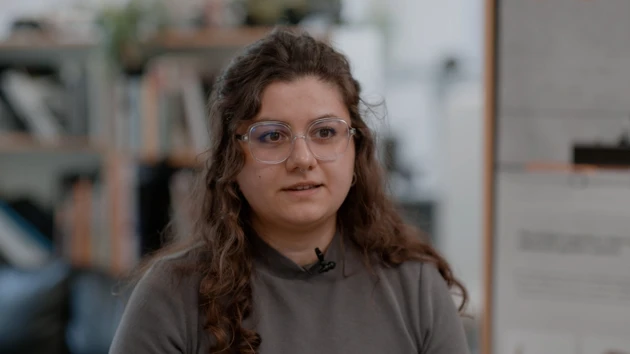
Ece Günesen shares the motivations behind Umbra, a project shaped by questions of ambiguity, self-trust, and how we might live with, rather than define, women’s health data.
Designing with ambiguity, not against it
Rather than proposing another optimised tracking system, Ece shifts the design question. What if ambiguity is not a flaw to eliminate, but a condition to work with?
Her approach draws on frictional design and poetic computation, treating ambiguity as something that can support reflection rather than confusion. Instead of interfaces that flatten complexity into a single score, she explores forms of “healthy friction” that slow interpretation, invite curiosity, and make more room for self-trust.
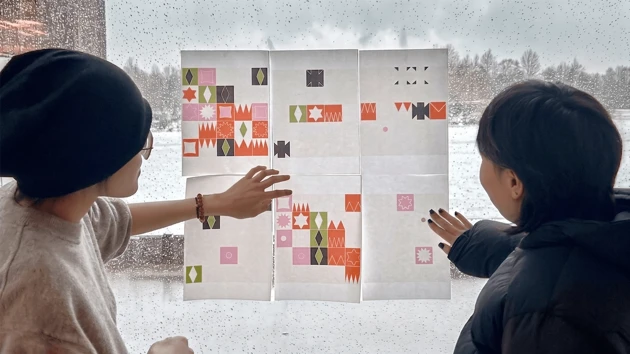
“My hope is that somehow bringing a little bit of healthy friction into this relationship could reward curiosity and engagement and patience with oneself.”
This is also why she is drawn to analogue interaction. Knobs, dials, and learned interfaces do not deliver instant answers by default. They ask more of the user, but they also leave more space for interpretation.
Two objects, one shift in authority
The outcome is a pair of designed artefacts that work together to shift the relationship between person and data, away from optimisation and towards attunement.
Umbra is a health data display that renders biosignals as evolving glyphs rather than scores. It uses ambiguity deliberately, showing patterns and changes over time without collapsing them into a single interpretation. In Ece’s framing, illegibility is not a lack of information. It is a way of returning interpretive authority to the individual, rather than deepening dependence on the system.
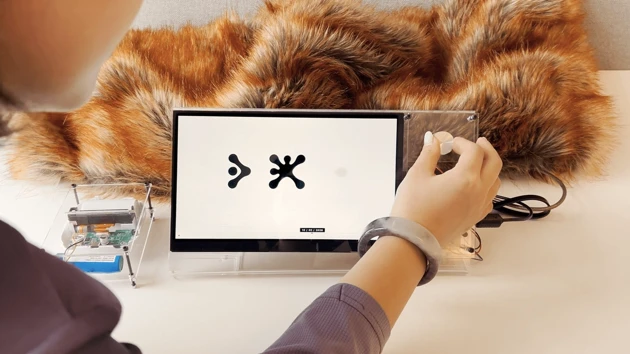
Umbra opens up health data as something to be read, not resolved, inviting interpretation rather than delivering answers.
Sibyl is a companion object, described as a satellite, that offers questions instead of answers. It prints prompts intended for reflection and noticing, not diagnosis. The aim is not to produce instant insight, but to create conditions where insight can emerge gradually, through attention and lived context.
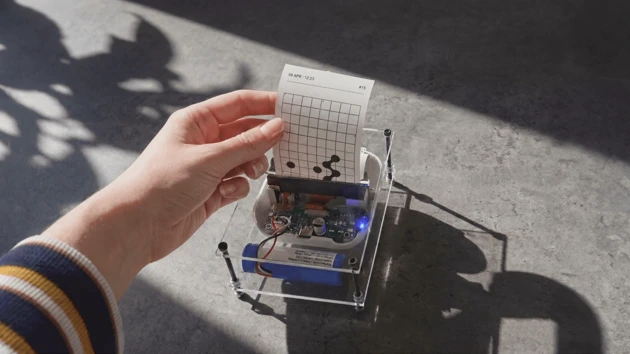
Sibyl shifts the role of the interface from instruction to inquiry, supporting reflection through prompts that unfold over time.
Ece is clear that she is not trying to produce a neat solution.
“I’m not trying to explore a finite solution in itself. I want to make the question a bit more concrete so that we can have dialogues”.
Together, Umbra and Sibyl propose what she calls self-cryptography: a practice in which data becomes meaningful through interpretation, context, and lived experience, rather than through a supposedly universal score.
Why it matters
At a moment when health wearables are spreading quickly and AI is becoming part of personal health platforms, the project offers a different idea of progress. Ece’s work suggests that ethical interaction design is not only about more precision and less friction. It is also about the kinds of relationships our tools create, whether they cultivate dependence or agency, and whether they support care or push people towards compliance and self-judgement.
Most importantly, it reframes women’s health data as something to live with, not something to fix. In doing so, it asks a broader question that extends beyond femtech: if bodies are complex and context matters, how should our interfaces behave if they are to remain humane?
Project in brief
Student: Ece Günesen
Programme: MFA Interaction Design
Project: Umbra
Focus: Women’s health data, ambiguity, and interpretive authority
Concept: Two artefacts: Umbra, a glyph-based health data display, and Sibyl, a companion object that prints questions rather than answers
Aim: To support attunement and self-trust, rather than constant optimisation