
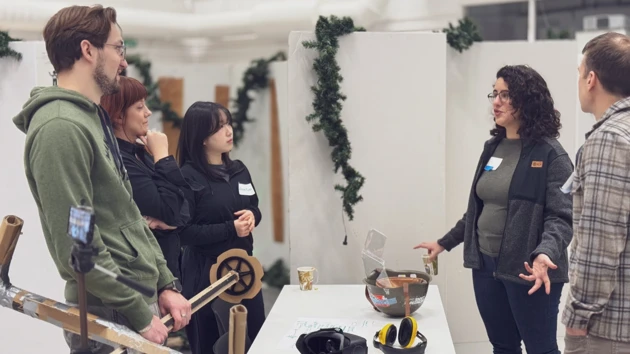
Participating companies discussing prototype developments with students during the 2025 Hot Team course.
Publication date: 2025-12-08
Hot Team 2025: Designing the future of forestry
This year’s Hot Team course invited students to rethink one of Sweden’s most traditional forestry practices: how young forests are managed to ensure healthy growth. The challenge was to explore new ways for humans, machines and nature to work together in creating a more sustainable system.
Text: Jens Persson

Image:Benjamin Fodor
Rethinking forestry practices
In forestry, young trees often need to be selectively removed so that the remaining ones have space, light and nutrients to grow strong. This process, called precommercial thinning, shapes the future forest and influences its biodiversity, resilience and economic value.
Today, much of this work is done manually, requiring significant time and physical effort. With growing demands for efficiency and sustainability, the course asked students to imagine mechanical and digital solutions that respect ecological processes while supporting human needs.
Collaboration with industry partners
Working in close dialogue with 'The Cluster of Forest Technology' and their industry partners such as Holmen Skog, SCA, Svea Skog, VIMEK, Algoryx and the Swedish University of Agricultural Sciences, students combined design methodology with insights from technology and silviculture, which is the science and practice of managing forest growth and health.
The brief encouraged a more-than-human perspective, challenging teams to see the forest not just as a resource but as a living ecosystem. Could machines learn from nature’s strategies? Could sensors and digital systems create intelligent networks where trees, soil and humans interact?
A learning experience beyond design
For Markus Rådberg, a BFA2 student, the experience was as much about collaboration as it was about forestry. “I think it’s more about working as a team rather than the assignment itself,” he said. “I really enjoyed the prototyping part and the teamwork aspect. It’s exciting and fun.”
The course pushed students to navigate diverse opinions and ideas, a challenge Markus welcomed. “Everyone has their own perspective, and we need to take all ideas into consideration and really think about what we’re making.”
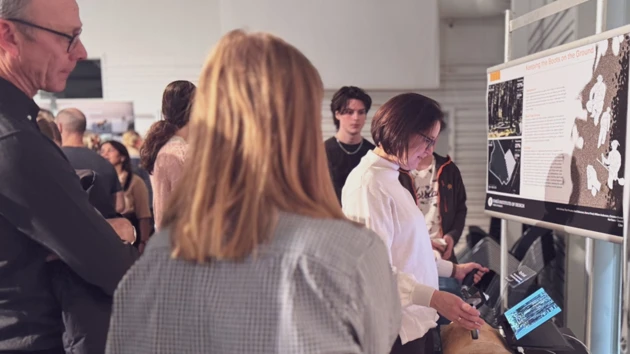
Participating companies exploring the students' final concepts.
The Hot Team format, with its fast-paced, interdisciplinary approach, continues to be a hallmark of UID’s learning environment. By engaging with real-world challenges and industry partners, students not only develop design proposals but also contribute to conversations about sustainability and innovation in forestry.
From new machine concepts to systems that integrate humans, technology and ecology, the outcomes of Hot Team 2025 aim to inspire a future where design fosters coexistence and co-creation in the forest landscapes of tomorrow.