
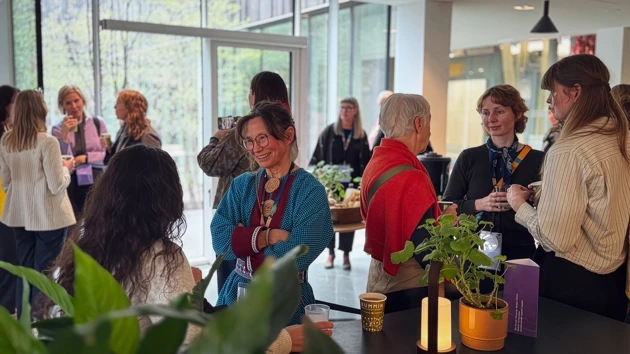
Professor Gunvor Guttorm in discussion with participants during a fika break on the first day of the symposium, continuing exchanges on Sápmi knowledge and design practices.
Publication date: 2026-05-18
Rethinking Nordic design histories in Sápmi: Many Places, Many Design Histories
What happens when design history is no longer centred in established capitals, but shaped by place, lived experience, and diverse ways of knowing? From 6 to 8 May 2026, UID hosted the nineteenth edition of the Nordic Forum for Design History Biennial Symposium.
Text: Jens Persson

Symposium convenor Maria Göransdotter, Associate Professor at UID, in conversation with a participant in front of the exhibition "Resistant Fibres, Fibrous Histories: The Work of Emiko Tokushige in the Collection of Designmuseum Danmark", created by Amalie Voss, Designmuseum Danmark.
Image:Jens PerssonTitled Many Places, Many Design Histories, the gathering brought together researchers, designers, curators and craftspeople to explore how design histories can be rethought, remade and shared across contexts. Held at UID in Ubmeje/Umeå, the symposium marked a significant shift in the Nordic Forum’s geography. For the first time in its history, the event took place in Sápmi, in what has long been considered ”the periphery” in relation to Nordic urban centres and museum institutions. This change set the tone for a programme that foregrounded place as both a critical lens and a starting point for new conversations.
Place, people and practice
The symposium unfolded across three days, combining keynote lectures, peer-reviewed presentations, panel discussions and site-based activities. The programme reflected a shared commitment to expanding the field of design history beyond established centres and narratives. The full programme for the Nordic Forum for Design History Biennial Symposium is available here.
Two keynote speakers offered complementary perspectives rooted in northern and Arctic contexts. Professor Gunvor Guttorm examined Sámi knowledge traditions and material practices through the lens of duodji, highlighting the deep interconnections between making, landscape and cultural continuity. Dr Bart Pushaw addressed questions of coloniality and relationality in Arctic visual culture, inviting participants to critically reflect on the ethical and methodological frameworks that shape design-historical research.
Across the sessions, contributors explored a wide spectrum of topics, from textile histories and museum practices to Cold War design discourses and contemporary digital archives. Presentations engaged with materials as carriers of knowledge, with everyday objects as sites of meaning, and with archives as evolving, community-driven infrastructures. The programme included twenty peer-reviewed contributions alongside interactive installations and workshops, encouraging dialogue across disciplines and practices.
A recurring focus was the importance of situating design within specific ecological, cultural and geopolitical contexts. Papers highlighted how craft traditions, such as Sámi duodji, continue to evolve through exchange, adaptation and embodied knowledge, while also questioning how such practices have been represented or overlooked within dominant narratives.
Reflecting on the ambition behind the symposium, convenor Maria Göransdotter emphasised the role of context in shaping both research and dialogue:
“By gathering in Sápmi, we opened up for conversations that might not emerge elsewhere. It allowed us to engage more directly with questions of place, responsibility and whose histories are being told.”
Collaboration and exchange
The symposium fostered an open and collaborative environment, reflecting the Nordic Forum’s long-standing role as a platform for exchange across academic and professional communities. Conversations extended beyond formal presentations, with interactive formats inviting participation and co-creation.
A workshop led by curators Katja Klaus and Philipp Sack from the Bauhaus Dessau Foundation invited participants to engage with an interactive atlas exploring design historical blind spots. Open throughout the symposium, the format encouraged ongoing contributions, allowing participants to collectively reflect on gaps, perspectives and overlooked narratives within the field.
The programme also emphasised regional engagement. A panel discussion on craft practices in Norrbotten brought together artists, art consultants and archivists to share perspectives rooted in northern Sweden. Their contributions highlighted the role of local ecosystems, community knowledge and sustainable practices in shaping both historical and contemporary design work.
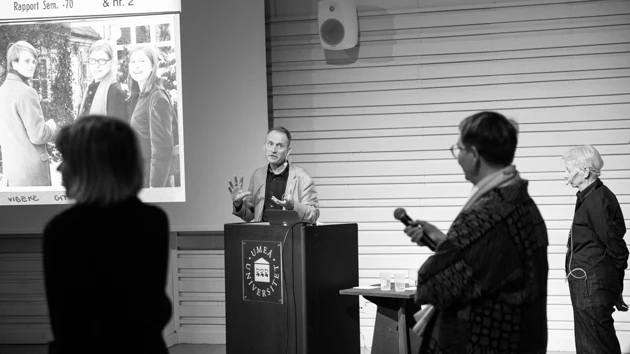
Presentation by Anders V. Munch and Vibeke Riisberg examining Danish design students, activist movements, and the SDO seminar in Copenhagen 1969.
Christina Zetterlund, co-convenor and associate professor of Design History, pointed to the importance of these shared processes:
“What became clear during the symposium was that design history grows through dialogue. When we listen across disciplines and communities, we begin to see connections that reshape how the field can develop.”
Beyond the symposium space
On the final day, participants visited Västerbottens Museum and the open-air site Gammlia, where guided tours and a workshop provided opportunities to engage directly with regional histories and Sámi cultural practices. These activities extended the symposium’s themes into lived environments, connecting academic inquiry with situated experience.
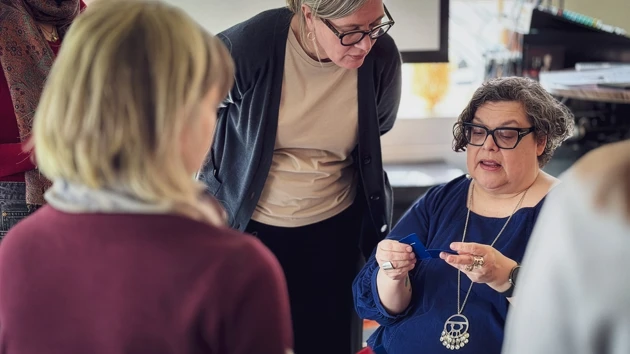
Anna‑Stina Svakko engaging workshop attendees in Sámi embroidery during a hands-on workshop at Gammlia, sharing techniques and stories rooted in duodji.
An embroidery workshop led by Sámi designer and duojár Anna-Stina Svakko offered a hands-on introduction to traditional stitching techniques. Working with natural materials and guided by stories and demonstrations, participants explored how knowledge is transmitted through making, reinforcing the symposium’s attention to learning through practice.
Rethinking design histories
Throughout the event, a shared question emerged: how can design history better reflect the plurality of experiences, places and practices that shape it?
Rather than offering a singular answer, the symposium demonstrated a range of approaches. Contributors proposed new methodologies, revisited archival material, and experimented with alternative formats for storytelling and exhibition-making. Together, these efforts pointed towards a more inclusive, situated and forward-looking understanding of the field.
Dr Denise Hagströmer, Design Historian and Senior Curator of Design at the National Museum of Art, Architecture and Design in Oslo, reflected on how the location shaped the conversations:
“Being here in Sápmi has really opened up new horizons. It’s brought new knowledge, new ideas, and new frames of reference. That kind of focus feels quite unusual for the symposium, and very welcome. It invites you to look at the field from a different angle.”
Her reflection echoed a broader sentiment throughout the symposium: that expanding design history requires not only new research, but new contexts for dialogue and exchange.
Many Places, Many Design Histories demonstrated that design history is not a fixed field, but an evolving practice shaped by collaboration, curiosity and care. By situating the conversation in Ubmeje/Umeå, within Sápmi, the symposium opened a shared space to rethink inherited narratives and explore more inclusive futures for the discipline.