
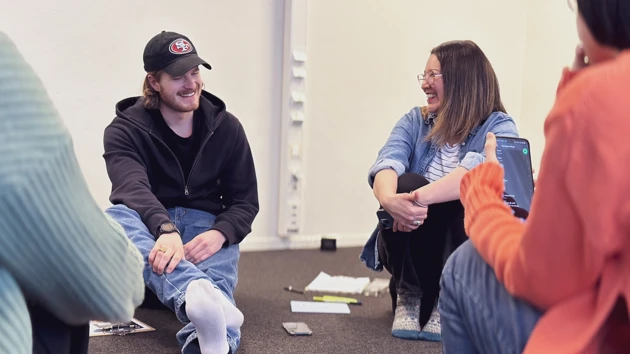
Pamela Gil-Salas leads a workshop with students on how companies use music data to understand and predict user behaviour.
Publication date: 2025-12-02
Rethinking digital power: The colonial legacy of Big Tech
What if the digital systems we rely on every day are not neutral tools, but extensions of old power structures? Pamela Gil-Salas, a doctoral researcher at Umeå Institute of Design, is challenging this assumption through her work on digital governance.
Text: Jens Persson

Pamela Gil-Salas presenting at the Cooperative AI conference in Istanbul.
Pamela Gil-Salas argues that the way data is managed today mirrors patterns of extraction and control that once defined colonial economies. Her question is simple yet urgent: how do we design governance models that protect collective agency instead of deepening dependence on Big Tech?
“Historical colonialism may be over,” she says, “but coloniality of power means that these colonial structures start to reconfigure.” Data now flows through infrastructures that cross borders, concentrating control in a handful of corporations. This is not just a technical challenge. It is a political economy shaping behaviour, markets, and governance.
Autonomía(s) as counter-narrative
Gil-Salas introduces autonomía(s), plural collective agencies, as a counterpoint to this concentration of power. The concept draws on Latin American movements that defended land and built community infrastructures for water and energy.
“I wanted to pursue autonomía(s) because it was a push back against that,” she explains. Her research translates those principles into the governance of data, proposing frameworks that prioritise communal needs over market imperatives.
Why design matters
Design plays a central role. “Design has something that is very powerful and that is that it’s generative,” she says. Where critical frameworks often diagnose problems without offering solutions, design creates possibilities. Her work explores community design, co-design, and participatory approaches as tools for building autonomy in digital systems.
This work is not abstract. It responds to the realities of data colonialism, where behavioural traces from everyday interactions are commodified and sold. It also addresses sustainability. Data is not immaterial. It depends on energy-intensive infrastructures, hardware, and labour – often invisible and precarious in the Global South.
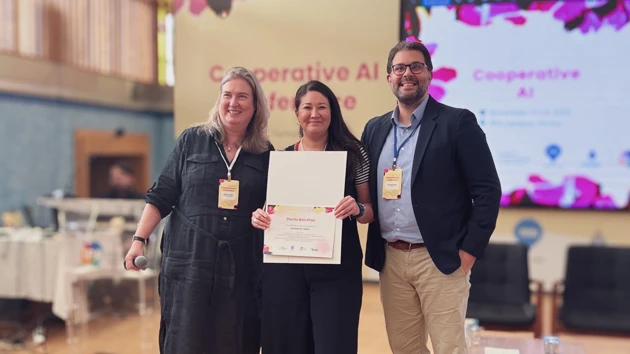
Pamela Gil-Salas was awarded the Du Bois Prize for "innovative contributions to platform cooperativism and democratic digital ecosystems".
Plural futures
Gil-Salas calls for a shift in perspective. “I would say futures, not future,” she notes. Instead of designing for a single future, she advocates for pluriversal design: futures that accommodate diverse voices and worldviews. This is not only a technical challenge but a cultural one, requiring governance models that embed care, cooperation, and shared responsibility.
In an era dominated by platforms and algorithms, her research asks a fundamental question: what would it mean to design digital systems that enable autonomy rather than extraction? The answer may shape whether our digital futures are equitable or merely efficient.