
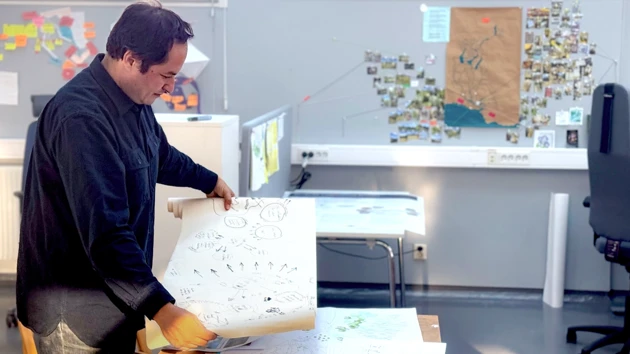
Sergio Bravo Josepshon in the UID Research Studio.
Publication date: 2026-03-10
Making the present: Designing with communities of the land
What if the path to sustainability is already being shaped by communities who work closely with the land? This question guides the research of Sergio Bravo Josephson, a doctoral researcher at UID, who studies how local groups sustain the social and ecological systems that make everyday life possible. His work invites designers to engage with these communities as partners, learning from their ways of caring for place.
Text: Jens Persson

Sergio Bravo Josephson, PhD researcher at UID, is working with grassroots groups in Chile, Spain, Italy, and Sweden to understand how people use creativity and collaboration to protect their land and way of life.
Image:Jens PerssonPeople and place
Sergio’s PhD project examines how local communities organise, construct and care for shared systems that support social and environmental justice. These practices often recognise the relationships between people, land, animals and wider ecosystems, offering an expanded view of how design can respond to the needs of a living environment.
His motivation is both personal and professional. Growing up as an immigrant in Sweden gave him the sense of being simultaneously inside and outside, a position that nurtured his curiosity and made it easier to question established ways of thinking. This perspective continues to guide his interest in approaches to design that explore multiple worldviews.
Designing with, not for
In Sergio’s work, design is understood as a tool for strengthening community practices. Instead of bringing in new concepts from the outside, he works with participatory methods that help local ideas become visible, workable and ready to build upon. One example is a project with shepherds in the Madrid region, where he helped co design a modular lambing shelter in the Casa de Campo park. Built through simple DIY methods and digital fabrication, the structure could be assembled gradually by community members. The project supported the return of grazing to the area, encouraged biodiversity through natural fertilisation cycles and reduced the need for machine based landscape maintenance.
He explains, “Designers are often trained to generate ideas, but in these contexts the ideas already exist. My role is to participate, to help make those ideas visible and buildable, and to understand how design can take a different position.”
Beyond the usual frame
A key motivation for Sergio is to move beyond what he describes as the limits of a market centred worldview. He argues that when sustainability is interpreted only through this lens, design risks reproducing the very systems that create harm. Working with communities who engage directly with land and territory opens other ways of knowing, from bioregional literacy to care for biodiversity.
This is also personal. Having grown up moving between different cultural and social contexts, Sergio developed an awareness of what sits beneath everyday norms. This experience helps him recognise assumptions more easily and listen closely for alternative viewpoints.
From products to processes
A central part of Sergio’s argument is to shift design attention from finished products to the processes and knowledge systems that enable communities to shape their own conditions. His work focuses on the present, not only on distant or speculative futures. “These communities are not just imagining what comes next, they are actively making their present,” he explains. “If we learn to engage with that process together, we can create meaningful change now.”
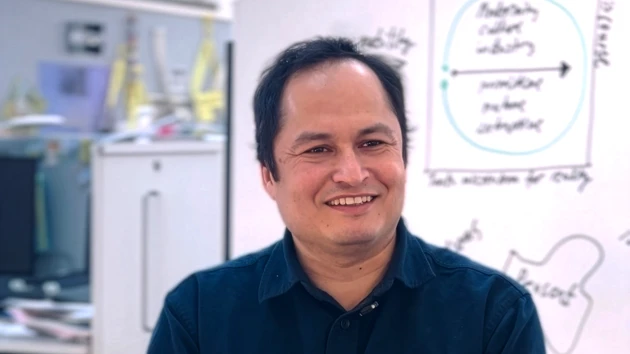
Sergio Bravo Josephson studies how grassroots groups care for land and territory, expanding how design can respond to social and ecological needs.
Within this approach, design takes part in a living system that includes people, animals, plants and soils, and follows timescales that extend far beyond standard project timelines. It serves as a reminder that sustainability depends on the rhythms and relationships within an ecosystem just as much as on tools or technologies.
Why it matters
By learning from grassroots ecologies, Sergio’s research brings forward counter narratives that challenge extractive or paternalistic approaches to design. His goal is to develop practical strategies that support life affirming transitions, grounded in more than human perspectives and long term commitments to place. These strategies can help both communities and institutions work in ways that honour local knowledge and ecological interdependence.
The research also invites a broader reflection on the role of design. If we want different outcomes, we must be willing to adopt different commitments. In this sense, Sergio’s work is not only about supporting communities who are already driving change. It is also about helping design practice evolve so that it can genuinely contribute to more sustainable and just ways of living.