Jörgen Bergqvist
Group CEO & Founding Partner, Ocean Collective
Previous roles as commercial manager, country manager and CEO at companies such as P&G, Carlsberg, LEGO, Brio and Delicato
Master's degree in Business Administration
Graduated in 2002



PROFILE What does it really mean to succeed in business? For Jörgen Bergqvist, an alumnus from the business school, the answer has changed over time. From commercial and leadership roles in established organizations such as Procter & Gamble, Carlsberg, LEGO, BRIO and Delicato, Jörgen is now co-founder and CEO of Ocean Collective, a company with a focus on sustainable oceans and system change.
Group CEO & Founding Partner, Ocean Collective
Previous roles as commercial manager, country manager and CEO at companies such as P&G, Carlsberg, LEGO, Brio and Delicato
Master's degree in Business Administration
Graduated in 2002
Honestly, it was a bit like traveling back in time. I have many fond memories from my time as a student and it felt good and a bit nostalgic to revisit the school. It was fun to meet curious students who also had several interesting questions.
– In general, I have benefited greatly from being able to analyze complex situations and take on unclear tasks. Then I feel that with a broad social education it is easier for me to analyze and understand the world we live in. Recently, I have greatly enjoyed the courses I studied in strategy and organizational change. Theories and models that stand the test of time and have inspired and helped me a lot in my current work.
– One of my driving forces is to learn new things and push boundaries, and I have therefore actively sought out environments, roles and companies where I can learn something new.
– Another driving force I have that has also been important is to dare to take on clear responsibility for results, even in difficult contexts where the outcome is uncertain.
– If I were to point out two roles that have meant a lot to me, it is my very first employer Procter & Gamble where I had the chance in a highly competitive environment to take responsibility and show results. It was a very developing time. Another important choice was my role as country manager for LEGO. A role that meant clear responsibility for results and organization, but also an assignment that meant leading extensive change.
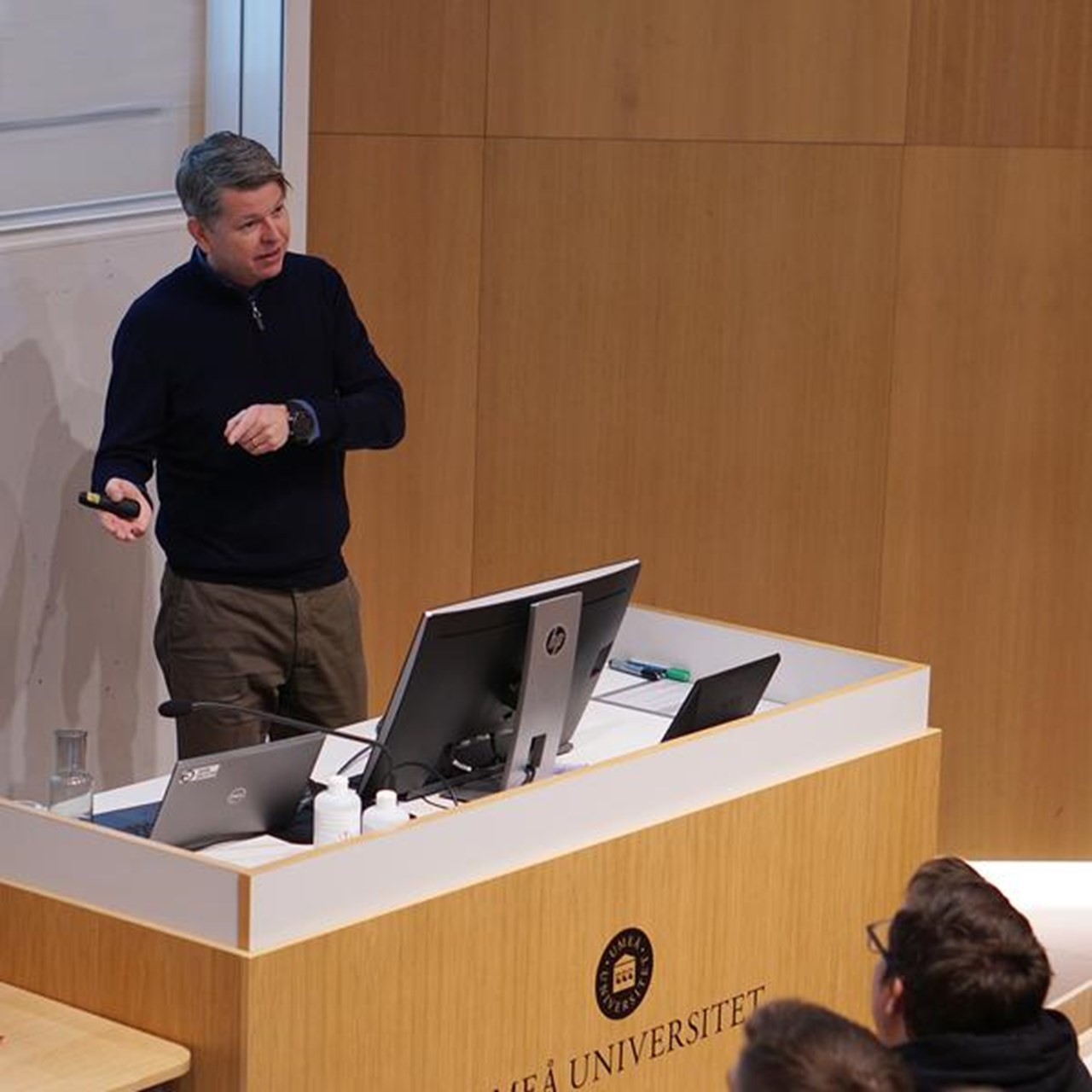
Jörgen lectures to students on campus.
ImageRickard Lindberg– Change means pushing boundaries, both for people and for businesses. To succeed together with others in getting to a new place is a fantastic feeling, it creates a special pride and community for everyone who participates, as I am attracted to. What attracts me to that type of assignment is also that it is difficult (if it had been easy, it would have already been completed), there is often an intellectual and analytical component, but the biggest part is about motivating people at different levels in an organization to move together to a new place.
– Another important aspect of change is identifying the right speed of change, and what resources are required. Qualities that are important for success as a change leader include a high degree of empathy and relationship skills, imagination and empathy (what is still right in our past) combined with articulating an attractive vision (why we should change), building strong teams that complement each other, but also a certain mental strength and perseverance when things never go as planned.
Change means pushing boundaries, both for people and for businesses. To succeed together with others in getting to a new place is a fantastic feeling, it creates a special pride and community that everyone who participates like me is attracted to.
– All the time. I have not worked with any change process that has gone exactly according to plan. The ability to take a step back, reflect, and adjust course is absolutely crucial. The difficulty is just knowing when to adjust and when to stay the course.
– A technique called ASSOCIATION-DISSOCIATION, where you regularly train yourself and the organization to reflect, has helped me a lot. It is also important to surround yourself with individuals who have the integrity to speak out and question and can see things from perspectives other than your own.
– About 10 years ago, I had the privilege of taking a course at Stockholm Resilience Center that made me seriously reflect on the climate crisis we are experiencing. I realized that companies have a uniquely important task to lead the way and, through innovation and leadership, create a new direction for the world through new products and services.
– One of the most important systems that needs to be transformed to overcome the climate crisis is our food system. That is why I since then have worked in various ways with the transformation of the food system; as an entrepreneur, business leader, investor, and advisor. Ocean Collective is an extension of this commitment. Food from the sea has enormous potential to contribute to solutions, both because it is healthy, but also because seafood generally has a very low climate impact and in some cases is even climate positive (e.g. algae in the oceans contribute to the oxygenation of our planet).
I realized that companies have a uniquely important task to lead the way and, through innovation and leadership, create a new direction for the world through new products and services.
– However, seafood also needs to be transformed as we have unfortunately already reached the limit of what our oceans can handle. New raw materials, new production techniques, new products are needed, and all of this is difficult to do alone. Ocean Collective therefore functions as an accelerator of new innovations in combination with traditional businesses that create positive cash flows, provide access to markets, and enable the production and scaling up of new solutions. By doing everything in-house as a company (and not as a traditional investor), we can control the pace and direction of the solutions we engage in.
– I have always had a strong interest in society, and during my studies I therefore chose to complete two different degrees. In addition to my Master's degree in Business Administration, I also completed a Bachelor's degree in Political Science. Within political science, I delved into the democratization process in Eastern Europe after the dissolution of the Soviet Union, but also environmental policy.
– Experiences that have greatly influenced me are working in family-owned businesses with clear values, all of which have always had a strong commitment to society in addition to their own direct operations. Companies like BRIO, LEGO, and Delicato all have in common that they combine a clear higher purpose (e.g. developing tomorrow's builders who solve social problems, which is LEGO's purpose) with their business idea. Through this combination and the long-term perspective that characterizes family-owned companies, I have learned that companies can contribute to social change. This insight into the ownership model combined with newfound insights into the climate crisis was the starting point for putting impact at the core of my business operations.
– The biggest difference with Ocean Collective is that it is I who largely designed the business idea, vision, business strategy and model, and attracted the capital required. Much greater influence on the foundation, in other words, but also greater responsibility. Another important difference is that I work much more closely with investors and the entrepreneurs we choose to engage with. We can only succeed as a team – a Collective.
– Our starting point for long-term change is that both economic sustainability and climate sustainability are required. It is rare for something to have as much of this in it from the start, which means that we sometimes need to prioritize activities that draw more on economic sustainability, and that we can sometimes do the opposite. We measure our progress through the collective efforts Ocean Collective achieves and as long as this is net positive, we consider ourselves successful. We therefore call ourselves pragmatic visionaries.
– Don't be afraid of responsibility - dare to take on leadership roles and assignments, even if you feel unsure if you will be able to do it! You are allowed to fail. Be sure to surround yourself with talented employees and colleagues who lead together with you. Leadership sometimes means that your role is more of an enabler for others, sometimes it means that you yourself need to take more initiative.
Don't be afraid of responsibility - dare to take on leading roles and assignments, even if you feel unsure if you will be able to do it! You are allowed to fail.
– Future business models will need to combine sustainability and economic rationality at the core of the business and the business idea. Sustainability is not optional.
– Apply to businesses that have both heart and brain, and that offer good opportunities to influence but also to develop yourself.
– I believe that the business community in Sweden and Northern Europe is already well on its way in terms of ambitions, innovations and system change. An important issue is to balance ambition with economic and political reality. Real impact only comes from those activities that also manage to become self-financing. It is also important to maintain hope in times of geopolitical turbulence. There is a lot of good change happening from below, but unfortunately it does not reach the same media impact as major world events.
– Commitment, Curiosity, and Impact.
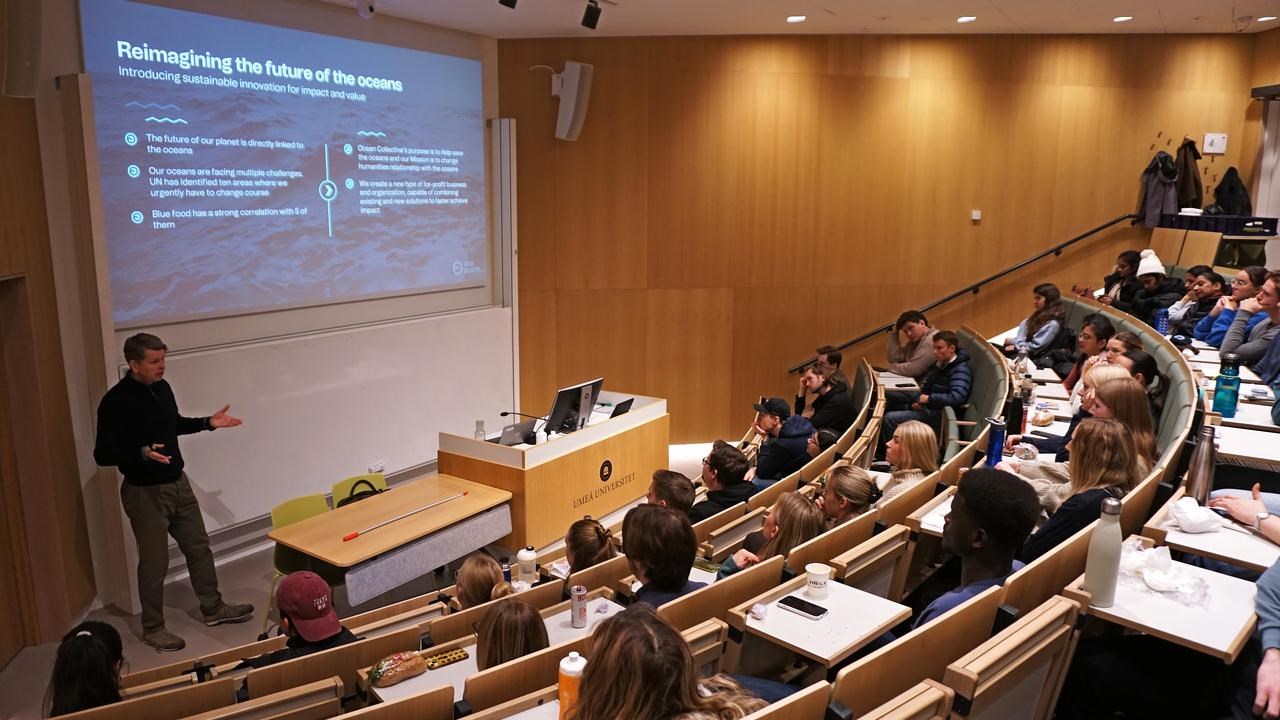
Jörgen lectures to students on campus.
ImageRickard Lindberg