

"False"
Skip to content
printicon
Main menu hidden.
Published: 2026-06-01

Graduate course collaboration sparks new plant growth insights

NEWS A chance encounter between a plant physiologist and a computational biologist at Umeå University’s interdisciplinary "IceLab Camp" has developed into an ongoing collaboration exploring how plants regulate root growth in response to nutrients. Mathematical models were a crucial component to bypass a major experimental bottleneck.

From IceLab Camp project to research collaboration

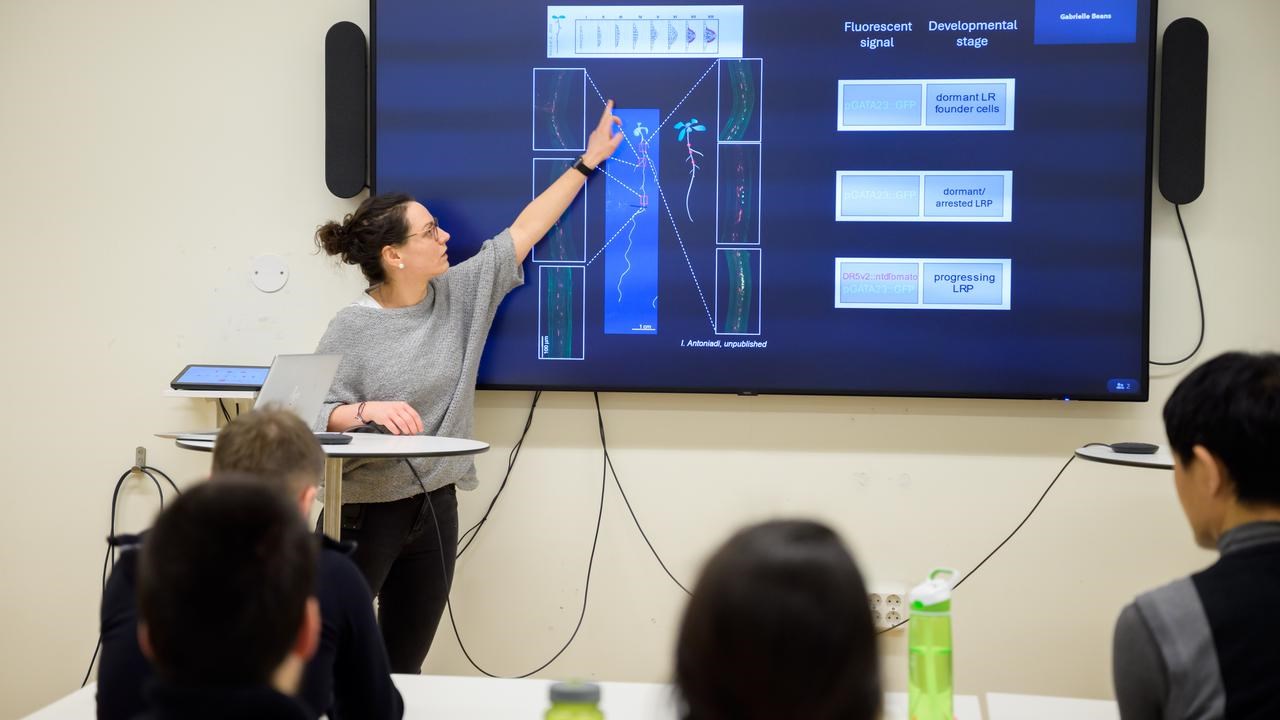
The collaboration began in September 2024 during IceLab Camp, an interdisciplinary graduate course organized by the Integrated Science Lab (IceLab) at Umeå University. The course is designed to spark new interdisciplinary research ideas. Barbora Pařízková, a plant physiologist at the Umeå Plant Science Centre, and Suvam Roy, a computational biologist at the Department of Molecular Biology, were brought together through the course’s interdisciplinary team-building approach.

This collaboration showed how mathematical models can help us test scenarios that are simply not possible in real life. It turned a biological wall into a roadmap for discovery.

As participants presented their research projects to one another, the pair discovered that Suvam Roy’s expertise in computational modelling could help Barbora Pařízková in her research on how different forms of nitrogen affect plant architecture. Specifically, it could help overcome a major limitation in her experimental work.

"When we started talking about our projects, I realised Suvam might provide computational tools that could help to overcome an experimental bottleneck in mine. I study the role of plant hormones in root development, but these hormones are so essential that we cannot remove them genetically. We needed modelling to simulate situations we cannot create experimentally," Barbora Pařízková explains.

This formed the basis for their joint project for the course. While the course came to an end, the collaboration did not – Barbora and Suvam continued working together and now, in the spring of 2026, their research is ready to be submitted to an academic journal. 

Mathematical modelling reveals hidden root growth mechanisms

The research team focused on the effect of organic nitrogen on root development. They looked closely at at the amino acid L-Glutamine (L-GLN) and its growth-promoting effects. They discovered that L-GLN triggers auxin, a plant hormone critical for root development. Because auxin is essential for survival, plants have evolved multiple overlapping pathways for producing it.  If one pathway is blocked, other pathways can compensate and production continues. This makes it nearly impossible for traditional lab experiments to study individual auxin biosynthetic pathways.

When some biological questions cannot easily be tested experimentally, mathematical models can help researchers explore possible scenarios and generate predictions.

Using in silico metabolic simulations based on transcriptomics data, the researchers explored how plants respond to the amino acid L-Glutamine (L-GLN), an organic nitrogen source. “The model suggested that plants supplied with glutamine activated an alternative auxin biosynthesis pathway compared with plants supplied with nitrate, promoting root growth", explains Suvam Roy.

The computational modelling also helped identify candidate regulatory genes involved in activation of specialized root primordia in response to L-GLN via auxin. Two of these genes appeared to limit activation of lateral root growth.To validate the model’s predictions, the team generated plants lacking these genes and observed increased lateral root activation.

The authors are excited to share more details on their discoveries with the wider scientific community once the peer review process is completed.

The value of interdisciplinary collaboration

Barbora Pařízková had sought help with how to study individual biosynthesis pathways of the critical plant growth hormone auxin before. She presented her research problem at an IceLab Lunch Pitch event in the spring of 2024, but did not find the right connection to other researchers then. She persisted, however, and at IceLab Camp the right ingredients came together to make the research possible. 

"This collaboration showed how mathematical models can help us test scenarios that are simply not possible in real life," says Barbora Pařízková. "It turned a biological wall into a roadmap for discovery."

For Suvam Roy, the project highlights the value of interdisciplinary environments and activities where researchers with very different expertise can exchange ideas early on.

“The project emerged directly from conversations during IceLab Camp,” he says. “It showed how computational and experimental approaches can complement one another in unexpected ways.”


About IceLab Camp

IceLab Camp is held annually in northern Sweden during autumn. The focus of the course is on interdisciplinary collaboration, communication, and creativity in research. Through collaborative exercises and group projects, participants develop research ideas while learning tools for working across scientific disciplines.

Applications for the next IceLab Camp are open until 10 June 2026. More information about the course can be found at this link: IceLab Camp