

About the dissertation:
Sofi Sandström, Department of Diagnostics and Intervention at Umeå University, successfully defended her thesis on January 30, 2026.
NEWS It is well known that physical activity is essential for good health – especially for older adults – but how we exercise can make a significant difference. A new doctoral thesis from Umeå University shows that short, high‑intensity training sessions not only save time but may also be more effective than traditional endurance training for older individuals.
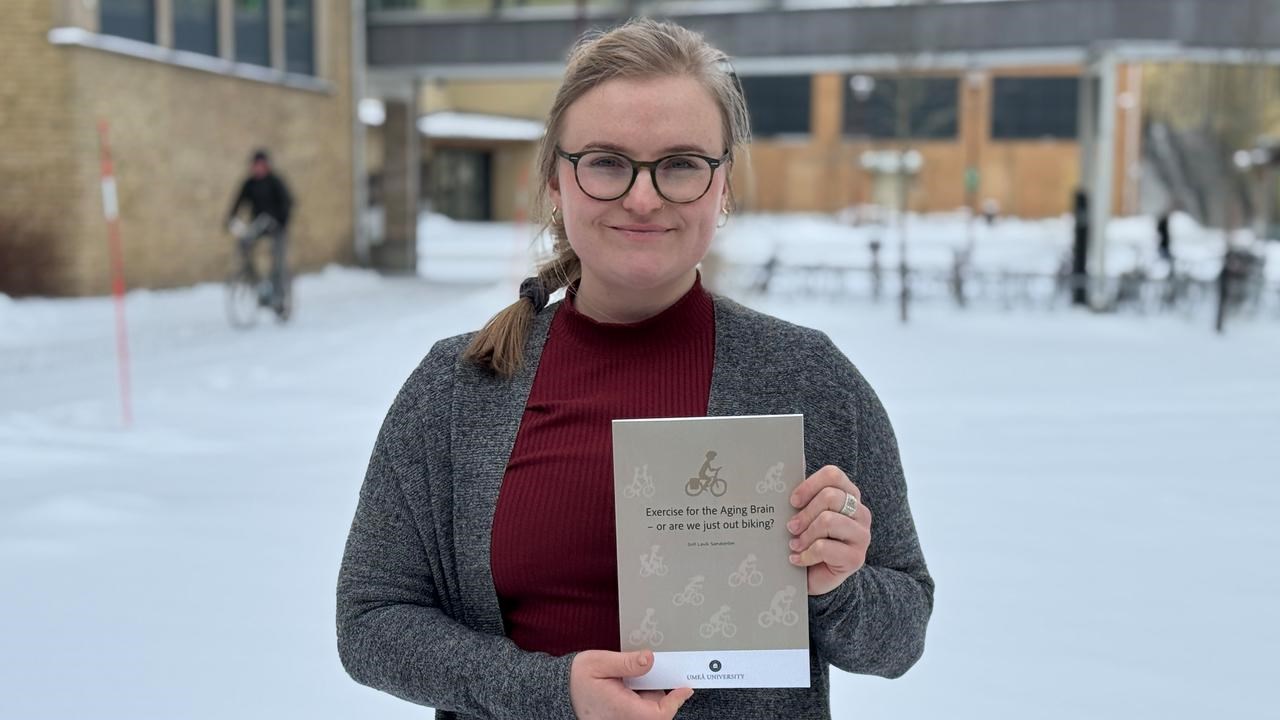
Sofi Sandström, Department of Diagnostics and Intervention at Umeå University, has investigated high-intensity training for people 65 years of age and older in her thesis.
ImageIngrid SöderberghOne of the most exciting findings in my research is the link between muscle strength and brain function
“One of the most exciting findings in my research is the link between muscle strength and brain function. When sessions become shorter and the intensity increases, older adults seem to gain additional benefits for both leg strength and working memory,” says Sofi Sandström, who conducted her doctoral work at the Department of Diagnostics and Intervention at Umeå University.
Physical activity is known to provide a wide range of health benefits, and for older adults it is particularly crucial, many age‑related declines can actually be improved through exercise. Yet many older individuals remain physically inactive, posing a major public health challenge.
High‑intensity training (HIT), which consists of very short but intense, pulse‑raising intervals, is a relatively new exercise method that has shown promising health effects in younger adults. Sara Sandström’s thesis, based on the Umeå HIT Study, examines how different levels of training intensity affect fitness, brain function, and muscle strength in people over the age of 65.
The study involved 68 participants aged 66 to 79 who did not typically exercise regularly. They were randomly assigned to two groups, both training twice weekly for three months on stationary bikes. One group performed moderate‑intensity endurance training (40‑minute sessions), while the other completed high‑intensity interval training (10 x 6‑second intervals in 20‑minute sessions).
The findings show that both groups improved their fitness and blood pressure to a similar degree, regardless of training intensity. However, the shorter and more intense sessions produced greater gains in leg strength and working memory, which is two functions that often decline with age. Sofi Sandström argues that the results make high‑intensity training a surprisingly promising method.
“Researchers have previously been uncertain whether older adults should engage in high‑intensity training at all, but my results suggest it works at least as well as moderate‑intensity exercise. High‑intensity, controlled sessions could therefore become an important alternative for older individuals looking to vary their training,” she says.
Cognitive function was assessed using a broad test battery focusing on working memory. Brain activation during working‑memory tasks was also measured using MRI. The results showed that increased leg strength was associated with greater frontal‑lobe activation during the memory task as well as better test performance. This suggests that muscular adaptation may be an important target for training aimed at protecting brain health.
Earlier research has suggested that age‑related changes in the brain’s white matter limit the effects of traditional endurance training on working memory. Individuals with more pronounced white‑matter changes often show smaller improvements. However, Sara Sandström’s thesis found that high‑intensity training improved working memory even among participants with substantial white‑matter changes.
“This indicates that high‑intensity exercise may be particularly valuable for people showing early changes in white matter,” says Sofi Sandström.
To explore how high‑intensity training could be made accessible to a wider audience, Sofi Sandström also investigated home‑based alternatives requiring no advanced equipment. This was done in a co‑creation study where researchers and participants worked together on a solution.
The high‑intensity session was adapted into fast‑paced “sit‑to‑stand” movements using a standard chair, an approach that produced similar immediate physiological responses to the high‑intensity cycling sessions.
“The next step is to develop a mobile app that can guide the training sessions and to test the programme with a new group of older adults to see if the results hold for those without prior HIT experience. The goal is for the training to be performed at home in the future,” Sofi Sandström says.
Sofi Sandström, Department of Diagnostics and Intervention at Umeå University, successfully defended her thesis on January 30, 2026.
