
Curiosity and observation play a central role in Kim Onchoi Stenmark's approach to design.
Publication date: 2026-09-17
Making materials matter
After graduating from the Bachelor's Programme in Industrial Design at Umeå Institute of Design, Kim Onchoi Stenmark built a career around one of design's most pressing challenges: how to create products and systems that use resources more responsibly. Today, she helps industries, brands, and innovators explore new materials and technologies for a more sustainable future.
Text: Jens Persson

Kim Onchoi Stenmark works at the intersection of design, materials, and innovation, turning emerging ideas into tangible possibilities.
When Kim Onchoi Stenmark completed her studies in the Bachelor's Programme in Industrial Design at UID, she was ready to take on challenges, even those that seemed beyond her experience level.
One job application in particular stood out. The position required several years of professional experience, something she did not yet have. Still, the opportunity sounded too interesting to ignore.
"I applied anyway," she says. "The position sounded interesting, and the person I would replace was a former Umeå alumni that I knew from before."
The company reconsidered the requirements and offered her the role.
That willingness to step forward, learn, and embrace uncertainty continues to shape her work today.
Turning emerging ideas into real-world solutions
As an Industrial Designer at FutureLab & Partners, Kim works at the intersection of design, materials, and innovation. Her role focuses on conceptualising and visualising new materials and manufacturing techniques that are still under development.
Working closely with industries, brands, research institutes, converters, and startups, she helps translate emerging technologies into solutions that can eventually reach the market, often within the packaging industry.
The work demands both creativity and collaboration.
"I try to talk to different people in my team to understand every angle of a problem," she says.

For Kim, understanding a challenge means looking beyond a single perspective. Inspiration can come from design, art, nature, or conversations with colleagues from different disciplines. Ideas are then explored through sketching, prototyping, and iteration.
Despite the increasing sophistication of digital tools, physical models remain a vital part of her process.
"3D prints always help to get a better understanding of the object. It's easy to stare blind at the screen."
A foundation built at UID
Looking back at her time at UID, Kim points to the design process itself as one of the most valuable lessons.
"It gave me the basic need to know the design process," she says. "Working through research, ideation, prototyping, and visualisation. To have broad knowledge and the opportunity to test different things was valuable."
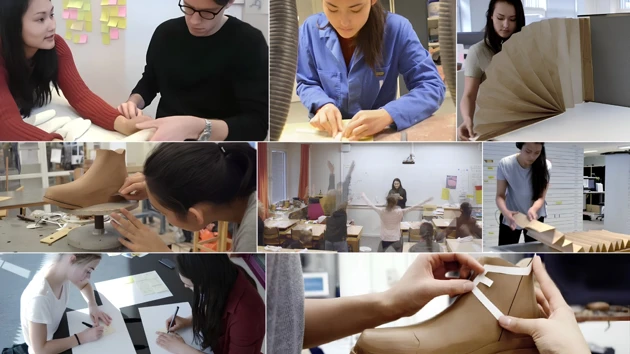
During her studies at UID, Kim explored the full design process through research, sketching, prototyping, making, and testing ideas across a range of projects.
That broad foundation continues to support her work today. Whether exploring new materials or developing future-focused concepts, the ability to move between research, making, and communication remains central to her practice.
Designing with a systems perspective
Much of Kim's work is shaped by questions about sustainability and circularity. Rather than searching for simple solutions, she sees the challenge as understanding how products, materials, and systems interact over time.
"Is this designed to use minimum resources? Can it be recycled?" she asks when evaluating concepts.
Yet she is quick to point out that recycling alone is not enough.
"Designing for reuse in one form or another is better."
She believes designers need to think beyond individual products and consider how materials can remain valuable for longer, whether through reuse, repair, remanufacturing, or smarter resource use.
Kim also stresses that responsibility must be shared across industries.
"We can't rely on one type of material," she says. "The big issue is that brand owners and manufacturers need to take action and make products that work in a sustainable system."
For her, sustainable design is not only about reducing environmental impact. It is also about balancing function, aesthetics, emotion, and value.
"All things can create value and emotion, more or less, and we are aiming for more."
Finding your own strengths
Outside work, Kim's curiosity continues through painting, crochet, whittling, glass blowing, rug tufting, and other hands-on creative pursuits.
The desire to make, test, and learn new things is a thread that connects both her personal interests and professional career.
Asked what advice she would give her younger self at UID, her answer reflects an insight familiar to many design students.
"You don't need to be good at everything."
She remembers how easy it was to compare herself to classmates with exceptional sketching skills, workshop expertise, or technical abilities. Over time, she realised that every designer develops their own unique strengths.
"You have your strength, and if you haven't found it yet, you will eventually."
For current students, it is a reminder that growth takes time and that learning alongside talented peers is an opportunity rather than a competition.
"It's great to be surrounded by talented people."
For Kim, that mindset continues to guide her work today: stay curious, keep exploring, and create value with both people and nature in mind.