
Presenting and refining ideas with colleagues is an important part of translating cultural insight and technological opportunities into meaningful products.
Learn more about the programme
Master's Programme in Advanced Product Design

Mansour Ourasanah graduated from the MFA Programme in Advanced Product Design at Umeå Institute of Design in 2012 and is today Design Manager at KitchenAid.
Image: Mansour OurasanahFor Mansour Ourasanah, design is both a profession and a deeply personal responsibility.
As Design Manager at KitchenAid, Mansour leads a diverse team working across products including multicookers, rice cookers, countertop ovens and air fryers. His role extends beyond industrial design to encompass strategy, consumer and market research, innovation, trend analysis and brand positioning.
The variety is part of what continues to motivate him.
“I thrive on the excitement and variety that comes with juggling multiple responsibilities and exploring new ways to drive impact as a designer within a business environment,” he says.
Finding the right place to grow
Before studying at Umeå Institute of Design, Mansour had already spent two years working at a design consultancy in the United States. He wanted to develop within an environment offering varied projects, fast-moving processes and regular opportunities to take on new design challenges.
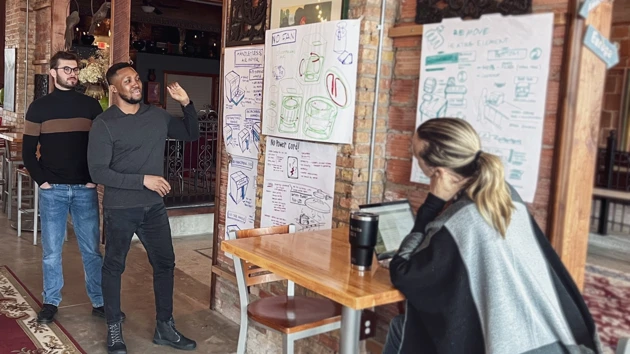
During a break from UID, he secured internships at both frog and KitchenAid. Experiencing a design consultancy and a large company helped him understand the kind of environment in which he could contribute most effectively.
He discovered that he preferred a setting where he could follow the design process over a longer period, contributing from the first concept through to the launch of a finished product.
“After interning at KitchenAid, I knew it was where I wanted to return after graduation, and I did,” Mansour says. “To my surprise, I’ve remained here ever since, and it’s been a fun ride.”
A place to develop his own voice
Mansour first encountered UID while studying engineering at the University of Notre Dame. Browsing a book of student projects, he was struck by how the work combined research, future-focused problem-solving, aesthetic innovation and the humanisation of technology.
What stood out most was the individuality of the projects. Each appeared to reflect the outlook, experiences and cultural background of the person behind it.
Born in Togo and later raised in the United States, Mansour had little exposure to art and design while growing up. After moving from engineering into design, he often felt that he was trying to catch up with classmates who had entered the field through more conventional routes. He was also searching for his place within a profession that he felt was largely shaped by Western perspectives.
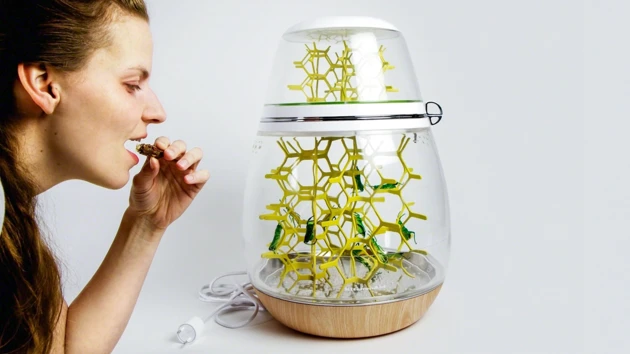
Lepsis, Mansour's degree project at Umeå Institute of Design, explored how insect farming could become part of everyday domestic life as a more resource-efficient source of protein.
The MFA Programme in Advanced Product Design offered the time, guidance and creative space to bring his different experiences together.
“Sometimes, we have to go back to move forward, and that’s exactly what UID represented for me,” he says.
In his degree project, Lepsis, Mansour brought together his cultural experiences and his interest in future social and environmental challenges. He designed a small-scale insect-breeding system for the home, intended to make grasshoppers more accessible as a resource-efficient source of protein.
The project drew on his childhood in Togo, where grasshoppers formed part of the food culture, as well as the contrasting attitudes towards food that he later encountered in the United States. Designed to sit alongside other kitchen appliances, Lepsis also explored how design could help people reconnect with food production and reconsider unfamiliar sources of protein. By the time he graduated in 2012, Mansour had developed a much clearer understanding of his identity and abilities as a designer.
“When I left UID, I had a very clear idea of who I was as a designer and what my strengths and weaknesses were,” he says.
Sometimes, we have to go back to move forward.
Simplifying complex challenges
One of the most valuable abilities Mansour developed at UID was learning how to establish priorities, place ideas within their wider context and simplify solutions without losing their meaning.
Today, he begins a project by examining its context and the different ways in which the challenge might be addressed. This includes understanding both the needs that people express and those that are more difficult to articulate.
“The goal is to simplify the problem to its essence and create an intuitive experience that seamlessly integrates into the users’ lives,” he says.
Clarity is important not only in the finished product but throughout the development process. If an idea requires a complicated explanation to colleagues and decision-makers, Mansour believes it is likely to be even more difficult to communicate to people outside the organisation.
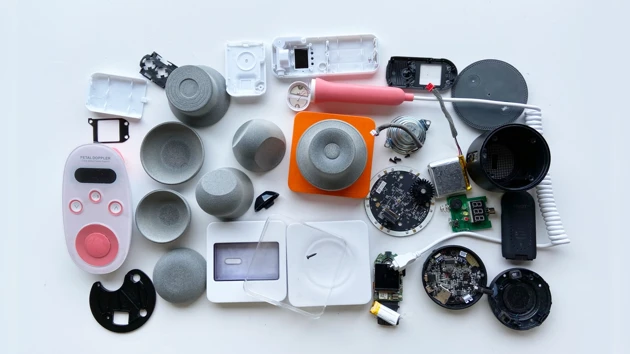
Exploring form, functionality and technical integration through prototyping is an important part of Mansour's design process.
To create shared understanding and challenge assumptions, he combines ideation workshops, sketching, consumer co-creation sessions and high-fidelity prototyping. These methods allow different perspectives to enter the process while giving teams something tangible around which to discuss, test and refine ideas.
Designing products that last
Mansour is conscious that every physical product has an environmental cost and could eventually become waste.
Earlier in his career, he struggled with the tension between commercial growth and environmental responsibility. At KitchenAid, he has found a way to address that tension through a design approach inspired by one of the brand’s best-known products: the stand mixer.
Designed to function for decades and often passed between generations, the stand mixer represents an alternative to short product cycles and disposability. Mansour explains that KitchenAid applies high standards to material selection, craftsmanship, functionality, safety, reliability and repairability, with longevity considered an essential part of responsible product development.
“This holistic approach ensures longevity and keeps our products out of landfills,” he says.
The work also extends to developing more environmentally responsible packaging solutions. For Mansour, initiatives like these demonstrate how designers can contribute to sustainability through decisions made across the complete product system, rather than through a single material or feature.
Protecting individuality in a technological world
Looking ahead, Mansour believes one of design’s most important challenges is helping to define the role technology should play in people’s lives.
New technologies are increasingly entering intimate and everyday spaces through wearable devices, social media, artificial intelligence and automation. This raises questions about where boundaries should be drawn and who gets to participate in shaping them.
How do we retain our humanity in a world of AI and automation?
“How do we retain our humanity in a world converging through wearable tech, social media, AI and automation?” he asks. “How do designers help people reclaim individuality and creativity amidst limitless conformity?”
He is also concerned about how technological development can affect access to information, education and employment, particularly in communities whose opportunities may be more vulnerable to automation.
Mansour sees design as a language capable of reaching across social and cultural boundaries. Every product reflects particular choices and values, which means every project also offers designers an opportunity to question conventions and challenge assumptions.
A practice shaped by culture
Mansour describes his design strength as working at the intersection of culture and technology.
His curiosity about human behaviour extends beyond what people buy or use. He is interested in the cultural preferences, experiences, motivations and inhibitions that influence everyday decisions.
His own experiences across different cultures have taught him to avoid reducing people to simple categories or relying on surface-level assumptions. Instead, he tries to remain comfortable with the uncertainty and complexity of human behaviour.
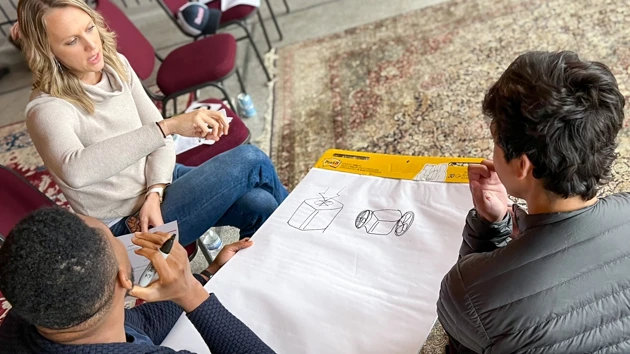
Mansour regularly uses sketching and collaborative ideation sessions to explore ideas and build shared understanding across teams.
At the same time, his interest in science fiction feeds a curiosity about how technology develops alongside culture.
“My most impactful projects merge these two passions of mine: harnessing the power of cultural nuance and technological innovation to create something new and thought-provoking,” he says.
Designing with a sense of purpose
For Mansour, becoming a designer was made possible by the choices and sacrifices of other people.
His parents left Togo for New York in search of greater opportunities for their family. Their journey and support remain central to how he understands his own career.
“I’m deeply aware that my career could’ve gone in a myriad of different directions without the people in my life who sacrificed so many of their own dreams for me to live mine,” he says.
That awareness gives his work a purpose extending beyond professional recognition.
“In everything I do, I strive to honour their sacrifices and push forward in ways they were never able to, and hopefully, when I’m done, I can leave the world a little better for my daughter and her generation.”
There is no single definition of success
Outside work, Mansour creates space for activities that offer a physical or mental reset. Sports, weightlifting and cycling help him maintain balance during demanding periods, while photography has become another way of exploring storytelling and observing the world. He also enjoys anime, books, poetry, music and audiobooks.
If he could return to his time at UID, he would tell his younger self to worry less about the distant future.
“Have perspective. Design isn’t a race. It’s a journey without a destination. Relax and enjoy the ride.”
His carefully prepared plans did not unfold in the way he expected. The journey instead brought unexpected roles, failures, achievements and experiences. Looking back, he feels that these different paths ultimately took him where he needed to be.
He would also tell himself to stop comparing his progress with that of other designers.
Design isn’t a race. It’s a journey.
After losing his father shortly before his first year at UID, Mansour placed immense pressure on himself to succeed. Over time, he realised that he had been treating success as if it had only one definition.
Today, he sees inspiration as a more constructive force than comparison. Inspiration creates the freedom to experiment, fail and continue developing a voice shaped by personal experience.
It is advice he still tries to follow.
“I’m still a work in progress,” he says.