
Spacecraft Technology and Design 7.5 credits
About the course
The course comprises two parts: a theoretical module of 1.5 credits and a practical module of 6 credits. The course starts with reviewing the basics of orbital mechanics (2-body problem, relative motion, conservation of energy and momentum, and Kepler's laws) and continues with an introduction to orbital mechanics for artificial satellites (e.g., sun synchronous, geostationary, and Molniya orbits). Advanced concepts in spacecraft orbit including transfer orbit, gravity assist, and aerobraking are explained, and real examples are shown and discussed. Main concepts of spacecraft attitude, i.e. the orientation in relation to a horizontal plane, (rotation, reference frame and inertial frame, local vertical and local horizontal, and transformation strategy) are explained and an introduction through different spacecraft systems and subsystems (mechanics and structure, electronics and power supply, telecommunication, thermal control, propulsion, data handling, attitude control, sensors and scientific payloads) are provided. Various launch vehicles and landing strategies are explained, and the theoretical module ends with an explanation of various environments that a spacecraft may face during its journey to a target as well as the environment at the target.
In parallel to the theoretical session, a practical training will be conducted to develop specific skills including electronics, programming, and structural design required for designing and building a mini-satellite (CanSat). The practical module starts with an introduction to logic circuits and digital systems and continues with an in-depth explanation on computer architecture, automated and semi-automated control systems, and hardware programming. A review to C++ and/or Python programming is given. Different parts of CanSat are introduced and different project work units are explained. The students are then divided into groups and each group is expected to design and build their own CanSat and ground station, which need to be tested and pass intensive reviews including preliminary design review (PDR) and critical design review (CDR). During the launch campaign, CanSats and ground stations will be tested under real conditions.
Apply
-
Spring 2027
-
Spacecraft Technology and Design
Second admissions round for EU/EEA citizens
VT27 / Umeå / English / On site
Application opens 15 September 2026Show more Show less
Starts25 March 2027
Ends6 June 2027
Number of credits7.5 credits
Type of studiesOn site
Study pace50%
Teaching hoursDaytime
Study locationUmeå
LanguageEnglish
Application codeUMU-5300O
Eligibility90 credits including Thermodynamics, Physical Measurement Techniques and a first course in scientific computing or equivalent. Proficiency in English and Swedish equivalent to the level required for basic eligibility for higher studies. Requirements for Swedish only apply if the course is held in Swedish.
SelectionAcademic credits
ApplicationThe online application opens 15 September 2026 at 09:00 CET. Application deadline is 15 October 2026. Please note: This second application round is intended only for EU/EEA/Swiss citizens.
Application and tuition feesAs a citizen of a country outside the European Union (EU), the European Economic Area (EEA) or Switzerland, you are required to pay application and tuition fees for studies at Umeå University.
Application fee: SEK 900
Tuition fee, first instalment: SEK 19,038
Total fee: SEK 19,038
-
How to apply
Apply online via universityadmissions.se
You apply to our programmes and courses via universityadmissions.se – the official website for higher education applications in Sweden. There, you can track your application, check that your documents have been registered, and log in to find our your admission results.
Late applications
Admissions to most programmes and courses typically close after the final application deadline. However, some programmes and courses may still accept late applications if seats are available. These are marked “Open for late application” on universityadmissions.se. Please note that late applications are not guaranteed to be reviewed.
More about application and admission
Explore your future at Umeå University
Join a vibrant academic community where high-quality education meets groundbreaking research in science, technology, humanities, and the arts. At Umeå University, you will learn from passionate, expert teachers and benefit from a close connection between research, education, collaboration, and innovation.
-
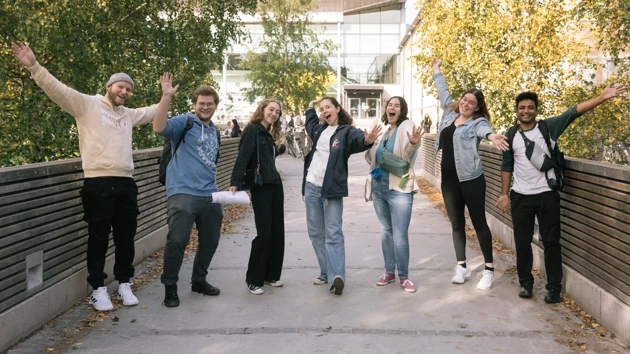
World's most satisfied international students
#1 globally in the main categories of Living, Support, and Overall Satisfaction.
-

A university with health at its core
Umeå University is certified as a Healthy Campus, with many initiatives that promote health and well-being.


Contact us
Your message goes to Infocenter, and they’ll make sure it gets to the right person – so you get the best and most relevant reply.
Course is given by
PhysicsGood to know

How to apply
A step-by-step guide to apply for studies at Umeå University.

International Student Guide
Essential information for your journey to Umeå and your studies here.

Study guidance
A study counsellor can help you with many of your study-related questions.