Statistical and Solid State Physics 12 credits
About the course
The course consists of two parts, Statistical Physics and Solid State Physics.
Statistical Physics. This part begins with a review of basic concepts in statistical physics, including probability theory. Canonical ensemble and concepts such as partition functions and density of states are introduced. This is followed by a review of the theory of grand canonical ensemble and its applications. Special emphasis is placed on systems of particles in specific single-particle states and on the Bose Einstein, Planck and Fermi Dirac distribution functions. Properties of degenerate Bose and Fermi gases are derived. Concepts and phenomena such as photon gas, blackbody radiation, Fermi energy and Bose-Einstein condensation are discussed. The Statistical Physics part concludes with a review of the classical limit, Maxwell's momentum distribution and the equipartition theorem.
Solid State Physics. This part begins with a review of the structure of crystals and the determination of crystal structure by X-ray diffraction. The course then mainly deals with the electrical and thermal properties of crystalline elements and their dependence on various variables such as temperature. The free electron model is introduced to describe the electrical and thermal properties of simpler metals, while band structure models must be introduced for more complicated metals and semiconductors. Doped semiconductors and some semiconductor applications are also covered. Lattice dynamics are described by introducing the phonon concept. The Debye model is used to describe heat capacity, volume expansion and thermal conductivity of insulators.
The course includes mandatory laboratory exercises and the course comprises the following modules:
Module 1: Statistical physics (theory) 4.5 credits
Module 2: Solid state physics (theory) 6 credits
Module 3: Solid state physics (laboratory) 1.5 credits
Apply
-
Spring 2027
-
Statistical and Solid State Physics
Second admissions round for EU/EEA citizens
VT27 / Umeå / English / On campus
Show more Show less
Starts18 January 2027
Ends24 March 2027
Number of credits12 credits
Type of studiesOn campus
Study pace80%
Teaching hoursDaytime
Study locationUmeå
LanguageEnglish
Application codeUMU-53009
EligibilityThermodynamics, or equivalent. Quantum Mechanics 1, or equivalent. Electromagnetics, or equivalent. Physical Measurement Techniques with electric circuit theory, or equivalent. Waves and Optics, or equivalent.
SelectionAcademic credits
ApplicationOnline applications are now open. Application deadline is 15 October 2026. Please note: This second application round is intended only for EU/EEA/Swiss citizens.
Application and tuition feesAs a citizen of a country outside the European Union (EU), the European Economic Area (EEA) or Switzerland, you are required to pay application and tuition fees for studies at Umeå University.
Application fee: SEK 900
Tuition fee, first instalment: SEK 30,460
Total fee: SEK 30,460
-
How to apply
Apply online via universityadmissions.se
You apply to our programmes and courses via universityadmissions.se – the official website for higher education applications in Sweden. There, you can track your application, check that your documents have been registered, and log in to find our your admission results.
Late applications
Admissions to most programmes and courses typically close after the final application deadline. However, some programmes and courses may still accept late applications if seats are available. These are marked “Open for late application” on universityadmissions.se. Please note that late applications are not guaranteed to be reviewed.
More about application and admission
Explore your future at Umeå University
Join a vibrant academic community where high-quality education meets groundbreaking research in science, technology, humanities, and the arts. At Umeå University, you will learn from passionate, expert teachers and benefit from a close connection between research, education, collaboration, and innovation.
-
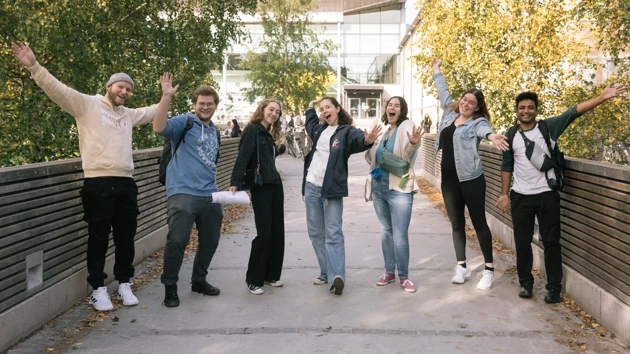
World's most satisfied international students
#1 globally in the main categories of Living, Support, and Overall Satisfaction.
-

A university with health at its core
Umeå University is certified as a Healthy Campus, with many initiatives that promote health and well-being.


Contact us
Your message goes to Infocenter, and they’ll make sure it gets to the right person – so you get the best and most relevant reply.
Contact person

Course is given by
PhysicsGood to know

How to apply
A step-by-step guide to apply for studies at Umeå University.

International Student Guide
Essential information for your journey to Umeå and your studies here.

Study guidance
A study counsellor can help you with many of your study-related questions.