
Biological research today generates increasing amounts of data, which puts bioinformaticians in high demand.
Learn more about the programme
Master's Programme in Bioinformatics

Nathaniel Street’s research has become almost entirely computational. ”Bioinformatics has become the core of what I do” he says.
Image: Samuel Pettersson”Bioinformatics has become the core of what I do” he says. ”I like these big noisy datasets and the challenge of extracting signals from them, gaining biological understanding from all that data.”
Nathaniel Street is a professor at the Department of Plant Physiology at Umeå University and Umeå Plant Science Centre. He works on species like Norway spruce, Scots pine and aspen – trees that dominate northern forests. His goal is to understand complex traits controlled by many thousands of genes, such as growth rate, stress response and chemical defences against insects and animals.

An aspen moose won’t like
”My ultimate dream would be to make for example an aspen tree that moose don’t like to eat. That would be a successful species for forestry.”
Traits like stress response in trees are vital for forestry and climate resilience, but studying them requires analysing enormous datasets. Nathaniel Street’s fascination with big data began during his doctoral studies.
”It was actually what brought me to Sweden” he says. ”In my project we had started measuring gene expression and I came to Umeå where other PhD students introduced me to how to do these analyses”.
His first visits to Umeå made him want to return and a few years later he came back as a post doc.
”One of the best places for tree research”
”I really like the research environment here. I have a passion for studying trees and Umeå is one of the best places in the world for tree research. I also really enjoy living here, I like northern Sweden and the lifestyle here.”
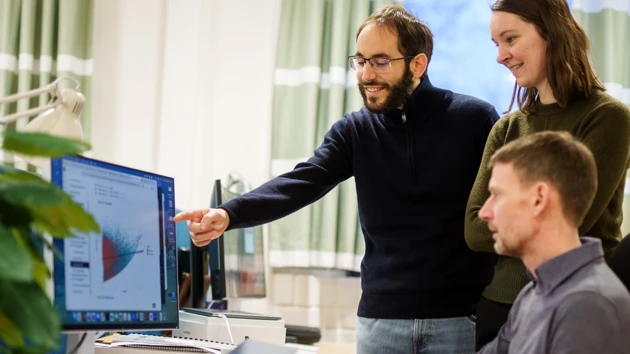
In Nathaniel Street’s group one person in the lab keeps the other nine busy analysing biological data. Here in the computing lab together with group members Edoardo Piombo and Elena van Zalen.
In the last ten years the field of bioinformatics has grown exponentially. Biological research today produces gigantic data sets, leaving scientists facing milllions to billions of datapoints from their experiments.
”It’s not something you can open in an Excel spreadsheet or look through by eye. We have to run the data on a supercomputer and even then it takes time to process.”
Extremely large datasets
Bioinformatics has profoundly changed scientific work.
”Today we have one person in the lab producing data for the other nine people in my research group to analyse” says Nathaniel Street. ”That is a typical situation in biology at the moment. It is very easy to generate extremely large datasets and the challenge is then processing all of that data to meaningful knowledge.”
A major challenge when studying the trees of northern forests is the size of their genomes. The genome of Norway spruce is about eight times bigger than the human genome. Sequencing and assembling the spruce genome has therefore been a huge undertaking.
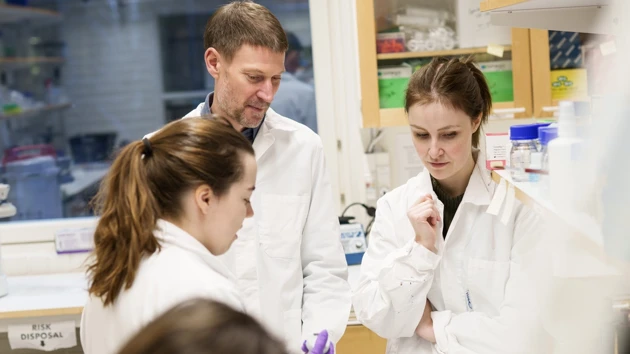
Nathaniel Street in the lab together with Amanda Mikko and Sara Rydman. His research about Norway spruce, Scots pine and aspen aims to understand complex traits controlled by many thousands of genes, such as growth rate, stress response and chemical defences against insects and animals.
Next comes understanding the role of the genes, linking differences between individuals in populations to differences in their genomes and characteristics, such as how they look or grow. To decipher this kind of puzzle bioinformatics tools are essential.
Many genes involved in a single characteristic
”Many biological traits are controlled by a large number of genes. Human height is the most classic example. Almost every gene in the human genome has a small influence on height. So it’s a weak signal to detect – you need datasets from many individuals to extract what influence a particular gene has. It is the same for many characteristics in humans as well as in plants.”
Through diligent work Nathaniel Street’s research group has come a long way in understanding the genomes of the northern tree species they focus on. Regarding the bitter-tasting toxins the trees produce to protect themselves from insects and grazing animals, the team has identified around 30 genes that are involved.
”We have now started to produce CRISPR-Cas9 knockouts to be able to validate that the genes we have found are actually doing what we think they are doing.”
Increasing use of machine learning and AI
How does he think the field of bioinformatics will evolve in the coming years?
”It will continue to be central to biology. There will just be more and more data and complexity. I think there will also be a shift into increasing usage of machine learning and artificial intelligence methods in bioinformatics.”
Whereas before you needed some people there who knew bioinformatics it has become the case that everybody needs to know bioinformatics
”AI and machine learning is involved already, but it will definitely not render people unnecessary. They will make the analyses more powerful, but we still need humans to look at and interpret the results.”
Bioinformaticians are very much in demand and will continue to be so, says Nathaniel Street. And it’s not just in research that bioinformaticians are needed. Hospitals, pharmaceutical companies and industry also require that kind of expertise.
”Whereas before you needed some people there who knew bioinformatics it has become the case that everybody needs to know bioinformatics.”
You might imagine a bioinformatician as someone glued to the computer all day long. That isn’t the case, most bioinformaticians are involved in several projects at the same time and the job is very collaborative, says Nathaniel Street.
”You tend to have a lot of meetings with other researchers. You also spend a lot of time looking at the results, discussing and searching in literature to interpret what you see in the data.”
ABOUT Nathaniel Street
Age: 46.
From: The south of England.
Lives: Close to Flurkmark, 30 kilometres outside Umeå.
Family: Wife.
Studied: Undergraduate and PhD degree from Southampton University, came to Umeå University as a post doc in 2007, now a professor at the Department of Plant Physiology.
Hobbies: Mainly outdoor activities – biking, running, skiing, also enjoys cooking and photography and listening to music.
Umeå in 3 words: Young, dynamic, international.
Myself in 3 words: Curious, reserved, passionate.
In 10 years from now: I like my work, so I will probably be doing the same things as now.