



"False"
Skip to content

Canvas, the learning platform, is currently offline. More information.

printicon
Main menu hidden.
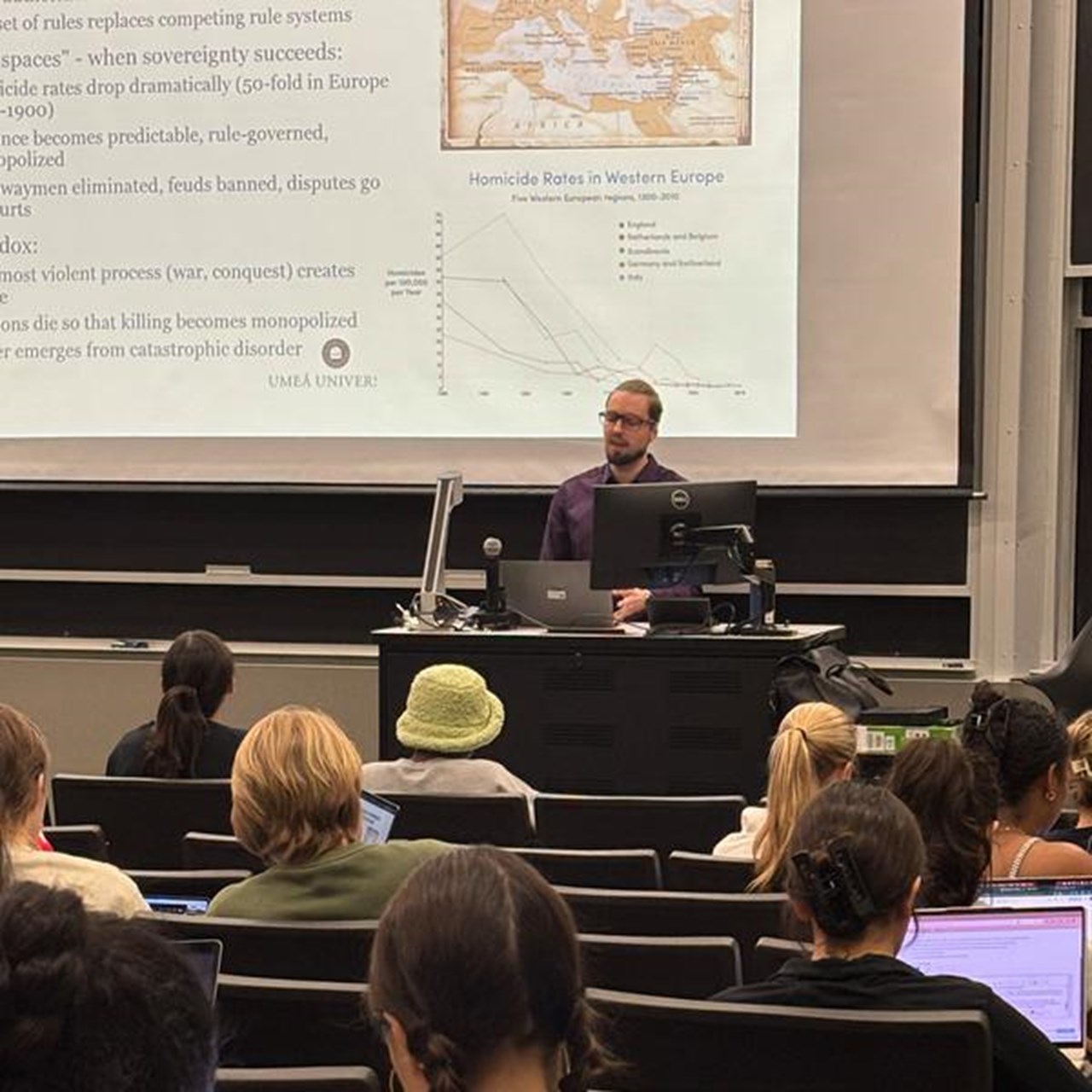
Mikael Goosen at the University of Texas, Austin
Published: 2026-05-08

A semester abroad in Texas gave new perspectives on teaching

PROFILE Curiosity, timing and a desire for new perspectives led Mikael Goossen, associate professor of sociology at Umeå University, to Austin, Texas. Through the STINT Teaching Sabbatical programme, he spent the autumn 2026 semester teaching criminology, exchanging ideas with colleagues, and reflecting on how education can be structured and delivered.

Text: David Meyers
Image: Mikael Goosen
Mikael Goosen at the University of Texas, Austin

Mikael Goossen is an associate professor of sociology at Umeå University, where he teaches criminology and works with questions about how institutions, identities and values shape people’s behaviours, attitudes and experiences. His research ranges from welfare policy and gender equality to white-collar crime, usually based on large datasets and quantitative methods. Before his STINT fellowship at the University of Texas at Austin, he spent half a year as a visiting fellow at the European University Institute, which helped broaden his international perspective and his interest in how social systems differ across countries.

What first inspired you to apply for a teaching sabbatical, and what ultimately motivated you to pursue it?

The timing couldn’t have been more fitting. After teaching criminology for many years, I was stepping into a larger responsibility at my department just as we were working toward building a new criminology  programme. I felt I needed fresh input — both pedagogically and structurally — to help us grow in the right direction.

The STINT sabbatical seemed like a rare chance to pause everyday routines and immerse myself in a different academic culture. At the same time, I have always been curious about how other universities think about criminology and how they teach it, as it is such an interdisciplinary subject. You could say that I applied for the Teaching Sabbatical out of both professional need and personal curiosity.

As you explored different opportunities, what made you choose the University of Texas at Austin?

UT Austin has a large and ambitious sociology department, with a strong presence in criminology — especially regarding prison studies and policing — and a long tradition of teaching big undergraduate courses. For someone interested in how programme structures shape learning, it was a goldmine. Another aspect that was really valuable was that the College of Liberal Arts were in the early stages of developing a new major in Law and Society, which aligned perfectly with what we are doing in Umeå.

One of the real strengths of the U.S. format is the long, steady rhythm of teaching the same class throughout an entire semester.

Which courses did you teach, and how would you describe the experience of teaching in a U.S. academic setting?

I taught Sociology of Criminal Justice to a large group of undergraduate students. I would say that one of the real strengths of the U.S. format is the long, steady rhythm of teaching the same class throughout an entire semester. Seeing the students twice a week over fifteen weeks created a depth of engagement that is more difficult to achieve in shorter Swedish course blocks: students had more time to let ideas sink in, revisit complex concepts, and grow increasingly confident in discussion. It also made it easier to build relationships, which in turn raised the level of classroom dialogue.

At the same time, the flexibility students have in crafting their own schedules and the practice of taking several courses in parallel meant I never had a complete sense of the students total workload and no chance to collaborate with other professors regarding this aspect. And designing a course that suited students with widely different academic backgrounds was sometimes challenging. But overall, the extended contact made the experience deeply rewarding.

From your perspective, what were the most striking academic and/or cultural differences between UT Austin and Umeå University?

What struck me most at UT Austin was the sense of autonomy and creative freedom in course design — instructors can shape syllabi, assessments, and grading models in ways that foster experimentation and responsiveness. This flexibility is genuinely inspiring, and it allows teaching to adapt quickly to new ideas and insights. At the same time, coming from a Swedish context where programme structures are built collaboratively and teaching teams coordinate progression, workload, and student support, I noticed how much more solitary teaching in the U.S. can be. Without regular programme‑level coordination, it becomes harder to understand students’ total workload or ensure coherence across courses.

What struck me most at UT Austin was the sense of autonomy and creative freedom in course design.

So, while I admired the agility and independence of the UT model, I also came to appreciate the UMU emphasis on collective planning and shared pedagogical responsibility — an approach that helps maintain balance and continuity for students moving through a structured program.

When you look back on your time abroad in Austin, which moments or experiences became the most memorable or meaningful?

Working with students was, of course, the highlight — seeing them connect abstract ideas about justice to their everyday understanding of society was incredibly rewarding. I also ended up in a small working group developing the new Law and Society major, and those conversations were truly rewarding in terms of gaining perspective on such things as student progression and learning as well as what is considered the goal of higher education within criminology and adjacent subjects.

Outside the university, one of the most memorable experiences was a visit to a Mennonite community in Pennsylvania, where I spent a long afternoon discussing the roots of Restorative Justice, which is an alternative justice and conflict-resolution model that I cover in my teaching. That visit gave me a perspective on the concept that was much more anchored in a community setting and something I hadn’t found in any textbook.

What advice would you give to colleagues who are thinking about applying for a STINT teaching sabbatical, and how can they make the most of the opportunity?

My biggest advice is this: be proactive. The STINT format is quite flexible, and the sabbatical doesn’t automatically create opportunities — you have to be active about shaping them. Reach out early, ask for meetings, and be clear about what you hope to learn. At the same time, leave room for the unexpected. Some of my most meaningful experiences in Austin came from simple hallway conversations or spontaneous invitations. And most importantly: spend as much time as you can with students. Their questions, reflections and perspectives will teach you as much as any formal workshop.

If you stay curious and actively seek out new experiences, the sabbatical has the potential to become a reset for how you think about teaching.

Some dark clouds concern the situation for academic freedom in the United States, and this was something that I did notice during my stay. Although I never felt pressured from the department or administration, I did talk to several faculty members who actually cautioned me about covering sensitive topics in class. To me this just underscores the continued importance of academic exchange, but it is something to take into consideration. Nevertheless, if you stay curious and actively seek out new experiences, the sabbatical has the potential to become a reset for how you think about teaching. Even if you, like me, end up with a sensation that a lot of the things that what we do in teaching at Umeå University actually are quite well thought out, this insight will be shaped by reflexive experience and perspective rather than by routine.

Mikael Goossen
Associate professor
E-mail
Email

About STINT Teaching Sabbatical

The STINT (The Foundation for the Internationalization of Higher Education and Research) Teaching Sabbatical programme gives researchers and lecturers, who are passionate about education, the opportunity to teach abroad during an autumn semester.

STINT collaborates with selected universities and colleges based in Botswana, Hong Kong, Japan, Singapore, and the USA. These represent a diversity of institutions committed to quality education in their respective regions of the world.

Learn more about STINT Teaching Sabbatical