

NEWS In Skellefteå, five possible futures became something to step into, experience and discuss. Researchers and staff affiliated with the Arctic Centre took part in Wastelands, a touring exhibition where climate scenarios took physical form.
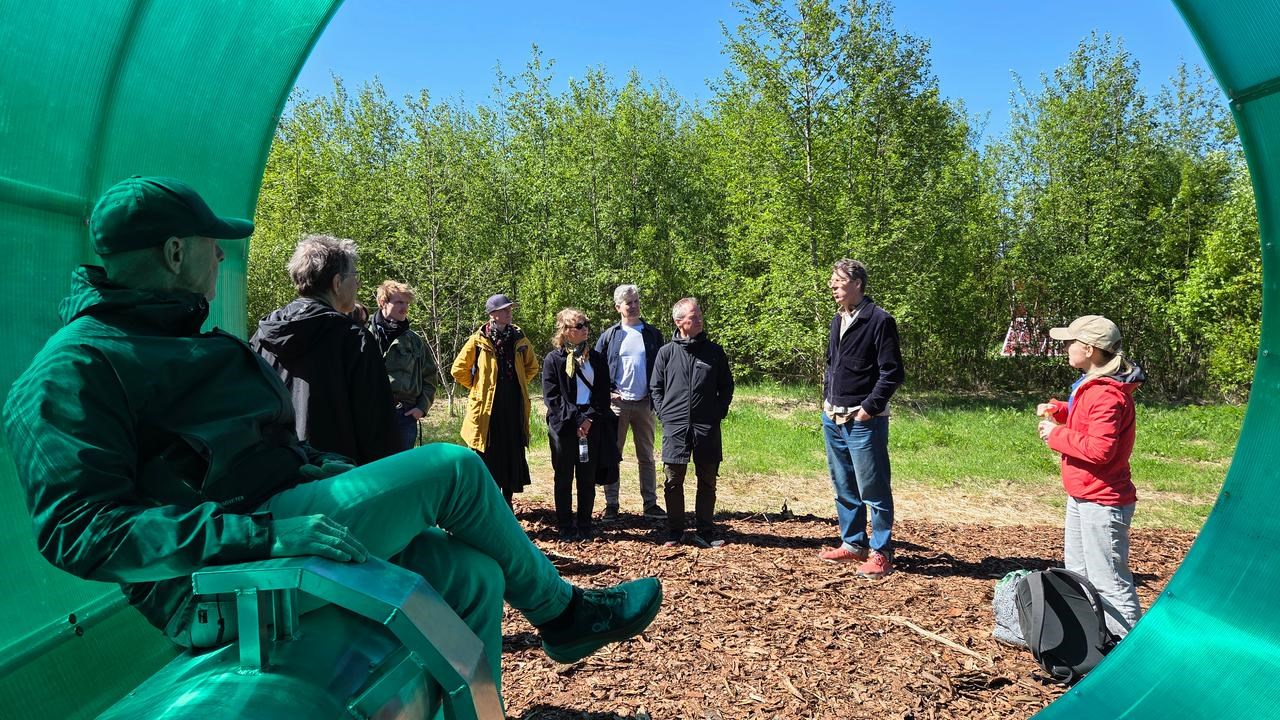
Climate scenario 1, the green path, a circle slowly rotating once every 24 hours, with space for different activities at different times of day.
ImageLena Maria NilssonWhen art meets research, the future can become both concrete and palpably close.
Over two intensive days, 29-30 May, the Arctic Centre took part in the project Wastelands in Skellefteå: an experimental exhibition where five climate scenarios took physical form and invited participants to reflect, discuss and, at times, feel the slightly uncomfortable sense that “this actually concerns me”.
Together with researchers from Umeå University and Luleå University of Technology, as well as urban planners from Skellefteå Municipality, participants were guided through five different visions of the future, ranging from hopeful transition to considerably darker alternatives. A journey into the future with no return ticket, but plenty of time for reflection.
In the first scenario, visitors encounter one possible sustainable future. They step into an artwork: a cylindrical green greenhouse with open walls, slowly rotating once every 24 hours. The space accommodates different activities depending on the time of day: sleeping, eating and working. The piece was created by the artist duo Bigert & Bergström. At the centre of the installation, artist Mats Bigert himself can be seen as part of the story, as if the future is already something we have stepped into.
Outside, a walking talks dialogue takes place, where researchers and municipal officials discuss possible ways forward. Have we already crossed the boundaries of a sustainable future? The conversation moves between concrete solutions and broader visions of transition, climate adaptation and urban planning. There is room for wide-ranging discussion, both literally and intellectually.
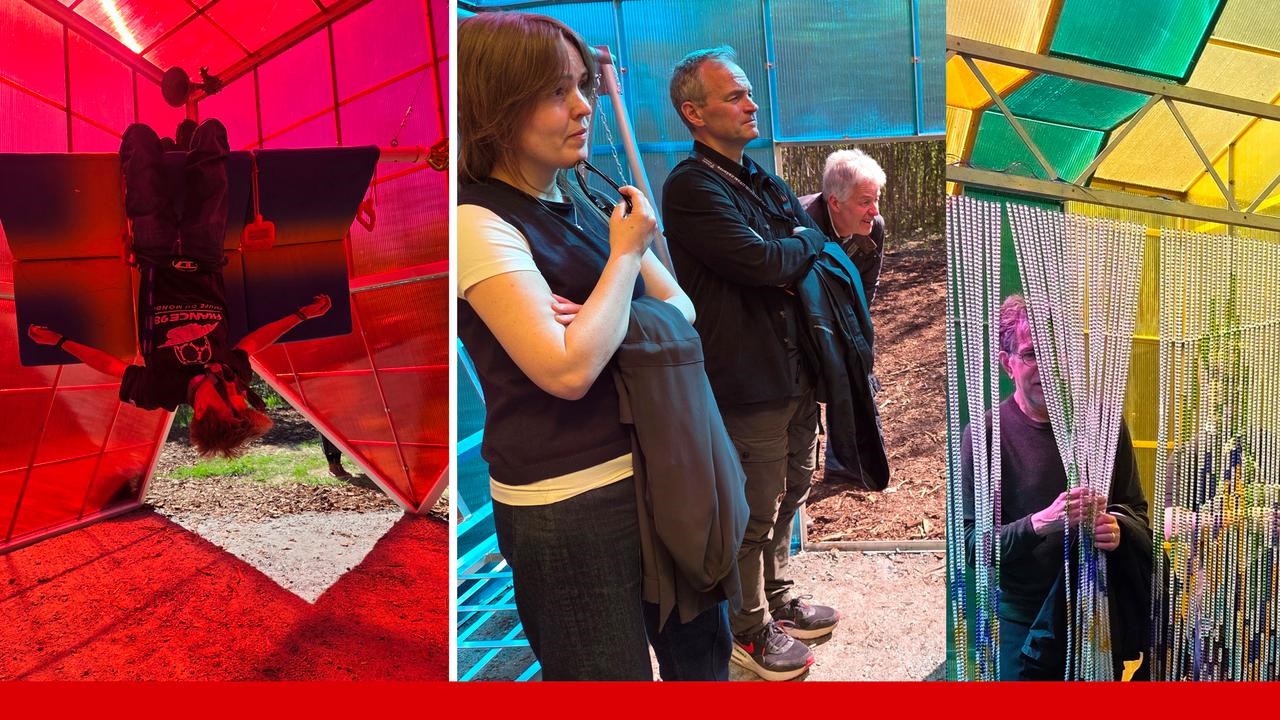
Climate scenario 2, Preserving the Old- Jean-Paul Garin balances in the upside-down world. Climate scenario 3- hanging bead diagrams and dialogue between researchers and municipal officials.
ImageLena Maria NilssonThe contrasts become clear in the next setting. Here, an upside-down red cottage with white trim stands in the landscape: one of Sweden’s most recognisable symbols, now quite literally turned on its head. Something that once felt stable suddenly feels… less reliable.
Doctoral student Jean-Paul Garin from the Department of Food, Nutrition and Culinary Science balances upside down in a hammock, dressed in fabric resembling a Swedish flag whose colours seem to bleed into one another. It is both an installation and a balancing act. At the same time, the public warning signal Hesa Fredrik plays the Swedish national anthem in distorted, sliding tones. The sound is based on climate data from Abisko and creates a slightly surreal atmosphere, as if the future is glitching in real time.
Jean-Paul Garin’s research focuses on how fermented plant-based foods can be made more attractive to consumers. This, too, is about transition, though in a more everyday form than upside-down houses.
In the third scenario, science takes physical form. A greenhouse has been built as a three-dimensional diagram of climate data, allowing visitors not only to understand the figures, but quite literally to touch them.
Inside, climate data is presented as beads and tactile objects. A hammock without cushions reinforces the message: facts can be hard, and sometimes that is exactly what is needed for them to sink in. The group moves into the installation, discusses and explores, in something between a seminar and a sensory experience.
Beside the cushionless hammock stands Moa Hedberg, a doctoral student in geography at Umeå University. From Skellefteå Municipality, participants in the dialogue include project manager Mikael Lindmark and planning director Lars Hedqvist. Lars Hedqvist has led the transformation of the former industrial area where the exhibition now stands, a process that has been underway for nearly two decades. This adds perspective when future scenarios are discussed in a place that has itself already undergone major change.
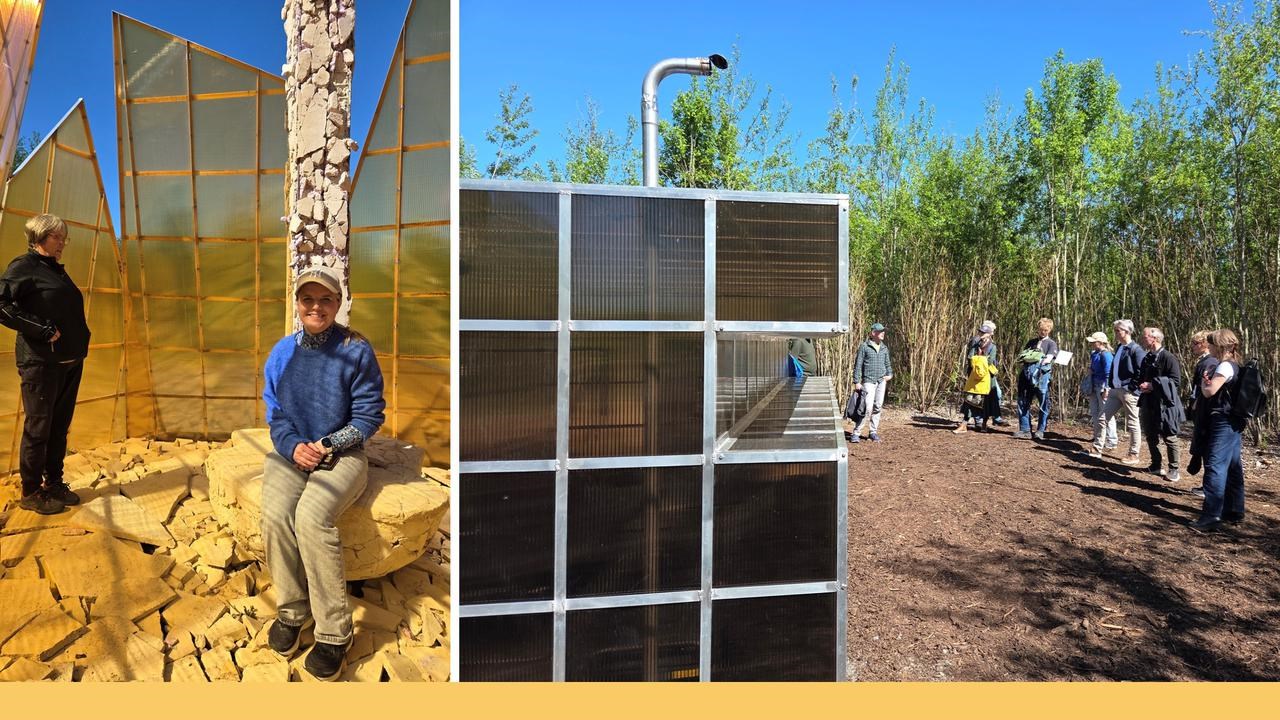
Climate scenario 4, A Divided World- researcher Kristina Lindvall connects the scenario to drought-affected areas in Africa. Climate scenario 5, A Fossil-Fuelled Future, foul-smelling smoke from burning rubber billows from the chimney.
ImageLena Maria NilssonThe fourth scenario shows a broken and open greenhouse: a world where systems have failed and inequalities have deepened. It is perhaps the quietest scenario, but also one of those that lingers the longest.
Kristina Lindvall connects the installation to her research on the health impacts of climate in dryland areas in Uganda and Kenya. She describes how climate change is already affecting communities today through increased health risks and changing living conditions. Here, it becomes clear that the future is not only about forecasts. It is already unfolding.
The final scenario is the darkest. Here, a future is imagined in which dependence on fossil fuels has continued and worsened. Inside the black greenhouse, shaped like a bunker, there is a black rubber sofa. The floor is covered with shredded rubber, and rubber is burned in the stove, creating foul-smelling smoke. It is an environment where nothing really feels possible, and that is also the point.
By the time the participants reach this point, the conversations have become noticeably more intense. Even if voices have not been raised, the content has become heavier. Questions of responsibility, agency and the direction of the future begin to press forward. These are no longer just hypothetical scenarios, but choices that must be made.
The walk ends at a lookout tower, where the participants gather for shared reflection. Here, the different experiences are brought together in group discussions. After moving through several possible futures, it feels almost natural to pause and compare impressions. The conversations move between the concrete and the existential. What do we take with us? And what do we do with it?
The Wastelands project shows how art can serve as a powerful tool for communicating research. By allowing participants to step into different future scenarios, not only as observers but as active participants, the project creates an experience that both moves people and raises questions.
In Skellefteå, the climate issue became not only something to understand, but something to feel, discuss and, perhaps most importantly, take a position on.
From Umeå University, eleven researchers and students took part, bringing broad expertise in climate, health and social issues.
Geography
Moa Hedberg, doctoral student.
Food, Nutrition and Culinary Science
Jean-Paul Garin, doctoral student.
Umeå School of Architecture
Luis Berríos Negrón, lecturer.
Maria Kamilla Larsen, research coordinator.
Pia Palo, doctoral student.
Public Health and Clinical Medicine
Marcus Schmitt-Egenolf, professor.
Epidemiology and Global Health
Christofer Åström, researcher.
Kristina Lindvall, researcher.
Lena Maria Nilsson, researcher and coordinator.
The exhibition is presented by the artist duo Bigert & Bergström, with dialogue support from climate researchers at Umeå University, coordinated through the Arctic Centre. The project has also received support from the Swedish research council Formas and the Swedish Postcode Foundation.