

NEWS AI is playing an increasingly important role in how research is conducted. In a new report, Klas Markström, Professor at Umeå University, tracks these developments and highlights a sharp increase in the number of preprints across several fields.
The report follows developments by analysing preprints from arXiv and other research repositories. In several disciplines, particularly mathematics and computer science, the number of preprints has risen dramatically during 2026. At the same time, AI has played a significant role in several high-profile research findings and mathematical breakthroughs.
“While news coverage and public debate tend to focus on individual major findings, many overlook the growing flood of new papers that AI-assisted research is now producing. This is most evident in mathematics, but it is also visible in fields such as chemistry and the social sciences,” says Klas Markström of the Department of Mathematics and Mathematical Statistics.
AI is no longer used solely to support tasks such as programming and data analysis. It is now contributing ideas, solutions and, in some cases, even research results. This rapid development is raising questions that many universities are currently grappling with: How should the use of AI be disclosed? How are quality assurance and peer review affected when research output increases? And what does AI mean for doctoral education and research funding?
At the same time, academic publishers, conferences and research organisations are updating their policies and guidelines. The report summarises the AI guidelines that several organisations have introduced over the past year.
The report is updated regularly and is intended to provide an up-to-date overview of how AI is influencing research, publishing and the research community more broadly.
Read the report “Preprint counts and AI policies in the AI-driven research wave”
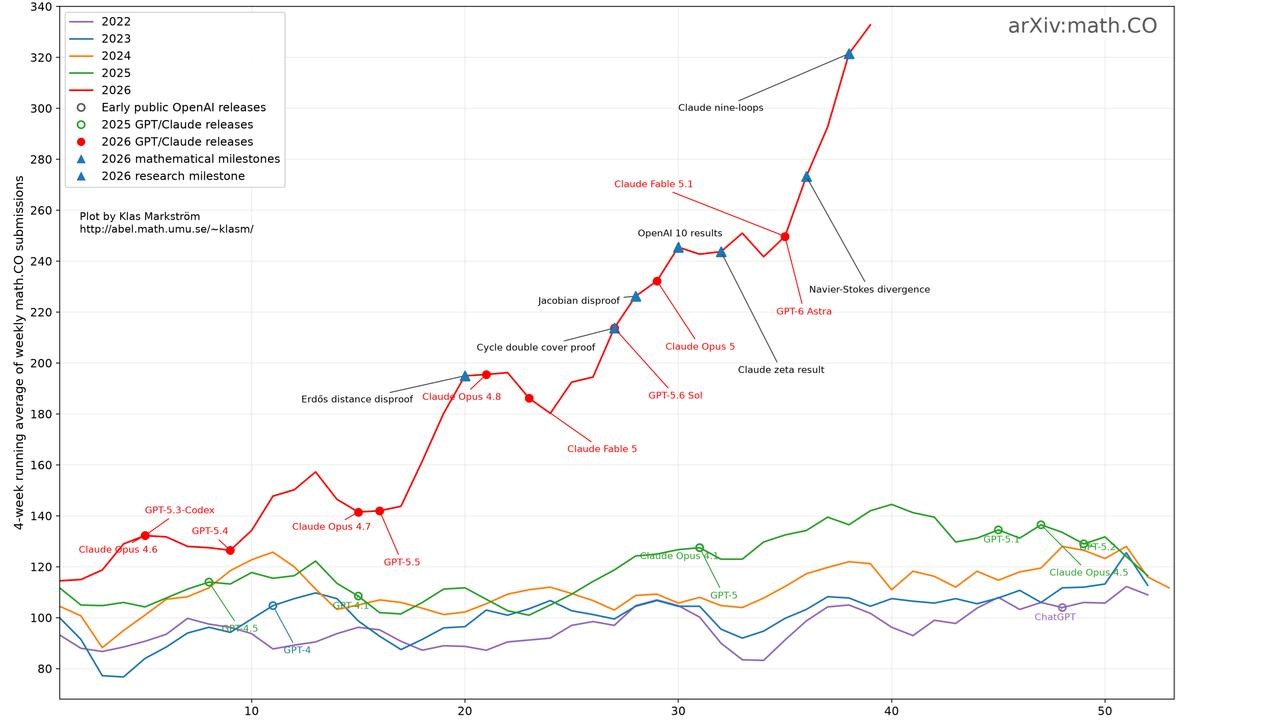
The number of preprints rose dramatically in 2026 (red line).
ImageKlas Markström