

"False"
Skip to content
printicon
Main menu hidden.
Published: 2026-04-23

AI shows how the right energy renovation can reduce both emissions and costs

NEWS The right renovation choices can make a major difference – for both the climate and the economy. However, what works best varies widely between buildings, locations and usage patterns. New research from Umeå University shows how AI-based analyses can provide locally tailored recommendations that lead to lower energy use, reduced emissions and lower costs.

Buildings account for around 30 per cent of global energy consumption and more than a quarter of global carbon dioxide emissions. Achieving climate targets therefore requires substantial improvements in the energy efficiency of existing buildings. At the same time, many current planning models rely on simplified assumptions, grouping buildings into broad categories and recommending the same measures regardless of local conditions.

With more detailed analyses, resources can be directed where they have the greatest impact

In his doctoral dissertation, Santhan Reddy Penaka, doctoral student at the Intelligent Human-Building Interaction (IHBI) lab, Department of Applied Physics and Electronics at Umeå University, has developed new data-driven methods that better account for the uniqueness of individual buildings.

"Existing models often assume that all buildings within a category perform in the same way, which leads to generic renovation recommendations. In reality, the most effective measure can vary significantly – even between neighbouring buildings", says Santhan Reddy Penaka.

AI captures differences between buildings

By combining machine learning, so-called explainable AI and data fusion – where multiple incomplete data sources are integrated – the research identifies which parts of a building have the greatest impact on energy use: walls, windows, roofs or floors.

A case study of 81 building clusters in Linköping, Lund and Umeå shows that the most effective renovation measures vary considerably depending on building type, climate zone and geographical location. In some cases, additional wall insulation is the most important intervention, while in others it has very little effect.

"Generic renovation plans risk overlooking this variation. With more detailed analyses, resources can be directed where they have the greatest impact", says Santhan Reddy Penaka.

How occupants behave also matters

Another key aspect of the model is that it accounts for how people actually use their homes – for example, how often windows are opened or how electrical appliances are used – rather than assuming average behavior.

The research shows that simplified assumptions about occupant behavior can skew energy-use calculations by up to 15 per cent. When applied to analyze Sweden’s upcoming power-based electricity tariff (planned for 2027), the model indicates that behavioral changes alone could reduce peak loads in the electricity system by 6–17 per cent, depending on building type.

From research to practical application

To make the results accessible beyond research, Santhan Reddy Penaka has developed an interactive 3D visualization platform. Homeowners can use it to compare their building’s energy performance with similar buildings in the local area and explore “what-if” scenarios for both renovation measures and behavioral changes.

"The goal is to move from broad policy recommendations to locally adapted, evidence-based strategies that municipalities and property owners can actually use", Santhan Reddy Penaka concludes.

About the doctoral defence

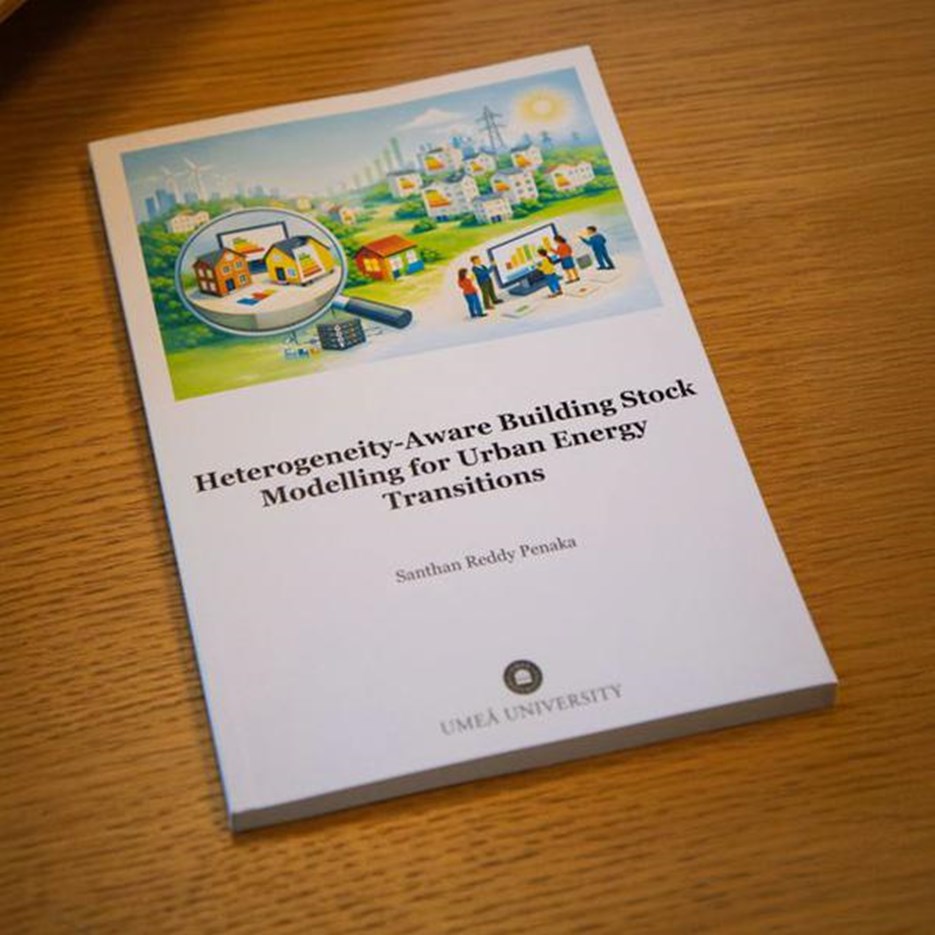
Dissertation title: Heterogeneity-Aware Building Stock Modelling for Urban Energy Transitions

Date and time: Wednesday, 29 April, 9:00 a.m. in NAT.D.300 (lecture hall), Naturvetarhuset, Umeå University

Supervisor: Weizhuo Lu, Professor, Department of Applied Physics and Electronics, Umeå University

Opponent: Joakim Widén, Professor, Department of Civil and Industrial Engineering, Uppsala University

Download the doctoral dissertation here.