

NEWS On 5 October 2026, the Nobel Assembly at Karolinska Institutet awarded the Nobel Prize in Physiology or Medicine to Karl Deisseroth, Peter Hegemann and Georg Nagel “for their discoveries concerning light-gated ion channels and optogenetics.” The prize recognizes a technology that transformed neuroscience by giving scientists an extraordinary new ability: using light to control the activity of selected living cells.

At Umeå University, Yaowen Wu’s group develops light-controlled molecular tools to program living cells for therapy and biotechnology.
Image Shuang LiFor decades, scientists could observe that particular neurons became active when an animal moved, learned, formed a memory or experienced fear. But observing activity does not show that it causes a behavior. Electrical stimulation could activate neurons, but it often affected many cells at once. Drugs could target biological pathways, but they generally acted more slowly and broadly.
Optogenetics changed the nature of these experiments. By introducing genes encoding light-sensitive proteins into selected cells, scientists could activate or inhibit those cells with precisely timed pulses of light. This made it possible to ask fundamentally new questions: Which neurons actually cause a behavior? Which circuits are responsible for a memory? What happens when a particular group of cells is activated or silenced for only a fraction of a second? In this way, optogenetics helped transform neuroscience from largely observing correlations to directly testing causality.
But the success of optogenetics also exposed a new scientific challenge. The most widely used optogenetic systems are based on natural light-sensitive proteins, such as rhodopsins, LOV proteins and cryptochromes. These biological modules are powerful, but they can be difficult to redesign. Changing their light sensitivity, switching behavior, binding properties or other characteristics often requires sophisticated protein engineering, and the outcome can be difficult to predict. These systems also have limited modularity, which poses challenges for reprogramming.
Yaowen Wu, Professor of Biochemistry at Umeå University, pioneered a new technology called chemo-optogenetics. Instead of relying entirely on a natural photoreceptor protein as the light-responsive module, chemo-optogenetics combines light with synthetic, light-responsive molecular glues. These molecules can bring two proteins together when illuminated and separate them when the light condition is changed. In other words, light is used to control protein dimerization or proximity, giving scientists a chemical way to reconfigure how components inside a living cell interact.
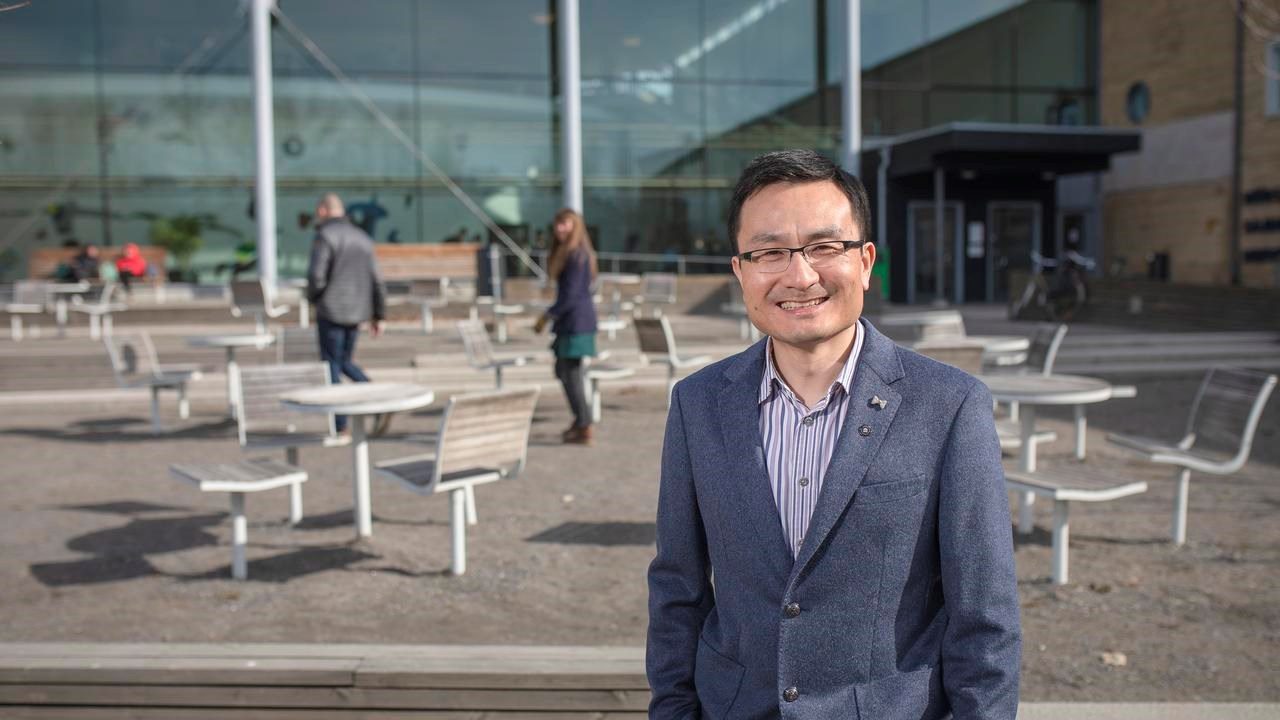
Yaowen Wu, Professor at the Department of Chemistry
ImageMattias PetterssonThis approach combines two strengths: the chemical flexibility of synthetic molecules and the spatial and temporal precision of light. In the early work on light-controlled chemically induced dimerization, Wu lab demonstrated the first-generation chemo-optogenetic tools, with which protein interactions and localization could be controlled reversibly with light at micrometer and millisecond scales. More recently, Wu lab developed the next-generation chemo-optogenetic systems based on modular photoswitchable molecular glues that enable repeated cycles of optical control and the reversible regulation of protein localization, function and abundance, as well as the positioning of organelles (a subunit within a cell that performs a specific function).
Both optogenetics and chemo-optogenetics use light to control biology. The fundamental difference is the architecture of the control system: classical optogenetics relies on natural light-sensitive proteins, whereas chemo-optogenetics uses synthetic light-responsive molecules to control protein proximity and interactions. This makes chemo-optogenetics particularly attractive when scientists want to redesign the system for a specific biological problem.
The implications extend beyond basic cell biology. Wu’s long-term goal is to use these tools to program living cells.
One important example is cancer immunotherapy. CAR-T cells are living immune cells that have been genetically engineered to recognize and attack cancer. They have produced remarkable results in some blood cancers, but important challenges remain, including insufficient activity in some patients and the risk of excessive immune activation.
Wu lab is therefore developing chemo-optogenetic approaches to control CAR-T-cell behavior more precisely in space and time. This work brings together chemical biology with expertise in clinical cell therapy through collaboration with Prof. Stephan Mielke at Karolinska Institutet/Karolinska University Hospital (ATMP center) and Prof. Gunilla Enblad at Uppsala University/Akademiska Hospital (ATMP center), who are leading figures in Sweden's CAR-T field. The goal is to develop more precisely controlled cell therapies that are safer, more effective and better adapted to individual patients.
The same principle can be applied to microorganisms. Microbes are already used as biological factories to produce medicines, chemicals and other valuable materials. But cells must balance competing metabolic pathways and permanently activating a production pathway is not always optimal. By developing programmable molecular switches, Wu lab aims to dynamically control cellular metabolism and biological production, essentially giving microorganisms instructions about how to allocate their resources.
– This points toward a broader vision: intelligent cells that can sense, process and execute instructions in a controllable way. Instead of treating living cells as fixed biological systems, we can increasingly think of them as programmable systems whose behavior can be adjusted with molecular precision. Wu says.
The 2026 Nobel Prize for optogenetics celebrates the breakthrough that made it possible to use light to ask causal questions about living cells and the brain. The next generation of optical technologies are moving from switching neurons on and off toward programming living cells.
Develops new tools for synthetic biology
New light-tuned chemical tools control processes in living cells
Herzog LK, Zhang J, Wu YW. (2026) Flipping the Switch: Next-Generation Chemo-Optogenetics for Reversible Control of Biological Systems. ChemPhotoChem 10 (3): e202500267. https://doi.org/10.1002/cptc.202500267
Zhang J, Herzog LK, … Wu YW. (2025) Modular Photoswitchable Molecular Glues for Chemo-Optogenetic Control of Protein Function in Living Cells. Angew Chem Int Ed. e202416456. https://doi.org/10.1002/anie.202416456
Klewer L, Wu YW. (2019) Light-Induced Dimerization Approaches to Control Cellular Processes. Chem Eur J. 25(54):12452-12463. https://doi.org/10.1002/chem.202403808
Chen X, Wu YW. (2018) Tunable and photoswitchable chemically induced dimerization for chemo-optogenetic control of protein and organelle positioning. Angew. Chem. Int. Ed. 57 (23): 6796-6799. https://doi.org/10.1002/anie.201800140