

NEWS LunaLEC is developing a new type of light: thin, flexible surfaces that can emit light directly from cards, labels, and security solutions. The company is now taking the next step toward large-scale production.

Christian Larsen and Erik Zäll from LunaLEC, a company based on research from Umeå University.
ImageSEKAI MediaThe technology is based on research conducted at Umeå University, where the OPEG (Organic Photonics and Electronics Group) research team, led by Ludvig Edman, has developed LECs (Light-Emitting Electrochemical Cells). This is a type of light-emitting component that is easier to manufacture than existing alternatives such as OLEDs and LEDs, partly because the manufacturing process does not require advanced vacuum techniques.
Simply put, they function like a reverse solar cell: instead of converting light into electricity, they emit light from a surface when an electric current is applied. Compared to related technologies, such as OLEDs, LECs consist of fewer layers, making them both easier to manufacture and more robust in practical use.
LunaLEC is currently working on adapting the technology for larger-scale production. A key step is transitioning from spraying material to “printing” it using inkjet technology. This makes it possible to place the material—and thus generate the light—exactly where desired—for example, to create illuminated logos or patterns.
“It sounds simple, but in practice it’s a challenge. Achieving even, thin layers without short circuits requires a lot of development work,” says Erik Zäll, COO at LunaLEC.

At the same time, the company has developed LECs that emit blue light instead of yellow light, which can then be converted into white light. This makes it possible to customize the color and appearance for different applications.
ImageSEKAI MediaPotential applications include smart cards, where components must withstand bending and heat, as well as labels and in-store materials where light can be used to attract attention. In these cases, the LECs can also be powered wirelessly via NFC—the same technology used in contactless payment cards. The company is in discussions with several card manufacturers who have shown strong interest.
The technology also has potential in the field of security. A specific light effect, unique to LECs, can serve as a hard-to-counterfeit authenticity marker, for example in ID documents or banknotes. And there is already interest—a central bank has reached out after discovering the technology.
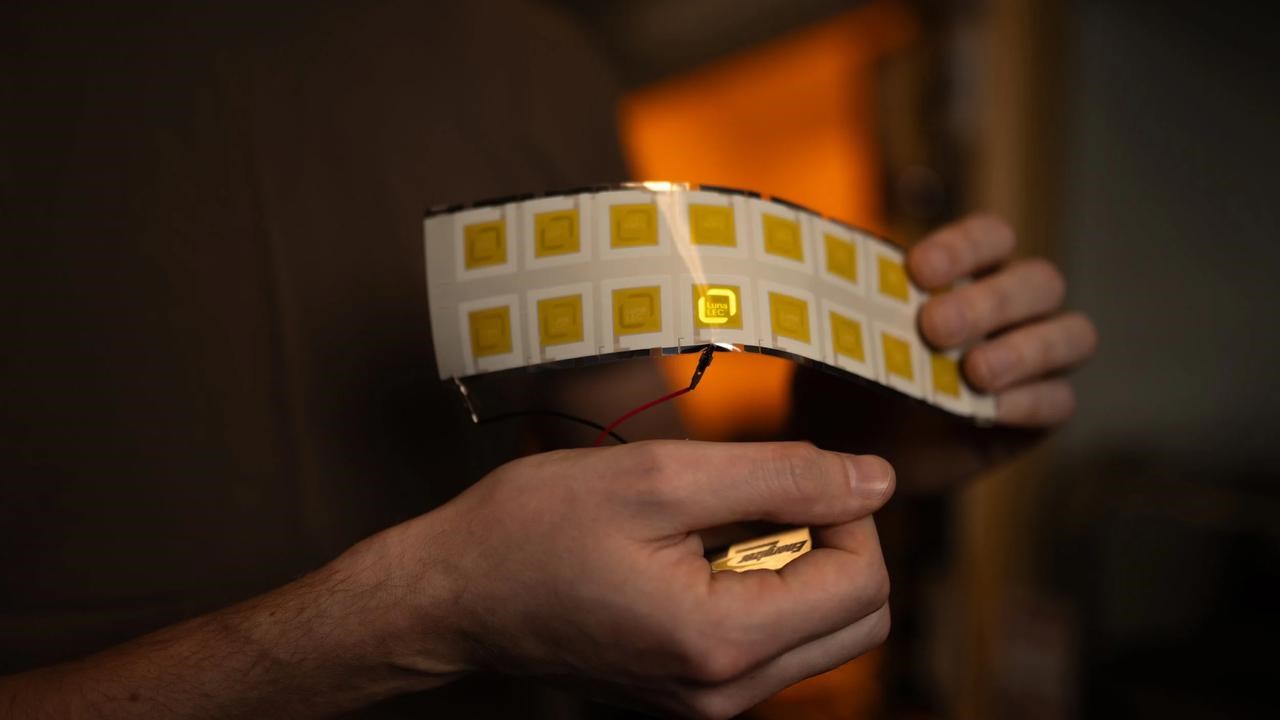
LunaLEC is demonstrating the technology.
ImageSEKAI MediaThe next step is to scale up production. Currently, the components are manufactured on a small scale in laboratories, but reaching the market requires processes that are suitable for industrial production.
“We want to demonstrate that the technology can be produced reliably, at the right quality, and in the volumes required. That’s why we’re collaborating with companies that have experience in large-scale manufacturing,” says Erik Zäll.
If successful, LunaLEC’s technology could become part of the next generation of printed electronics—where light is used not only for illumination, but also for functionality, design, and safety.
Learn more about LunaLEC and contact the team
https://www.lunalec.com/
LunaLEC has received business support from Innovation Office and an investment from Umeå University Holding AB.