

NEWS How do the body’s smallest molecular machines make the heart beat, muscles contract and nerve signals travel through the body? Despite decades of research, scientists still lack a direct understanding of how these vital processes work in real time. A team of researchers will now develop a method to capture molecular machines in action.
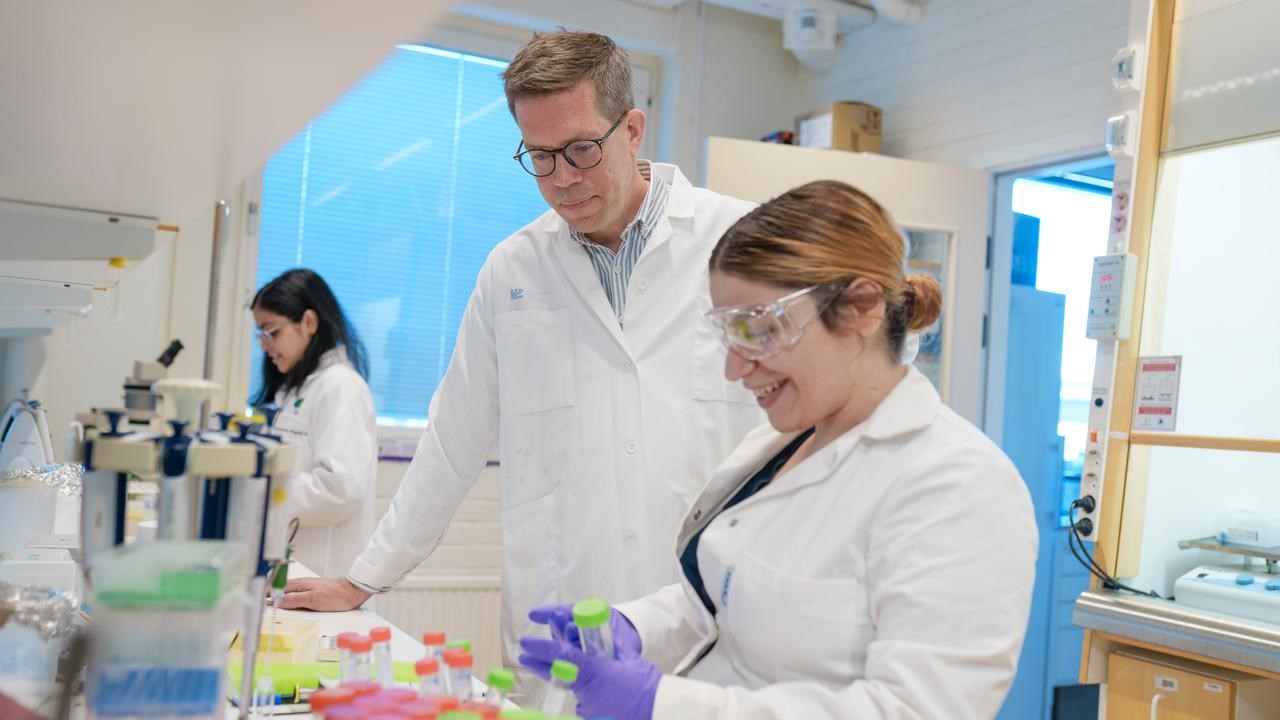
Magnus Andersson, Professor at the Department of Chemistry.
ImageMattias Pettersson“We want to establish a new national research capability that could help drive a shift in biology, from static images of life’s building blocks to a more direct understanding of how they function in time and space. We hope this knowledge will pave the way for future advances in medicine, biology and biotechnology,” says Magnus Andersson, Professor at the Chemistry Department at Umeå University.
Inside our cells are molecular machines that convert chemical energy into biological work. They regulate processes such as nerve signalling, muscle contraction and the body’s handling of essential metals. One important group is the P-type ATPases, proteins powered by the energy-carrying molecule ATP.
Although P-type ATPases have been studied for almost 70 years, researchers still do not know exactly how energy is converted into movement. The reason is that the key changes occur extremely rapidly, on timescales ranging from microseconds to milliseconds. Current methods usually capture only the beginning and end of a process, much like trying to understand a film from just a few still images.
The researchers therefore aim to develop time-resolved cryo-electron microscopy. By triggering a protein reaction and freezing it at carefully selected points in time, it will be possible to observe molecular machines while they are at work. For the first time, researchers will be able to follow how biological work is generated, step by step.
P-type ATPases will be the focus, but the method could also be used to study many other rapid biological processes that have so far been impossible to observe.