

NEWS Increasing tree growth without disrupting the trees' seasonal rhythm is a challenge. Researchers at Umeå Plant Science Centre have now developed an approach that allows aspen trees to grow more while still responding to the changing seasons. The key lies in a connection between the trees’ internal clock and the production of a growth-promoting hormone.

Maria E. Eriksson (left) and Manuela Jurca (right) Maria E. Eriksson (left) and Manuela Jurca (right) investigated how the internal clock can help coordinate tree growth with seasonal changes.
Image Anne HonselFor deciduous trees in northern climates, the timing of growth is crucial. As summer turns to autumn and days become shorter, trees stop growing and form buds that protect the developing shoots during winter. These seasonal changes are essential for surviving the cold months, but they also limit the time available for growth.
We wanted to find a way to combine increased growth with the trees' ability to respond to seasonal changes and maintain winter hardiness.
Maria E. Eriksson, group leader at Umeå Plant Science Centre and Associate Professor at Umeå University, has been interested in this balance since her PhD research. At that time, she and her colleagues discovered that increasing the production of gibberellin, a plant hormone that promotes growth, could make aspen trees grow more, accumulate more biomass and develop longer wood fibres. However, there was a drawback.
“These trees lose the ability to respond appropriately when days become shorter and therefore cannot accurately regulate the seasonal timing of growth. We wanted to find a way to combine increased growth with the trees' ability to respond to seasonal changes and maintain winter hardiness,” explains Maria E. Eriksson, who led the study.
To address this challenge, the researchers turned to the trees' internal clock. Like humans, plants use this clock to coordinate biological processes with the daily cycle of light and darkness. In trees, it also plays an important role in regulating seasonal growth.
The researchers chose a promoter - a region of DNA that controls when and where a gene is active - from a gene involved in cell division and growth. The gene’s activity is linked to the trees’ internal clock and decreases when days become shorter, making its promoter a promising tool for controlling gibberellin production.
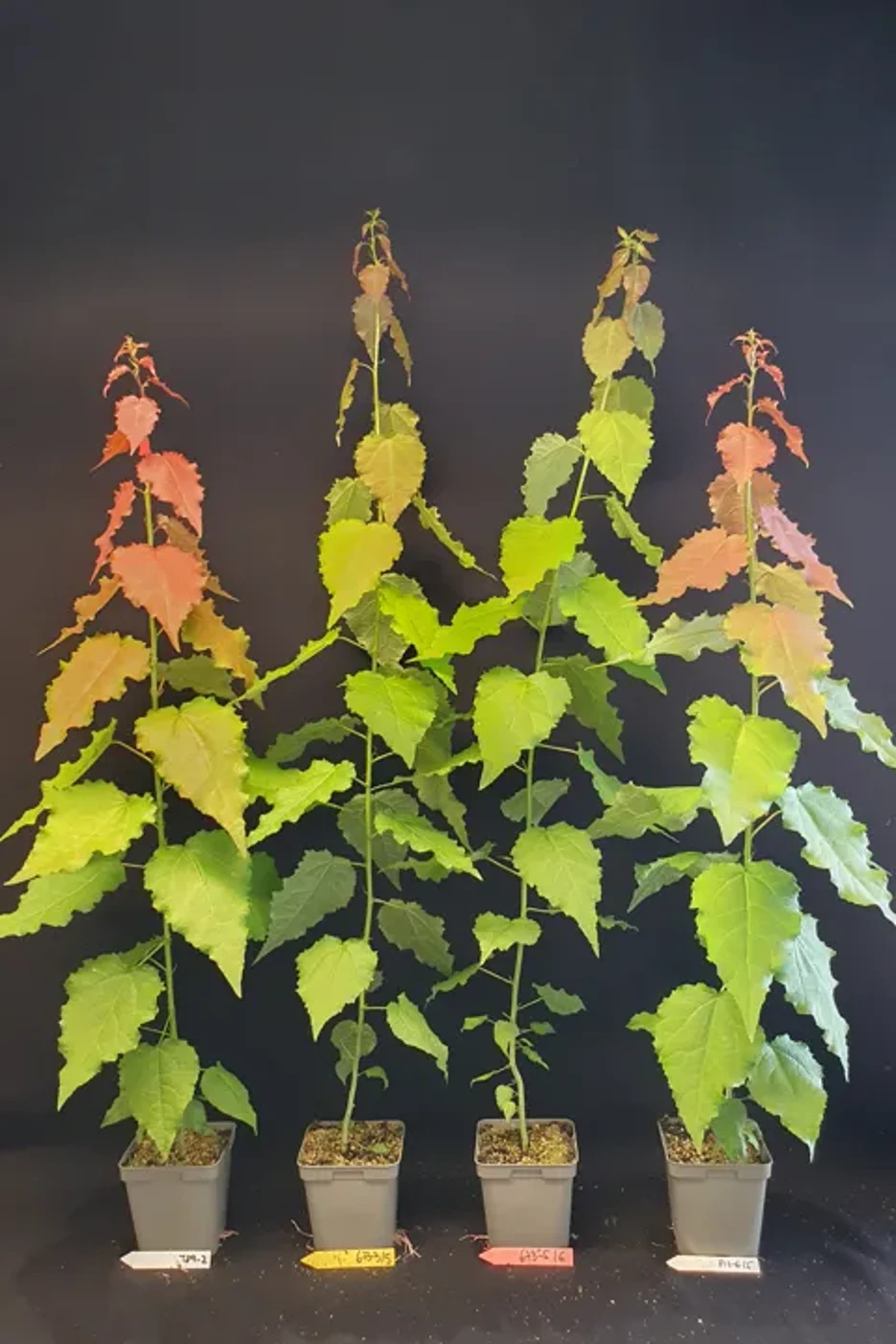
By using this promoter in genetically modified aspen trees, the researchers aimed to increase gibberellin production in growing tissues without keeping it continuously elevated as in earlier experiments.
Maria E. Eriksson (left) and Manuela Jurca (right) investigated how the internal clock can help coordinate tree growth with seasonal changes.
Image Manuela JurcaTo see whether this approach worked, the researchers tested the modified aspen trees under controlled conditions. Under long days, the trees grew taller and produced more stem biomass than unmodified trees. When exposed to shorter days, they stopped growing and formed buds. They were also able to resume growth after simulated winter conditions.
“It was an exciting and rewarding moment to see that we were able to achieve the balance between growth and seasonal adaptation we looked for,” says Manuela Jurca, the study's first author.
The researchers now want to better understand how the internal clock and plant hormones work together to regulate tree growth. They also hope to test the modified aspen trees in the field to see whether the results observed under controlled conditions also apply in a natural environment.
Manuela Jurca, Johan Sjölander, Bertold Mariën, Rajesh Kumar Singh, Alexander Vergara, Jun Yu, Thomas Moritz, Maria E Eriksson, Biotechnological adaptation of high-yielding, gibberellin-overproducing Populus trees to seasonal growth patterns, Journal of Experimental Botany 2026, DOI: https://doi.org/10.1093/jxb/erag483.
