

NEWS How pharmaceuticals move through the environment affects the risk of them spreading through soil and water. In his doctoral thesis, Rogers Swai has used advanced computer simulations to demonstrate and quantify how the properties of pharmaceutical molecules determine their ability to bind to clay minerals. The findings provide new insights into the processes that influence the environmental dispersion of pharmaceuticals.

Experimental studies have long shown that the charge of a pharmaceutical affects how strongly it binds to mineral surfaces in nature. This charge, in turn, changes depending on the pH of the water. What has remained difficult to understand is precisely why this occurs at the molecular level.
Using molecular dynamics simulations, Rogers Swai has been able to track individual pharmaceutical molecules and study their movements and interactions with clay minerals at the molecular scale. The results show how changes in charge and water salinity affect the molecules’ ability to bind to surfaces, how water molecules participate in the process, and which forces determine whether a pharmaceutical remains in place or is transported further through the environment.
– You can think of computer simulations as numerical experiments. First, I prepared a system in a specific state. Then, using Newton’s laws of motion in molecular dynamics simulations, I let the system evolve. Once the system reached equilibrium, I measured the properties I was interested in.

Image[Simon Jönsson]
The study focuses on the antibiotic ciprofloxacin, one of the most widely used antibiotics in the world. The simulations show that the same pharmaceutical can behave very differently depending on whether it is in acidic, neutral or alkaline environments. Some forms bind strongly to clay particles and become relatively immobile, while others are more easily transported by water.
Antibiotic residues are found in aquatic environments across the globe, and their spread has been linked, among other things, to the development of antibiotic resistance. The better we understand the processes that govern how pharmaceuticals move between water, soil and sediment, the better our ability to predict their environmental impacts and develop strategies to reduce them. By revealing the molecular mechanisms behind these processes, the thesis contributes knowledge that can be applied in future environmental and water research.
The thesis complements previous experimental studies by showing what actually happens at the molecular level. While experiments can demonstrate that a phenomenon exists, simulations can reveal the underlying mechanisms.
– we have created a blueprint for other labs to compile identical descriptor indexes for other abundant natural minerals such as iron oxides and zeolites. This descriptor can be used as a foundation metric to train large machine learning models. Instead of running heavy, several week supercomputer simulations for every single new molecule, an AI could use the descriptor to estimate clay-binding affinity for millions of compounds in matter of seconds.
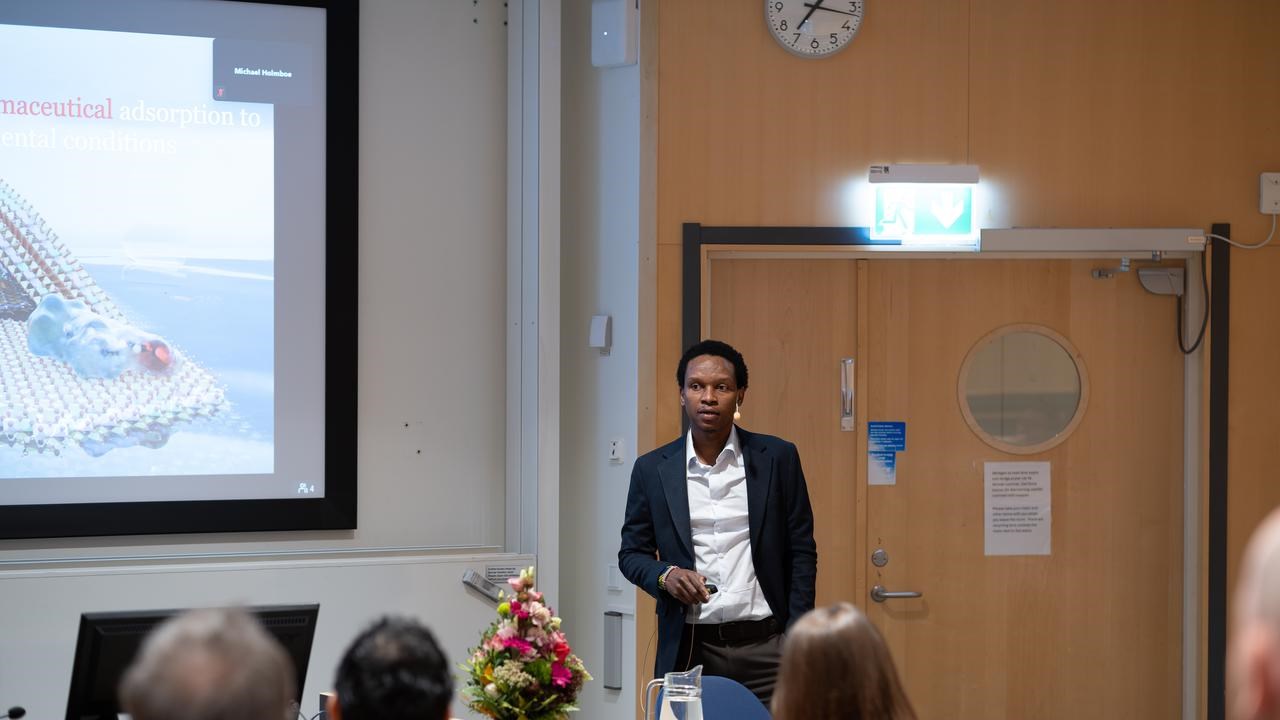
Image[Simon Jönsson]
As computing power has increased dramatically over the past decade, computer simulations have become an increasingly important tool for exploring the smallest building blocks of nature. Rogers Swai’s research demonstrates how molecular dynamics simulations can function as a kind of virtual microscope, enabling researchers to follow molecular movements and interactions in detail. This not only provides new knowledge about pharmaceuticals in the environment, but also illustrates how modern chemistry is increasingly combining experiments, theory and advanced computer simulations to understand and address complex societal challenges.
Title: Molecular dynamics simulations of pharmaceutical adsorption to montmorillonite under environmental conditions
Author: Rogers Swai, Department of Chemistry, Umeå University
Main supervisor: Michael Holmboe