


Edit Page
"False"
Skip to content
printicon
Main menu hidden.
Published: 2026-11-27

The Sleepy Sickness in Vilhelmina – a Hundred Year Old Mystery

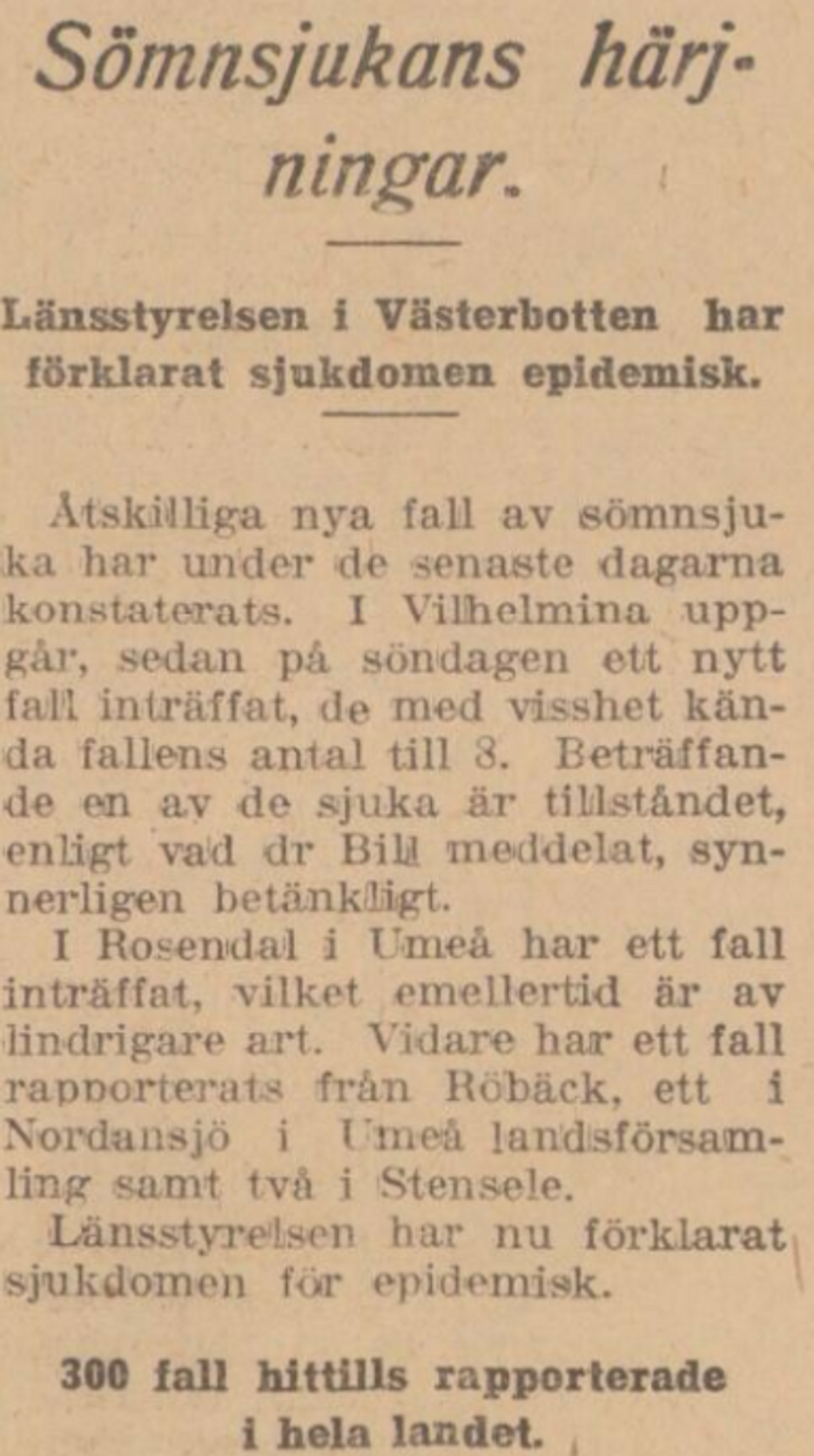
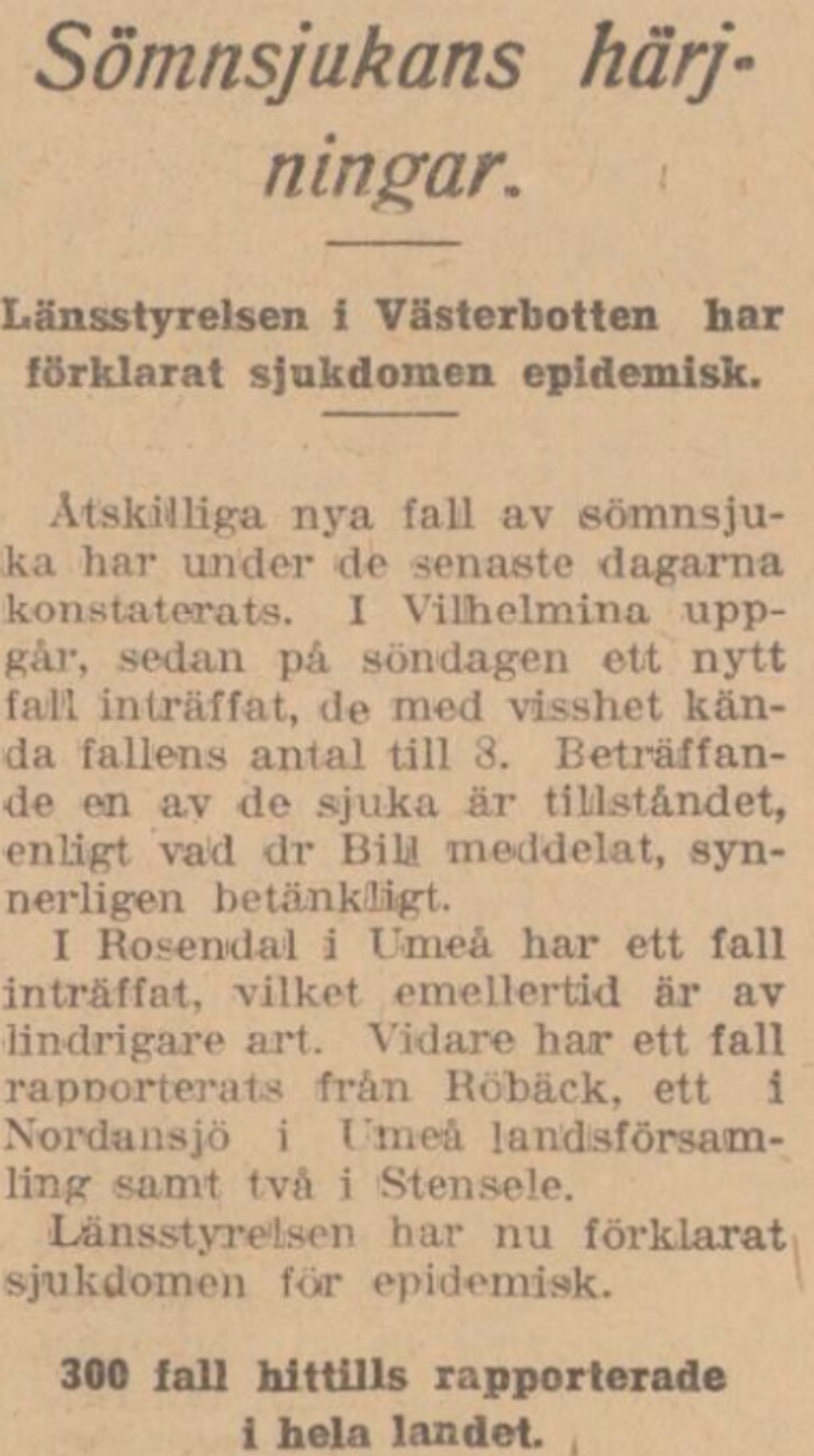
NEWS Researchers at CEDAR have studied and perhaps found an important piece in understanding one of the biggest medicinal mysteries of our time: the Sleepy Sickness that swept over Europe in the early 1900´s. During the 1920’s, Sweden was one of the hardest-hit countries in the world, with the highest number of reported cases in Västerbotten, and especially the inland community of Vilhelmina.

Lena Karlsson and Erling Häggström Gunfridsson are both researchers at the Centre of Demographic and Ageing Research (CEDAR). The 8 September, they published a research article titled “Encephalitis lethargica in Sweden, 1920–1930: national incidence and the 1921 outbreak in northern Sweden,” a study that investigates the geographic spread of the mysterious Sleepy Sickness.

Wanted to examine the spread in Sweden

The disease Encephalitis lethargica, or Sleepy Sickness, emerged around 1926 and disappeared around 1930, and what caused this disease is a mystery to this day. Sweden was one of the hardest-hit countries, which made the researchers Lena and Erling interested in examining how the disease spread in the country. To map the spread, they analysed national statistics from historical healthcare reports from SCB, and provincial medical reports from Regionarkivet Västerbotten.

”We wanted to see the geographic spread of the disease, and which other epidemics emerged before and after the outbreak. We also wanted to see if the results could contribute understanding of possible causes and mechanisms of the disease,” says Lena Karlsson.

The results show Vilhelmina as the hardest-hit community

The results show a clear geographical pattern in the spread of the Sleepy Sickness. It affected the Stockholm area first, and then quickly spread up North. In 1921, Sweden had the highest number of reported cases in the world, with a concentration in Västerbotten. Out of all reported cases in Västerbotten, almost 80 percent were located in Vilhelmina. The result surprised the researchers, since epidemics usually hit the hardest in densely populated cities, rather than sparsely populated areas.

“We suspect that the Sleepy Sickness most likely spread in the cities first, but that it happened before it was mandatory to report the cases,” explains Erling Häggström Gunfridsson.

Can perhaps explain the development of the disease

Another interesting discovery was that Vilhelmina had severe cases of both the Spanish Flu and Mumps prior to the Sleepy Sickness outbreak, which may help explaining the emergence of the Sleepy Sickness.

”We were surprised to find such a major Mumps epidemic only a few months prior to the outbreak of the Sleepy Sickness. There are theories of a connection between the Spanish Flu and Sleepy Sickness, but we could not see such connections in other areas. However, the combination of the Spanish Flu and Mumps may be relevant in the understanding of why Vilhelmina was so severely affected by the Sleepy Sickness. This finding is also consistent with hypotheses that multiple infections may have interacted in the development and spread of the disease,” the researchers elaborate..

The results are relevant for the medicinal research of today

The study shows how important historical population and health data can be to reconstruct epidemics and thus highlight questions that are still relevant within medicinal research today. Additionally, the results can contribute new perspectives on post-infectious conditions and long-term effects after infections. These questions are still highly relevant to this day, for example when it comes to post-covid.

About the article

Title: Encephalitis lethargica in Sweden, 1920–1930: national incidence and the 1921 outbreak in northern Sweden

Authors: Lena Karlsson, Erling Häggström Gunfridsson

Published in: Epidemiology & Infection, Volym 154

Date of publication: 8 September 2026

Link to the article