

About the grants
The Swedish Research Council awarded a total of just over SEK 22 million to six researchers at Umeå University in the call Research into viruses and pandemics 2025. A total of SEK 211 million was awarded.
NEWS Max Renner at Umeå University receives SEK 10 million from the Swedish Research Council for a project that will uncover how dangerous viruses build tiny factories inside our cells. Using cryo-electron microscopy, the researchers hope to understand how these viruses copy themselves – knowledge that could prove crucial in combating future outbreaks.

Max Renner, assistant professor at the Department of Chemistry.
ImageMattias PetterssonCertain viruses such as pneumoviruses, which cause respiratory infections, and the rarer but deadly henipaviruses, build small “viral factories” inside human cells. These structures gather everything the virus needs to multiply and spread. Yet what actually happens inside them remains largely unknown.
This is something Max Renner, assistant professor at the Department of Chemistry, now aims to change with his newly funded project.
“We are trying to figure out how these viruses work, down to the molecular level. Using advanced cryo-electron microscopy at cryogenic temperatures, we can see these processes in 3D inside frozen cells at extremely high resolution,” he says.
The project will map what viral factories look like, how they work, how their key components move and interact, and how their structures vary between different types of viruses. The researchers will also use synthetic proteins, designed with machine-learning approaches, to stop or slow down the virus machinery.
“We are currently just beginning to understand the internal structure of viral factories and how the virus’s copying machinery works inside actual human cells. This knowledge gap makes it difficult to develop targeted antivirals in cases where vaccines are not available,” says Max Renner.
By uncovering how these viruses replicate, hide from the immune system, and hijack our cells, the project will improve our ability to fight future viral threats. At the same time, there is potential to discover entirely new biological structures.
“The exploration of viral factories is just getting started. This means we may find mechanism no one has seen before,” says Max Renner.
Support from the Swedish Research Council now enables the research group to take important steps towards a deeper understanding of how viruses function – and, ultimately, how they can be stopped.
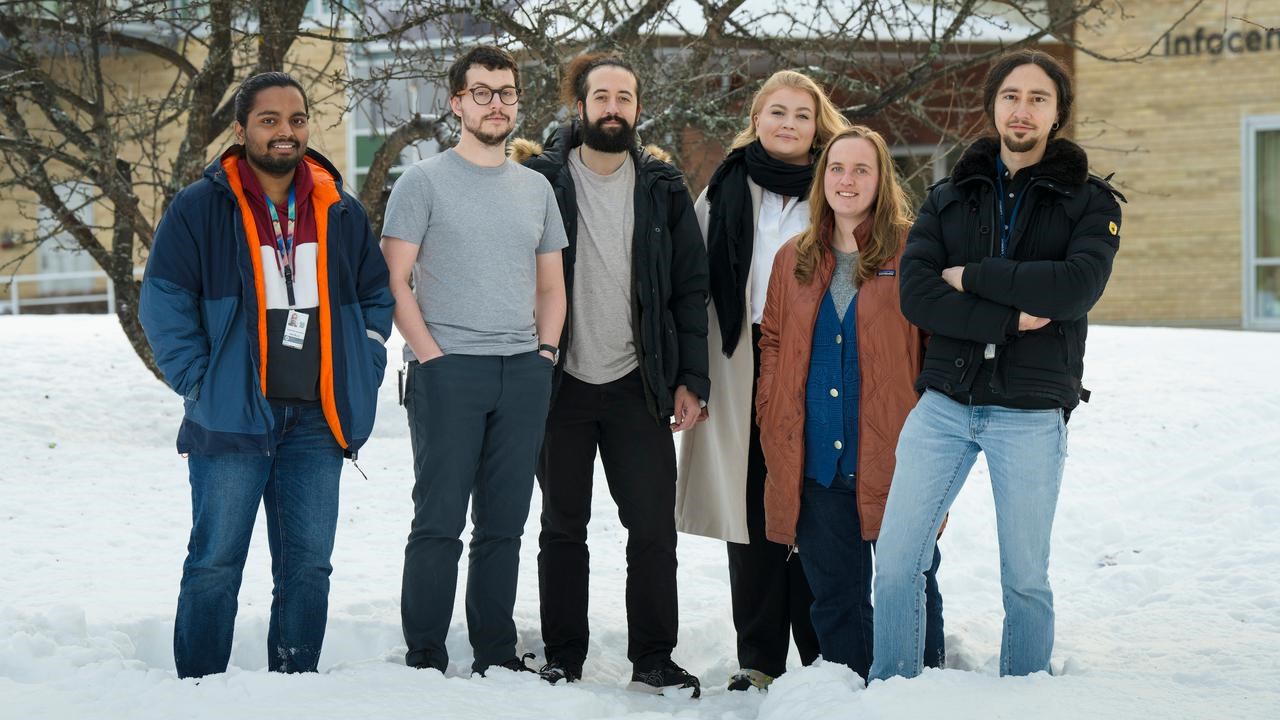
Max Renner with his research group: Rupesh Balaji Jayachandran, Erwan Quignon, Marcus Sundqvist, Kajsa Westberg and Jane Corwin.
ImageMattias PetterssonThe Swedish Research Council awarded a total of just over SEK 22 million to six researchers at Umeå University in the call Research into viruses and pandemics 2025. A total of SEK 211 million was awarded.