



"False"
Skip to content
printicon
Main menu hidden.
Published: 2026-09-21

Under stress, bacterial RNA and proteins tell different stories

NEWS Researchers at Umeå University have identified stress conditions in which RNA and protein levels diverge in disease-causing bacteria. Under osmotic stress, they traced this mismatch to reduced protein production, showing why RNA alone may not always reveal what is happening in the bacterial cell.

During infection, bacteria encounter rapidly changing and stressful environments inside the body. To understand how they adapt, researchers often measure messenger RNA (mRNA), which carries information from genes that can be translated into proteins. While mRNA levels are widely used to monitor bacterial responses, proteins carry out much of the work inside the cell and are influenced by processes that occur after RNA has been produced.

Scientists have long known that mRNA levels do not perfectly predict protein abundance. What has remained unclear is how that relationship changes under different stresses and across different bacterial pathogens.

In a new study published in the scientific journal PNAS, researchers compared three human pathogens: Salmonella enterica Typhimurium, Yersinia pseudotuberculosis and Staphylococcus aureus. By exposing them to ten infection-relevant conditions, they investigated whether the relationship between mRNA and protein levels was species-specific or broadly shared.

The cells can change their plans faster than they can build the things needed to carry them out.

Across all three species, mRNA and protein levels generally followed the same trends. However, stresses that triggered the largest changes in gene and protein expression also showed the weakest agreement between RNA and protein levels. In other words, under some of the most challenging conditions, RNA provided a less complete picture of what was happening inside the cell.

“When bacteria receive a sudden warning from their environment, they immediately start changing the messages inside the cell about what needs to happen next,” says Sena Gizem Süer, PhD student at the Department of Molecular Biology and part of the Stress Response Modeling at IceLab research school at Umeå University and shared first author of the study. “The cells can change their plans faster than they can build the things needed to carry them out.”

One stress condition stood out: osmotic stress, which occurs when changes in the concentration of dissolved substances around a cell disturb its water balance. Pathogens can encounter such environments in the body, for example in the gut lumen. Genes responding specifically to osmotic stress showed a particularly weak match between mRNA and protein levels in all three bacterial species.

To investigate why, the researchers combined computational analyses with laboratory experiments. Their analyses pointed to altered translation, the process in which ribosomes read mRNA and build proteins, under osmotic stress.

The experiments confirmed that bacteria continued to translate mRNA into proteins during osmotic stress, but at significantly reduced levels in both Yersinia and Salmonella.

“This agreement between computational and experimental approaches strengthened our confidence in the findings”, says Jérôme Arnoux, interdisciplinary postdoctoral fellow at Integrated Science Lab (IceLab) and the Department of Molecular Biology and shared first author.

Exactly why translation slows remains unclear. The researchers discuss several possible explanations, including changes affecting the cell envelope and the transport of molecules into the cell, but further studies will be needed to identify the underlying mechanism.

The ultimate goal is to be able to predict bacterial protein levels during infection

“Researchers often use mRNA as a proxy for what is happening at the protein level,” says Kemal Avican, Research Fellow at the Department of Molecular Biology and senior author of the study. “Our results show that we need to better understand the uncertainty in that relationship, particularly when studying bacterial pathogens under stress and during infection.”

The researchers are now extending the work to additional stress conditions that resemble environments bacteria encounter during infection.

“The ultimate goal is to be able to predict bacterial protein levels during infection. That is something we cannot currently do using proteomics alone,” says Kemal Avican.

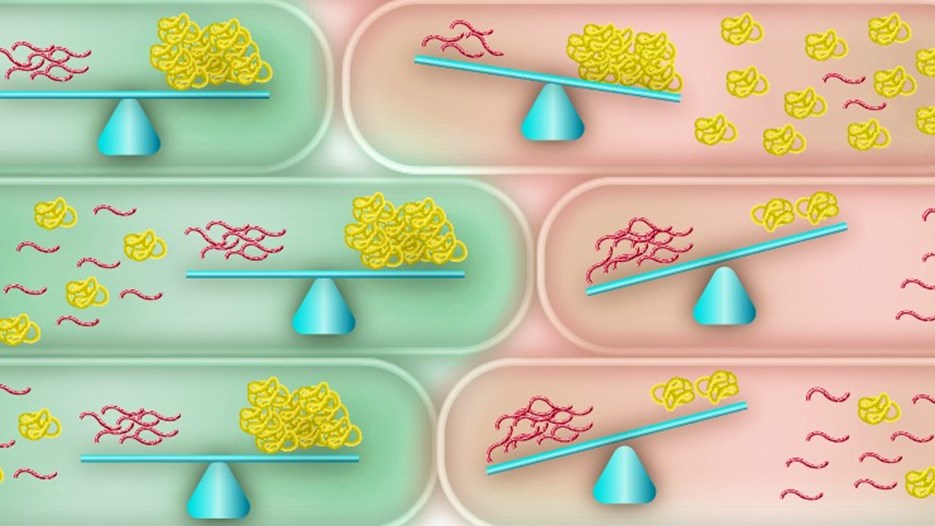
Representation of balance between mRNA and protein

Fact box: What is proteomics?

Proteomics is the study of all proteins present in a cell or organism at a given point in time. Because proteins carry out many of the cell’s most important functions, proteomics provides a snapshot of what is actually happening inside the cell. In this study, the researchers compared RNA and protein levels to investigate how accurately RNA can predict which proteins bacteria produce under different types of stress. The findings show that RNA does not always provide a complete picture of what is happening at the protein level.

Image: schematic illustration of the balance between mRNA and protein production under normal (left side) and stress conditions (right side).

About the scientific publication

S.G. Süer, J. Arnoux, Y.Y. Lim, G. Dhurve, R. Şen, C. Erdem, A. Mateus, & K. Avican, Bacterial stress responses lower mRNA–protein level correlations, Proc. Natl. Acad. Sci. U.S.A. 123 (38) e2613102123.

https://www.pnas.org/doi/10.1073/pnas.2613102123

Interdisciplinary collaboration

The movement between computation and experiment is reflected in the team behind the study. Five of the eight authors are connected to the interdisciplinary research environment IceLab (Integrated Science Lab), where Avican is a group leader, Süer is part of the Stress Response Modeling research school and Arnoux is an interdisciplinary postdoctoral fellow. The collaboration also brought together Avican with IceLab affiliates and fellow SciLifeLab group leaders André Mateus, whose lab contributed the proteomics work, and Cemal Erdem, whose group developed MOBILE, a computational tool used in this study.