

The graduate school AMTLR (Advancing research on the Mathematics Teaching-Learning Relationship) focuses designing, conducting and critically evaluating research that contribute to answering the key question: How and why do specific mathematics teaching designs lead to specific mathematics learning outcomes? AMTLR entails five specifically developed courses, work-in-progress seminars, and support from strong research environments offering apprenticeship in long-term research programmes.
A crucial question in educational systems all over the world is how to better support teachers in supporting students’ learning of mathematics. For this purpose, substantial efforts have been put into curriculum reforms and large-scale professional development programmes. However, obtaining substantial positive effects on students’ learning through such efforts is difficult, and ineffective mathematics teaching practices are still common.
Mathematics education research has made some progress in designing and implementing mathematics teaching that seems to promote students’ learning but documenting that improved learning outcomes are results of teaching rather than other variables is still challenging. In particular, there is a shortfall of studies directly investigating the mathematics teaching-learning relationship. As a result, some central claims about the mathematics teaching-learning relationship that are made and repeated go beyond existing empirical warrants.
If we are to improve future mathematics teaching and learning, we need to develop the competence of future mathematics education researchers in methods for investigating the mathematics teaching-learning relationship, and the competence of future mathematics teacher educators in evaluating evidence for claims about this relationship. Therefore, AMTLR aims to develop the doctoral students’ competence to design, conduct and critically evaluate research that contribute to answering the fundamental question: How and why do specific mathematics teaching designs lead to specific mathematics learning outcomes?
The educational activities and individual doctoral projects within AMTLR will focus on the elements and relationships foregrounded in the following model:
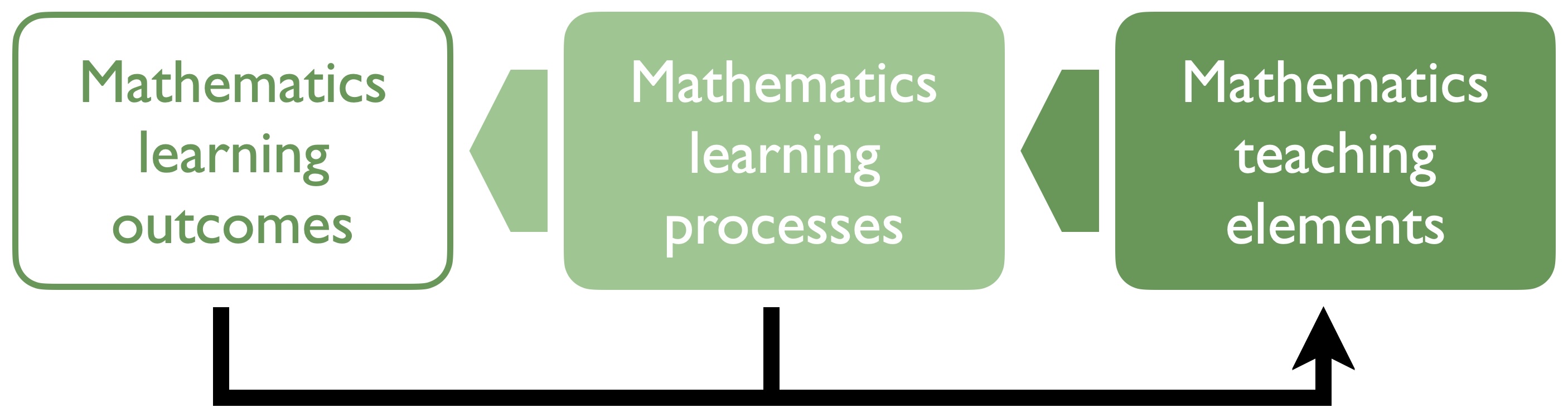
The model illustrates that teaching does not directly cause learning outcomes but indirectly through engaging students in learning processes that in turn result in new knowledge and competence. In addition, the same teaching design will not lead to the same learning for all students in all settings at all times. To effectively support students’ learning, teachers need to continuously assess students’ knowledge and behaviour in relation to desired learning processes and outcomes and provide accordingly adapted feedback and instructional activities. A key property of teaching design is thus how observed learning processes and learning outcomes feed back into adaptations of teaching. To develop new insights about this model, the doctoral students’ individual projects will test specific hypotheses about the mathematics teaching-learning relationship, which will entail conducting interventions, observing learning processes, measuring learning outcomes and making comparisons between groups.
AMTLR expects to result in: (1) new and more robust results regarding the mathematics teaching-learning relationship, (2) methodological advancements for investigating the mathematics teaching-learning relationship, and (3) doctors that are competent in how to (a) overview and evaluate existing support, and (b) build new support for how mathematics teaching should be designed to promote students’ learning, and can utilise this competence to increase the quality of mathematics education research and mathematics teacher education. To achieve this, AMTLR offers five specifically developed courses (45 ETCS in total), regular work-in-progress seminars, support from strong research environments where the doctoral students are part of established research groups who offer apprenticeship within their long-term research programmes, and access to a national network of researchers and doctoral students with a specific interest in the mathematics teaching-learning relationship.
AMTLR is a collaboration between Umeå university, Mälardalen University and Linneaus university. It is organised by a coordinator and a board of representatives from each partner university. AMTLR is funded by the Swedish Research Council.
Research programme