

"False"
Skip to content
printicon
Main menu hidden.
Published: 2026-10-05

3D printers can make advanced research more accessible

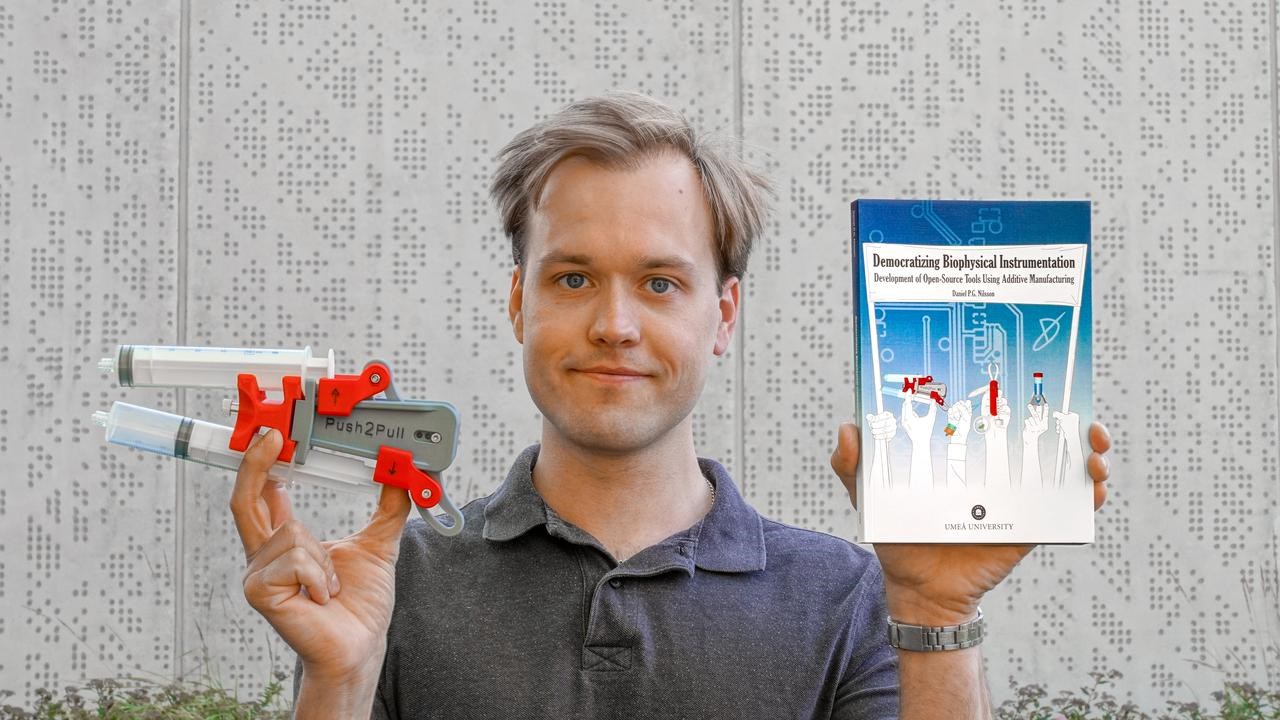
NEWS Developing new research equipment is often expensive and time-consuming. In his doctoral thesis, Daniel Nilsson at Umeå University demonstrates how standard 3D printers can be used to rapidly manufacture advanced scientific instruments directly in the laboratory.

Studying microorganisms requires instruments with extremely high precision. Such instruments are expensive and take a long time to manufacture using traditional methods, which has slowed progress in the field. It has also been difficult for the biologists who use these instruments to participate directly in their development.

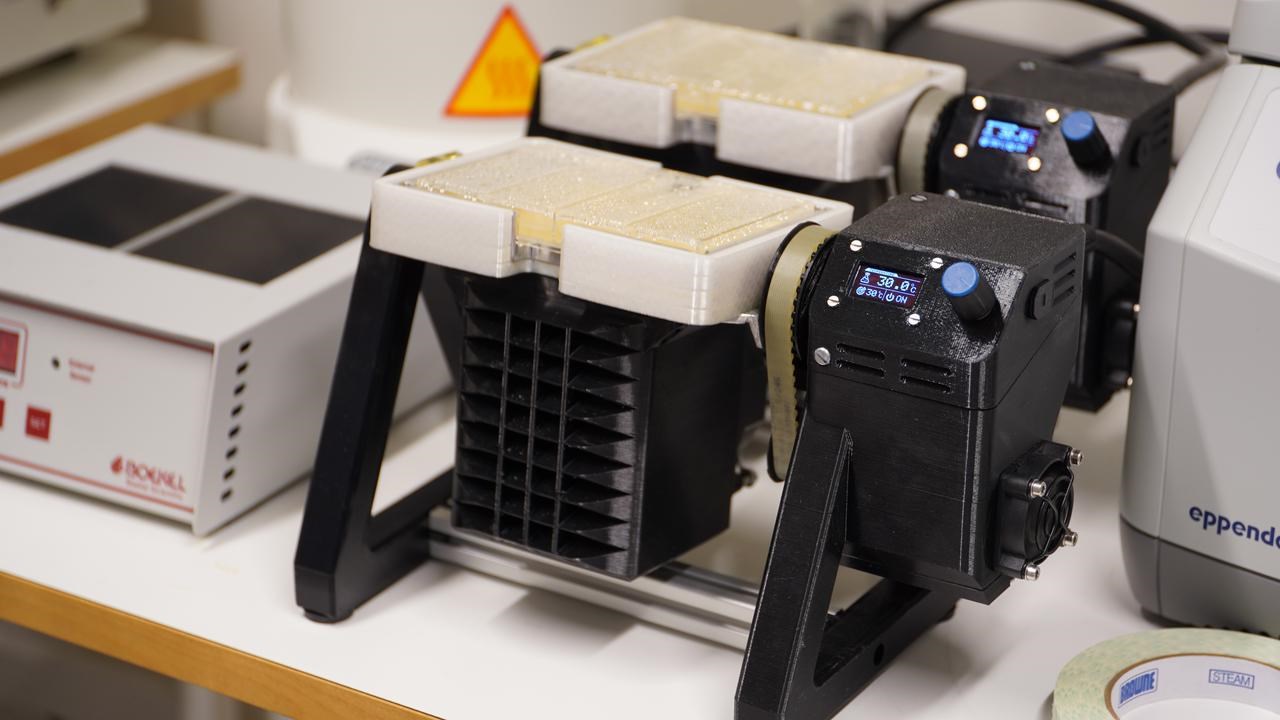
Using standard consumer-grade 3D printers, Daniel Nilsson at the Department of Physics has shown that it is possible to independently develop advanced, customised research instruments.

“We have developed a set of instruments that can be manufactured directly in the laboratory by anyone. We hope this will make biological research less expensive and more accessible to a larger number of researchers,” he says.

Instruments for detecting bacteria

Examples of the tools developed by the researchers include instruments for detecting and manipulating harmful bacteria using laser light, as well as tools for cultivating and measuring the properties of biofilms. Biofilms are slimy structures that bacteria can form on surfaces and that cause major problems in areas such as food production and healthcare.

A key idea behind the work is that researchers should be able to build, adapt and further develop equipment based on their own needs, rather than rely on expensive commercial solutions.

“These methods enable a more collaborative and needs-driven approach to development within the research community,” says Daniel Nilsson.

A practical guide

The thesis also includes a practical guide showing how researchers and other interested users can design 3D-printed tools and integrate open-source electronics.

“The same methods can be used both for advanced research instruments and for everyday technological solutions in the laboratory,” says Daniel Nilsson.

About the public defence and the researcher

On Friday 9 October, Daniel Nilsson of the Department of Physics at Umeå University will defend his doctoral thesis, Democratisation of Biophysical Instrumentation through Open-Source Design and Additive Manufacturing. The public defence will take place at 09:00 in Aula Anatomica (BIO.A.206) in the Biology Building. The faculty opponent is Christine Selhuber-Unkel of Heidelberg University.

Read the full thesis

Daniel Nilsson is a doctoral student in experimental physics. His research focuses on method and instrument development in biophysics, ranging from studies of single cells to models of biological flows. He has a background as an electrician, holds a Master of Science in Engineering degree in Engineering Physics, and has extensive experience building measurement equipment for researchers.

Contact

Daniel Nilsson
Research assistant
E-mail
Email