

About the thesis
Hanna Jerndal: Kidney injury following Covid-19: a whole population approach. Umeå University, 2026.
Read the thesis: https://urn.kb.se/resolve?urn=urn:nbn:se:umu:diva-258024
NEWS The risk of kidney injury remains elevated for up to a year after Covid-19. This is shown in a new doctoral thesis from Umeå University. The research also shows that healthcare registers fail to capture more than half of all cases of severe kidney injury.
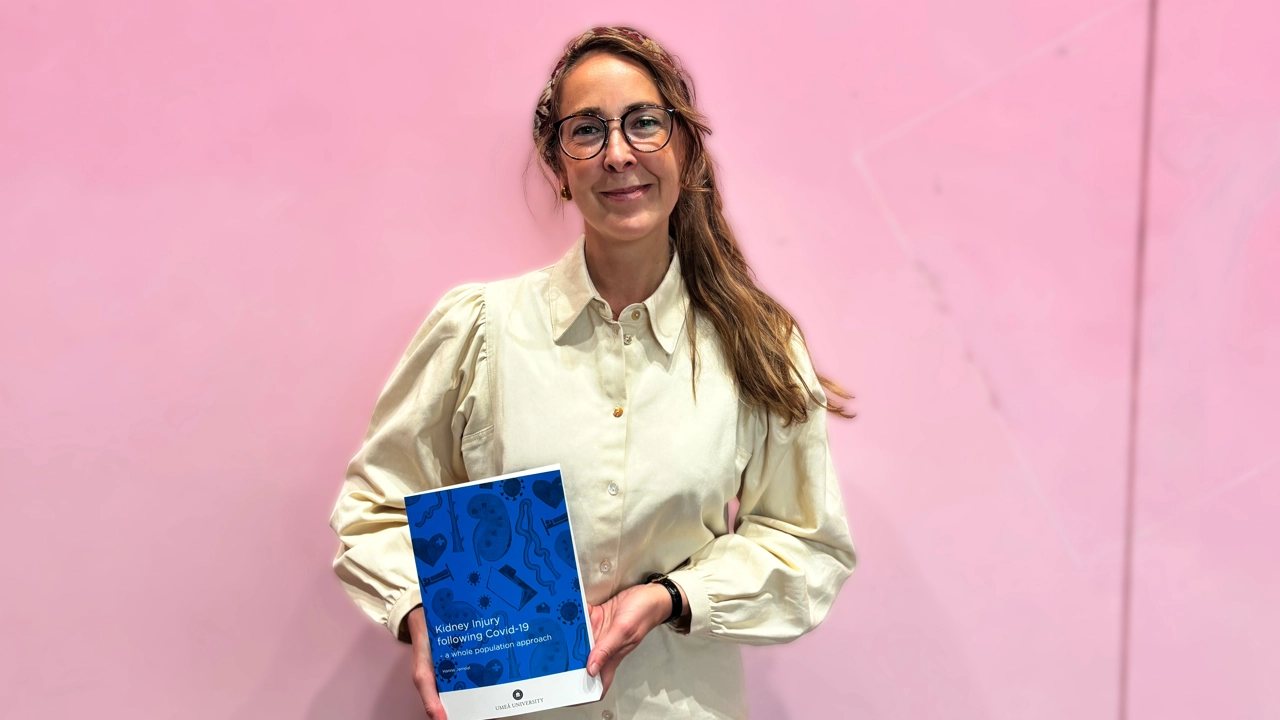
Hanna Jerndal’s thesis shows that the risk of kidney injury remains elevated for up to one year after COVID-19 and that more than half of severe kidney injury cases are not captured in healthcare records.
ImageAndreas Vilhelmsson“Kidney injury is an overlooked complication of Covid-19, and many cases are never recorded in healthcare systems. As a result, the scale of the problem risks being underestimated,” says Hanna Jerndal, who recently defended her doctoral thesis at the Department of Clinical Microbiology at Umeå University.
When Covid-19 was first identified, the disease was primarily regarded as a respiratory infection. However, it soon became clear that the SARS-CoV-2 virus affects several organs in the body, including the kidneys. What has remained unclear is how common kidney injury is at the population level and how long the increased risk persists.
In her thesis, Hanna Jerndal investigated the association between Covid-19 and kidney injury in large Nordic populations.
“Kidney injury is often a silent complication that initially develops without clear symptoms but can have serious long-term consequences. We therefore wanted to investigate how many people are actually affected and how well healthcare systems capture these cases,” says Hanna Jerndal.
To map the association between Covid-19 and kidney injury, Hanna Jerndal conducted several studies analysing national health registry data from Sweden and Denmark, covering more than 12 million individuals.
Using these population data, Hanna Jerndal was able to show that people infected with Covid-19 have a significantly increased risk of developing acute kidney injury during the first 60 days after infection. The risk remained elevated for up to a year after infection. The risk was greatest among men, people over the age of 50 and patients who had experienced severe Covid-19.
A key finding of the thesis is that national patient registers fail to capture more than 50 per cent of all cases of severe kidney injury. Only 47.3 per cent of laboratory-confirmed cases were diagnosed. This means that the true burden of kidney injury on both individuals and society, including following Covid-19, is likely to be considerably greater than the statistics indicate.
“We do not know for certain why so many patients with severe kidney injury do not receive a diagnosis. This needs to be investigated further in follow-up studies,” says Hanna Jerndal.
Because Sweden lacks national registers for laboratory data, the thesis project led to a research collaboration with Denmark. Hanna Jerndal also completed a research exchange at Statens Serum Institut in Copenhagen, Denmark’s counterpart to the Public Health Agency of Sweden.
“Denmark has built a fantastic data infrastructure where laboratory data are collected within hours of test results becoming available. This makes it possible to quickly address important public health questions. The collaboration with colleagues at Statens Serum Institut has been extremely rewarding,” says Hanna Jerndal.
In another sub-study, hospitalised patients were followed for six months using detailed biomarkers in the blood. The results showed signs of injury to the kidney’s glomeruli and tubules, the structures that filter the blood and form urine. Signs of kidney injury could be detected for up to six months after infection.
The findings highlight the need to follow up patients who have had moderate or severe Covid-19, so that kidney injury can be detected early and the risk of chronic kidney disease reduced. This is particularly important for people over the age of 50.
But follow-up is not the only issue. The findings also underline the importance of preventing severe Covid-19. Vaccination reduces the risk of severe disease and therefore also the risk of kidney injury following infection.
Better detection of kidney injury also requires access to laboratory values in national health registers, as a complement to diagnostic codes.
“We need a national register for laboratory data that can be linked with other Swedish health registers, similar to the Danish model. This would facilitate the early detection of disease, improve data quality in research and give patients better opportunities to receive appropriate care before irreversible damage occurs,” says Hanna Jerndal.
Hanna Jerndal: Kidney injury following Covid-19: a whole population approach. Umeå University, 2026.
Read the thesis: https://urn.kb.se/resolve?urn=urn:nbn:se:umu:diva-258024
