

NEWS Four years after its launch, it is time for the first doctoral thesis defence at the Arctic Graduate School at Umeå University. Rebecca Tapper will be the first to defend her thesis. The defence marks an important milestone for a cross-faculty initiative that has brought together doctoral students from different disciplines with a focus on the Arctic and sustainable development.

Rebecca Tapper is a doctoral student at the Department of Epidemiology and Global Health at Umeå University. Her thesis, ArctiHealth – Expanding the knowledge of risk management, health effects and experiences of occupational cold exposure, focuses on outdoor work in Arctic climates.
ImageHans KarlssonRebecca Tapper's thesis focuses on outdoor work in Arctic climates. Her research has included a review of previous research regarding cold risk management. She has also investigated how preschool-, park and maintenance-, and power grid workers in northern Sweden are exposed to cold climates by using wearable sensors for temperature and workers movement patterns while working outdoors.
Using wearable sensors, collecting health data and interviews, she has investigated cold-related symptoms, comfort, performance, and how workplaces manage the risks associated with cold exposure. The results show, among other things, that responsibility for managing cold-related risks is largely placed on individual workers rather than on the organisation. Rebecca therefore points to the need for a change in perspective, where working in cold environments should not be taken for granted as a natural circumstance, but recognised as an occupational health risk that needs to be addressed through organisational and preventive measures.
In the study, participants spent an average of 29% of their working day, equivalent to 2.2 hours, in temperatures below 10 degrees Celsius. Around one third reported that they often or always felt cold at work. Cold-related discomfort was also associated with musculoskeletal problems, abnormal cold sensitivity in the hands, and impaired concentration and mobility.
The results also reveal shortcomings in structured guidance and procedures for procuring work clothing. Women reported negative effects of cold and inadequate protection to a greater extent than men, raising questions about gender equality in occupational protection.
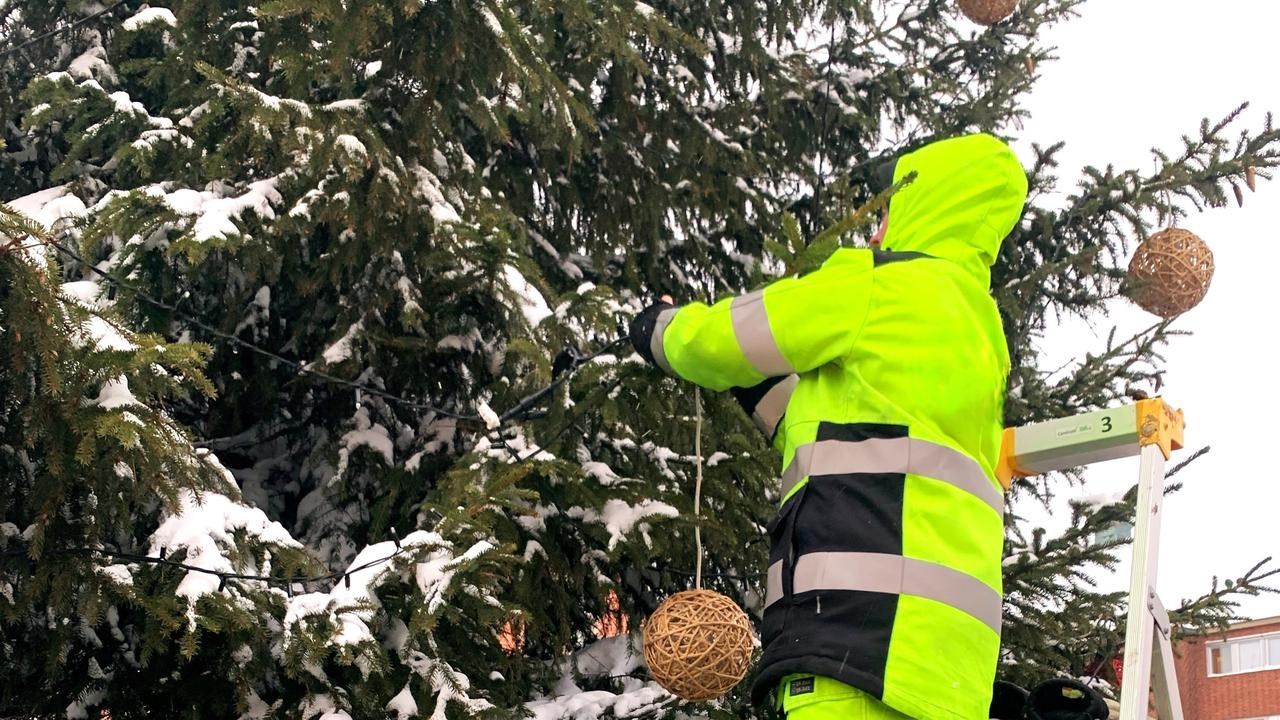
Many people who work outdoors are exposed to cold temperatures for several hours each day, the study shows.
Image: Rebecca Tapper
The Arctic Graduate School was initiated by the Vice-Chancellor in 2022 with the task of bringing together and coordinating Arctic research at the University and creating a platform with a focus on sustainable development in the Arctic. The Graduate School is part of the Arctic Centre and brings together doctoral students from different departments and disciplines across all faculties.
“One part was to try to bring the research together. But another was to try to find a platform where sustainable development could become an important component,” says Linda Lundmark, who has been responsible for the Graduate School.
Fourteen doctoral students are currently active in the Graduate School. Linda Lundmark highlights the fact that they come from a range of different disciplines as one of the strengths of the initiative.
“We have recruited broadly from different disciplines. I think that has worked extremely well. And I think it shows that research about, in and around the Arctic is taking place across the entire University,” she says.
Linda Lundmark also emphasises the importance of the Graduate School being interdisciplinary. Sustainable development in the Arctic encompasses social, ecological, economic and cultural dimensions, and the Graduate School includes research in a wide range of fields.
“All disciplines have something to contribute. And that is why it is also important that this is an interdisciplinary initiative,” she says.

Linda Lundmark is a Associate Professor at the Department of Geography and is responsible for doctoral education within the Arctic Graduate School for Sustainable Development.
ImageLinda LundmarkLinda Lundmark also sees the Graduate School as a way of preparing doctoral students for a research landscape in which working across disciplinary boundaries and together with actors outside the University is becoming increasingly important.
She describes how research funding calls increasingly require researchers to work together to address broad societal issues. For those who continue in academia, experience of collaborating with other disciplines and societal actors can be valuable when applying for research funding. These skills can also be useful outside academia, where, according to Linda Lundmark, doctoral graduates can serve as links between research and the organisations in which they work.
As part of the Graduate School's courses, doctoral students practise engaging with wider society. Among other things, they identify societal actors who are relevant to their own research, consider how to establish contact with them, and explore ways of working together.
We have recruited broadly from different disciplines. I think that has worked extremely well. And I think it shows that research about, in and around the Arctic is taking place across the entire University
For Rebecca, meeting doctoral students from other academic disciplines has been an important part of her time in the Graduate School. She describes how different disciplines have their own languages, methods and ways of writing, and how contact with other fields of research has given her the opportunity to view her own discipline from different perspectives.
“I find gaining insight into this incredibly valuable, because it helps you understand that the science you learn within your own discipline is not the only truth. I think it creates distance and encourages reflection on your own field, helping you to evaluate and navigate the academic world,” says Rebecca.
Meeting across disciplines has also provided new ways of approaching research questions and helped create contacts and networks. The doctoral students have travelled together, attended conferences and supported one another throughout their doctoral studies.
The Graduate School also includes joint courses, seminars and international activities. One seminar series is organised together with the universities in Rovaniemi and Tromsø within The Arctic Six. Field trips have also given the doctoral students opportunities to meet researchers and doctoral students at other universities.
Rebecca also highlights initiatives that the doctoral students themselves have developed during their time in the Graduate School. Together, they have, among other things, re-established APECS Sweden and organised their own interdisciplinary conference for early-career researchers.
“This would not have been possible if we had not had this interdisciplinary platform to build on,” says Rebecca.
Rebecca will now become the first of the Graduate School's doctoral students to reach the thesis defence. She says that the four years have passed quickly and particularly highlights the sense of community among the doctoral students, despite working in different research disciplines and on different projects.
“It has been great to go through this journey together, even though we all have such different projects and research disciplines. I really appreciate the friends I have made, the trips and conferences we have attended, and the fact that we have been able to support one another during our doctoral studies,” she says.
Being the first also means that she will be the first to leave the group.
“Being the first means that I am now leaving them, rather than them leaving me. Who knows what happens after you have defended your thesis?” says Rebecca.
For Linda Lundmark, the first thesis defence is an important milestone for the Graduate School.
“It means everything,” she says.
She describes a strong sense of pride, while emphasising that Rebecca is the one who has done the work.
“My part in all of this has been very small. She has done all the work, but I still feel proud. She has done such a fantastic job. And she has been important to the Graduate School by being present and taking part in what we have done,” says Linda Lundmark.

