

NEWS Cognitive linguistics, metaphor, and embodied cognition are central research interests of Lacey Okonski, who is currently a Marie Skłodowska Curie Actions Fellow at the University of Oslo and a postdoctoral research associate at the Department of Language Studies and Humlab, Umeå University.
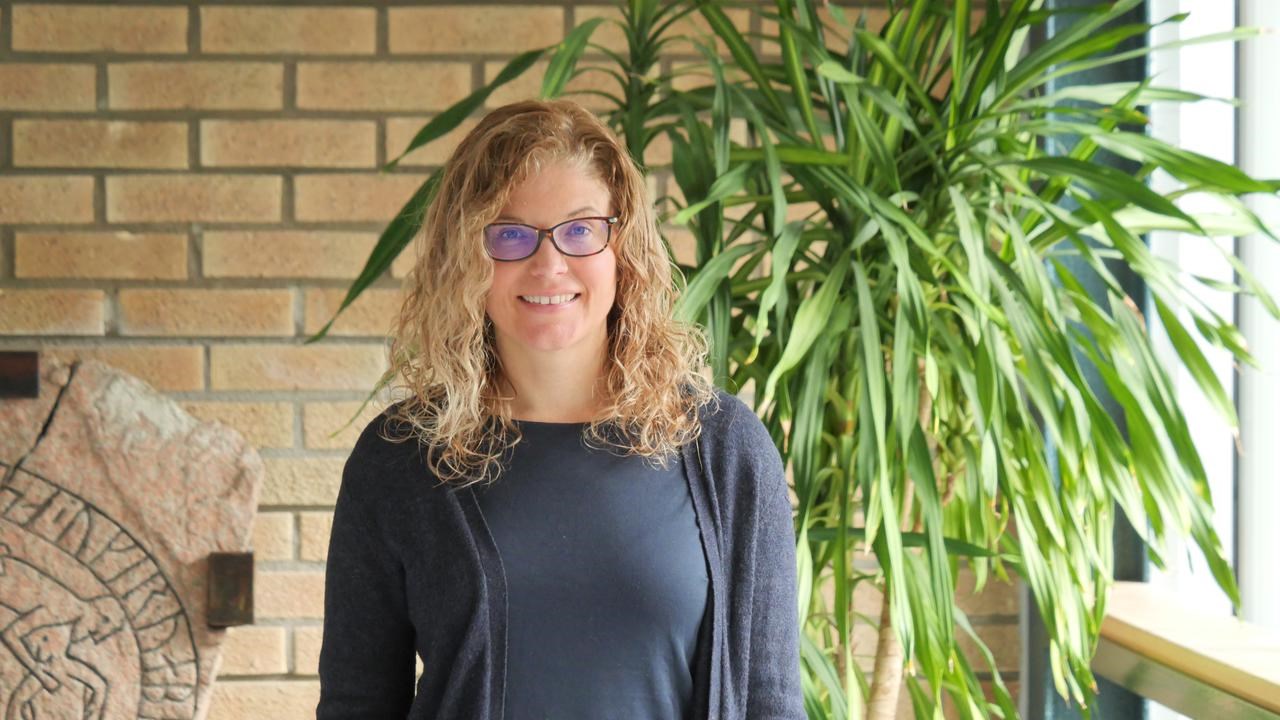
Lacey Okonski, Marie Skłodowska‑Curie Actions Fellow
ImageSandra LundströmCognitive linguistics explores how language, thought, and experience interact. Words and grammar are understood as grounded in how people conceptualize and experience the world. Key concepts include embodiment, metaphor, and language teaching and learning.
Embodied cognition argues that our whole body and our physical experiences influence our cognitive processes. Speakers regularly draw on their bodily experiences of space and movement to construe linguistic meaning in both metaphorical and non-metaphorical ways.
“Verbs such as kick, lick and pick are grounded in our understanding of our own experiences in performing these actions or observing others performing them", says Lacey Okonski.
Conceptual metaphors such as CHANGE IS MOTION, HAPPY IS UP and SAD/BAD IS DOWN can help learners to discover patterns between usage and body-world knowledge.
“The expression ‘I’m feeling down today’ commonly meaning someone is feeling sad or lacks energy, relies on the bodily grounding of verticality: the metaphor down draws on negative physical states of being sick or dead.”
Launched in August 2025 under the Marie Skłodowska-Curie Actions framework, the project Embodied Scenes addresses a persistent challenge in learning English as a second language: the usage patterns of prepositional constructions.
In two studies, the project tested a set of sample lessons targeting the preposition into which is understood as a metaphor grounded in physical containment and motion. For example, a bowl is a container that something can be put into and a country can go into a recession, metaphorically construed as entering a new state.
The lessons were piloted at two municipal upper-secondary schools in Umeå: Maja Beskowgymnasiet and Dragonskolan.
“Because English proficiency in Sweden is already high, we did not expect large effects. However, the results showed that the embodied scenes approach led to increased proficiency in the use of into, and this improvement was maintained over time.”
The project aims to produce profiles for several prepositions and to build lessons combining these profiles with an Embodied Scenes framework.
Metaphors are frequently used in the climate debate in the United States of America and previous studies have shown that climate metaphors resonate more so with Democrats than with Republicans. A 2025 article co‑authored with Claudia Gaele and Adan L. Martinez‑Cruz examined the effects of war metaphors in climate communication, such as the war against climate change, to combat excessive energy use and to kill the problems related to air pollution
The study found that such metaphors influence audiences differently depending on political affiliation.
“Our study shows that conservatives responded emotionally to the war metaphors, and they believed in the seriousness of the consequences, but they were less likely to increase in their support to take action against climate change. Liberals, by contrast, were more likely to take action. Both groups increased willingness to take action after exposure to the metaphors. Liberals were more likely to support international agreements to address climate change while conservatives were more likely to support taking individual actions to address climate change. The least popular climate action was boycotting businesses and the most popular was implementing tougher fuel efficiency requirements for vehicles.”
Lacey Okonski received her PhD from the University of California, Santa Cruz, is a Fullbright Fellow, and is currently a Marie Skłodowska-Curie Actions Fellow at the University of Oslo. During the spring semester 2026 she is a guest researcher at the Department of Language Studies, Umeå University.