

NEWS How can teachers develop their teaching in relation to the spaces they use? This is a central question in a new chapter in the International Handbook of Research on Learning Environments, co-authored by Åse Tieva, Director of the Centre for Educational Development (UPL).
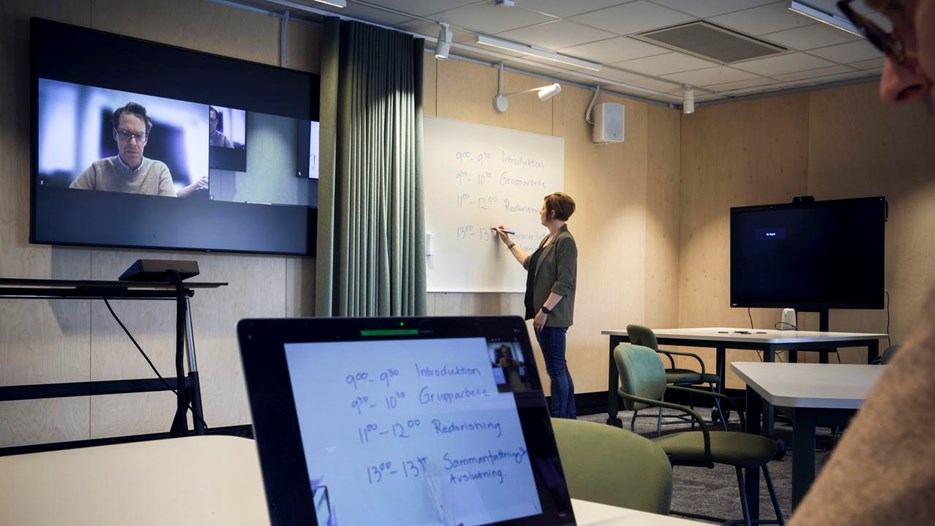
Åse Tieva in the former Learning Lab at Umeå university.
Image Nicke JohanssonThe chapter was written together with Marie Leijon at Malmö University, Magnus Hansson and Anna-Eva Olsson at Örebro University, and Elisabet Malvebo at the Swedish Naval Warfare Center and Malmö University.
The chapter builds on the Didactic Spatial Competence (DiSCo) model, developed by Leijon, Malvebo and Tieva. The model describes teachers’ didactic spatial competence, meaning their ability to plan, implement and develop teaching in different learning environments. It also introduces a visual tool, Room and Activity Diagrams, which helps teachers explore the relationship between spatial design and teaching activities.
“When developing teaching, we often focus on content and pedagogy, but the space also influences what we can do together. In this chapter, we show how teachers can make the interplay between learning environments and pedagogical practice visible and reflect on it,” says Åse Tieva.
Read more about the chapter “DiSCo in Space: Supporting Teachers’ Didactic Spatial Competence”
