

NEWS What do batteries and the final disposal of nuclear waste have in common? Maybe more than you think. Researchers at Umeå University are now bringing together expertise from two research fields to understand how ions move through solid materials. The project has received funding from the Carl Trygger Foundation and marks a step towards establishing research on solid-state batteries at the University.
In most batteries used today, ions move between the electrodes through a liquid electrolyte. This works well, but the liquid also comes with limitations. The solvent can be flammable, the electrolyte can freeze at low temperatures, and the fact that the electrolyte is liquid places constraints on battery design.
One alternative is solid electrolytes, in which ions are instead transported through a solid material. Such materials are of interest for future batteries, but they present a fundamental challenge: ions often have considerably more difficulty moving through solids than through liquids. This is where two seemingly quite different research fields at Umeå University began to converge.
The project is led by Andy Ohlin, Associate Professor at the Department of Chemistry, whose research includes electrochemistry and battery materials. The research group already works on sodium-ion batteries with liquid electrolytes. The new project is a step towards also establishing research on ion transport in solid materials.
The idea for the project grew out of discussions about whether clays could be used in metal-ion batteries. The relatively low ionic conductivity of clay led the researchers to a more fundamental question: what determines how ions move through solid and confined environments? Clay minerals turned out to be a particularly interesting system for investigating this question.
Michael Holmboe, also Associate Professor at the Department of Chemistry, conducts research in geochemistry and uses molecular simulations, among other methods, to study how water and different ions affect mineral surfaces. Such processes are important in research on the final disposal of nuclear waste, where swelling clay minerals can be used as a protective transport barrier. In the new project, different clay minerals will instead serve as model systems for understanding ion transport.
– At first glance, our research may seem very different, but in both cases it is really about ions, how they are transported and how they are stored in solid phases. With that in mind, collaborating was quite natural, and our expertise in the field is highly complementary, which makes a project like this particularly interesting,” says Andy Ohlin.
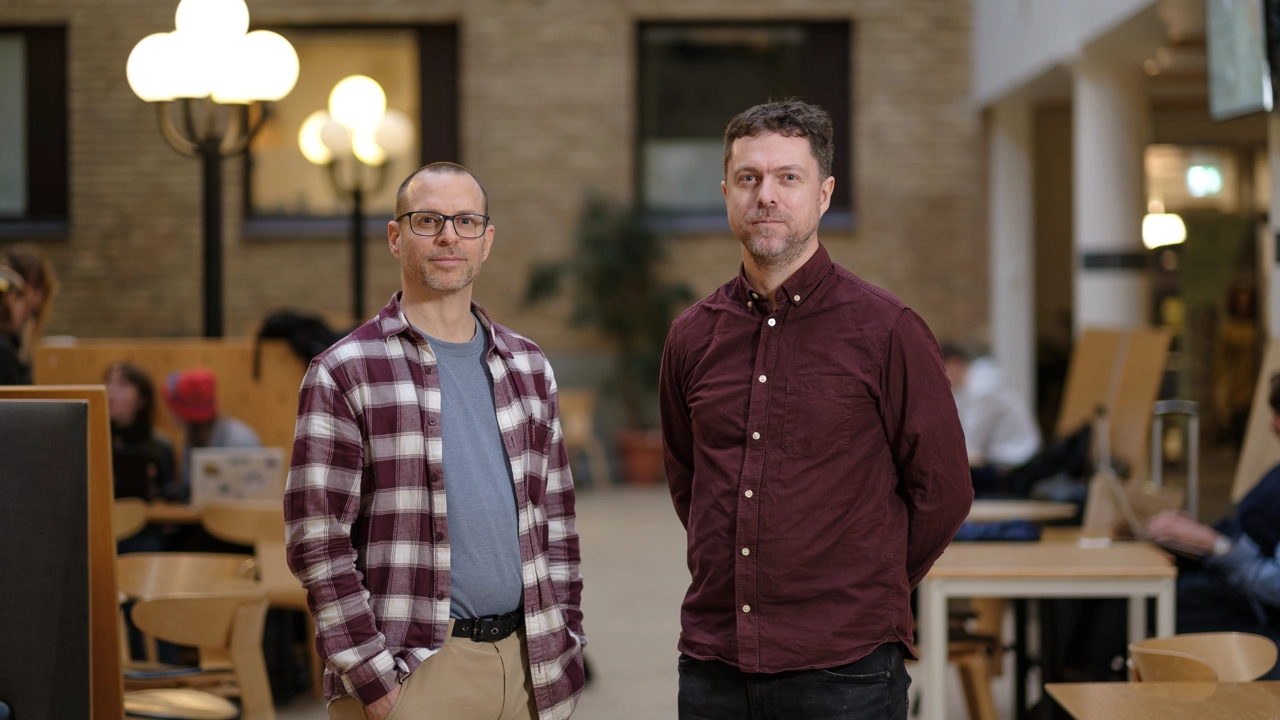
Andy Ohlin and Michael Holmboe at the Department of Chemistry.
ImageSimon JönssonThe researchers will study montmorillonite, a clay mineral in which ions and water occupy very small spaces between layers in the material. By varying the ions present in the clay, its water content and the temperature, the researchers can investigate which factors govern the movement of ions. A central part of the project is for experiments and computer simulations to study the same systems under conditions that are as similar as possible. Electrochemical measurements can show how effectively ions are transported through the material, while simulations can provide an atomic-level picture of what governs their movement. In this way, experiments can be used to improve and test the models, while the models can help interpret the measurements.
The researchers will investigate sodium, calcium and magnesium ions, among others, and how their movement is affected by the water content of the clay. The aim is not to find the clay with the highest ionic conductivity, but to understand why ion transport behaves the way it does.
–The measurements show what happens, while the simulations explain why. Together, they allow us to do something that neither method can achieve on its own: predict how ions will move before we have measured it. That knowledge can be applied far beyond mineral surfaces, says Michael Holmboe.
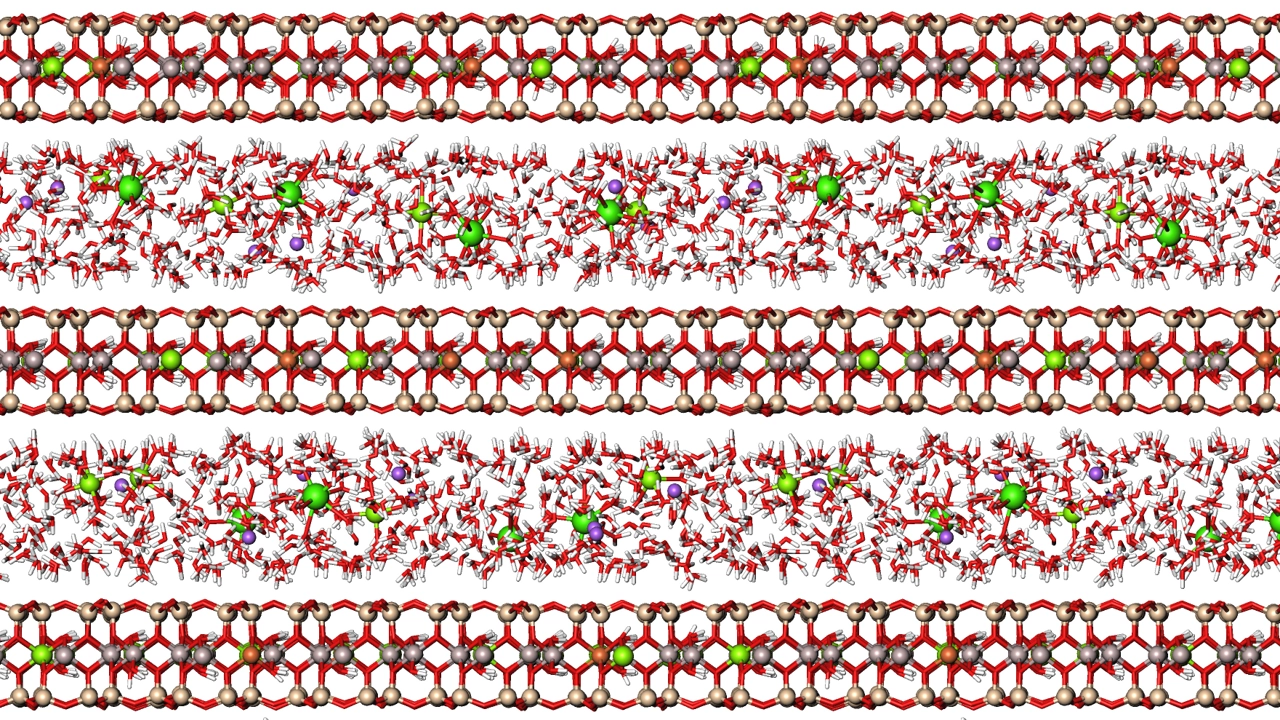
layers of clay with water-filled channels containing ions in between. The ions can bind both to water and to the surfaces of the clay layers, which affects how they are transported.
The project is funded by the Carl Trygger Foundation and includes funding for a postdoctoral researcher. For battery research at the Department of Chemistry, the project represents a broadening of scope and will build expertise in studying ion transport in solid materials.

