

Research network BRUM brings together researchers at Umeå University working on batteries, with a focus on sodium-ion technology: electrode materials, performance in cold climates, separators and solid-state electrolytes, as well as the recycling of lithium-ion batteries. The work is funded by the Swedish Research Council (Vetenskapsrådet), the Swedish Energy Agency, the Kempe Foundations and Toyota Motor Europe.
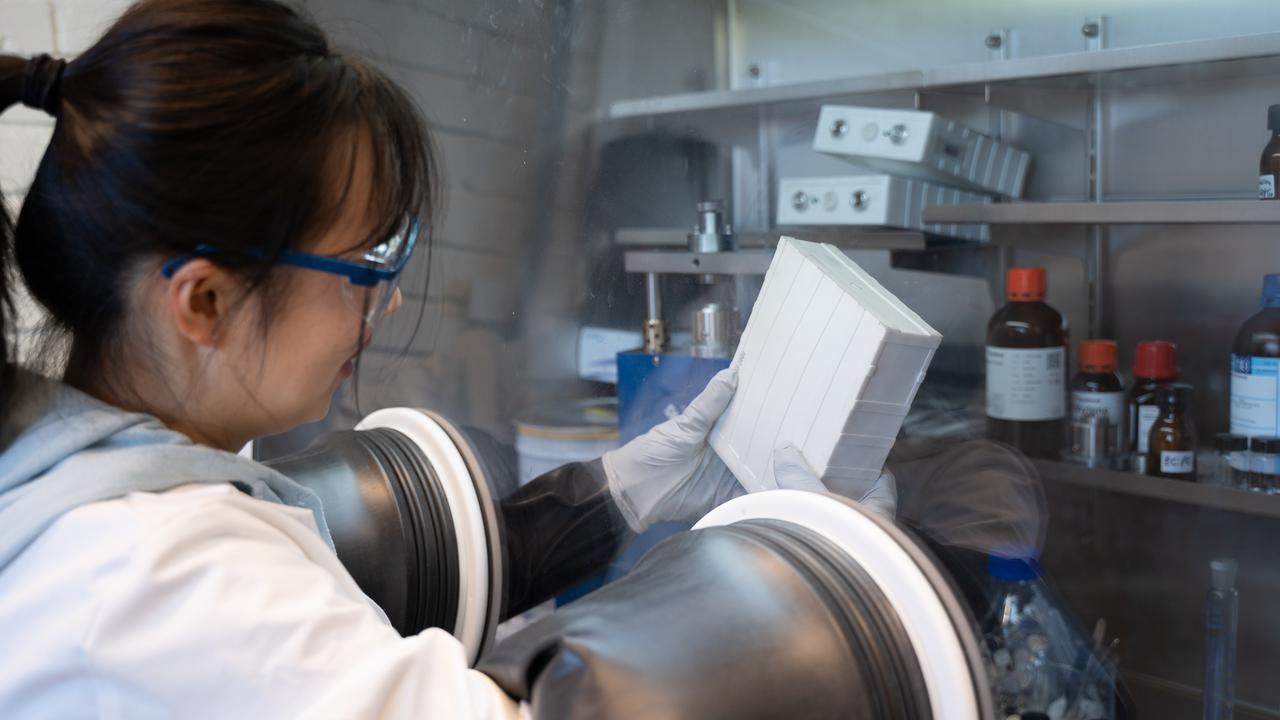
Sodium is abundant, cheap and geographically widespread. That makes sodium-ion batteries attractive for grid storage and for applications where cost and supply security matter more than weight. The technology is less mature than lithium-ion, and many of the materials developed for lithium do not carry over to sodium, so sodium-ion batteries need materials designed for them from the outset.
Battery performance drops sharply in the cold, which reduces both capacity and lifetime during a northern Swedish winter. In "Batteries for the North" (Kempe Foundations, JCSMK24-511, 2025–2027), research groups from the Departments of Chemistry and Physics, including that of Eduardo Gracia, develop new cathode, anode and separator materials to improve the low-temperature performance of sodium-ion batteries.
The voltage of a battery is set by the difference in redox potential between its two electrodes: the anode needs redox processes at low potential and the cathode at high potential. Both electrodes must also take up and release the sodium ion reversibly, and sodium is too large for graphite, the standard lithium-ion anode. Oxides of niobium, tungsten, vanadium, tantalum and molybdenum are attractive because these metals have several accessible oxidation states, so their redox potentials can be tuned through composition and structure. With support from the Kempe Foundations (JCSMK22-0094), we develop such oxides as electrode materials, in part by using polyoxometalates as molecular building blocks. We are also developing glass-ceramic electrode materials.
Lithium-ion batteries use well-established polyolefin separators, but sodium-ion batteries have no equivalent yet. Erfan Mehmandar Oskuei, a doctoral student at the department, is developing electrospun separators for sodium-ion cells. Electrospinning produces thin, highly porous fibre mats whose structure can be controlled during fabrication, which makes it well suited to tailoring a separator to sodium-ion chemistry.
Dr. Katarzyna Jankowska leads Project SEBASTIAN, funded by the Swedish Energy Agency (Energimyndigheten), which develops cellulose-based separators for sodium-ion cells. Dr. Jankowska is based at the Department of Chemistry, Umeå University.
Read more about the project here.
Xiaojing Xu, a doctoral student at the department, is developing a water-based method for recycling the components of lithium-ion batteries directly. It avoids grinding the batteries down and works across different lithium-ion battery types. The project is a collaboration with Toyota Motor Europe through the Industrial Doctoral School. Read more about the Toyota collaboration.
A battery is only as sustainable as the materials that go into it. We are exploring renewable and waste-derived feedstocks for battery components, including biomass from the boreal forest as a source of hard carbon, the standard anode material in commercial sodium-ion cells.
Replacing flammable liquid electrolytes with solids would make batteries safer, but the solid has to conduct sodium ions well and stay stable against both electrodes. Glass-ceramics are an attractive option because their conductivity can be tuned through composition and heat treatment. We are building on our glass-ceramic electrode work to develop glass-ceramic solid electrolytes.
Lorem ispum


