

NEWS How can AI provide police officers with better support in complex situations? In a unique interdisciplinary collaboration, researchers in Police Research and Computing Science at Umeå University have explored the opportunities and risks associated with using AI-based interactive systems in police work. The results show significant potential for integrating AI support into police interventions, but the researchers emphasise that human autonomy and ethical considerations must remain in focus.

Anders Schogster and Jonas Hansson, Unit of Police Work, collaborates in a research project with Juan-Carlos Nieves, the Department of Computing Science.
ImageJenny KarlssonThe research project is based on a close collaboration between Police Research and Computing Science. The project began when Juan-Carlos Nieves, a researcher at the Department of Computing Science, contacted Jonas Hansson and Anders Schogster at the Unit of Police Work. The study used Microsoft HoloLens to investigate how trustworthy AI and Mixed Reality can support police decision-making in real time. The headset makes it possible to project digital information directly into the police officer's field of view. The technology can be controlled through eye movements and voice commands and can, for example, be used to identify objects and potential risks.
The researchers emphasise that collaboration between the two units has been crucial for exploring responsible AI solutions for police work while also understanding the real needs of police officers. The researchers in Computing Science have contributed with expertise in AI, Mixed Reality and ethical assessment frameworks, while researchers in police work and practising police officers have contributed with operational experience and tactical knowledge.
The collaboration has been a very important part of the project. You need to understand police work in order to implement change
"We are not always aware of the possibilities offered by computing science, and computing scientists are not always aware of the needs within police work. The collaboration has been a very important part of the project. You need to understand police work in order to implement change," says Jonas Hansson, researcher at the Unit of Police Work.
A multi-staged study was conducted in collaboration with police education programmes and law enforcement agencies in Sweden and Catalonia. Before the practical tests, participants took part in two workshops. The first workshop introduced fundamental principles of trustworthy AI, while the second workshop gave the participants hands-on experience of Mixed Reality and HoloLens.
A total of 39 police officers and instructors participated in the study. During a tactical exercise, the participants carried out a high-risk vehicle stop using HoloLens as a support tool. The results showed that the police officers had a very positive attitude towards the system's usefulness, ease of use, and trustworthiness.
"The results were better than I expected. The police officers were very interested in the technology and saw many possibilities," says Anders Schogster, police officer and teacher at the Unit of Police Work.
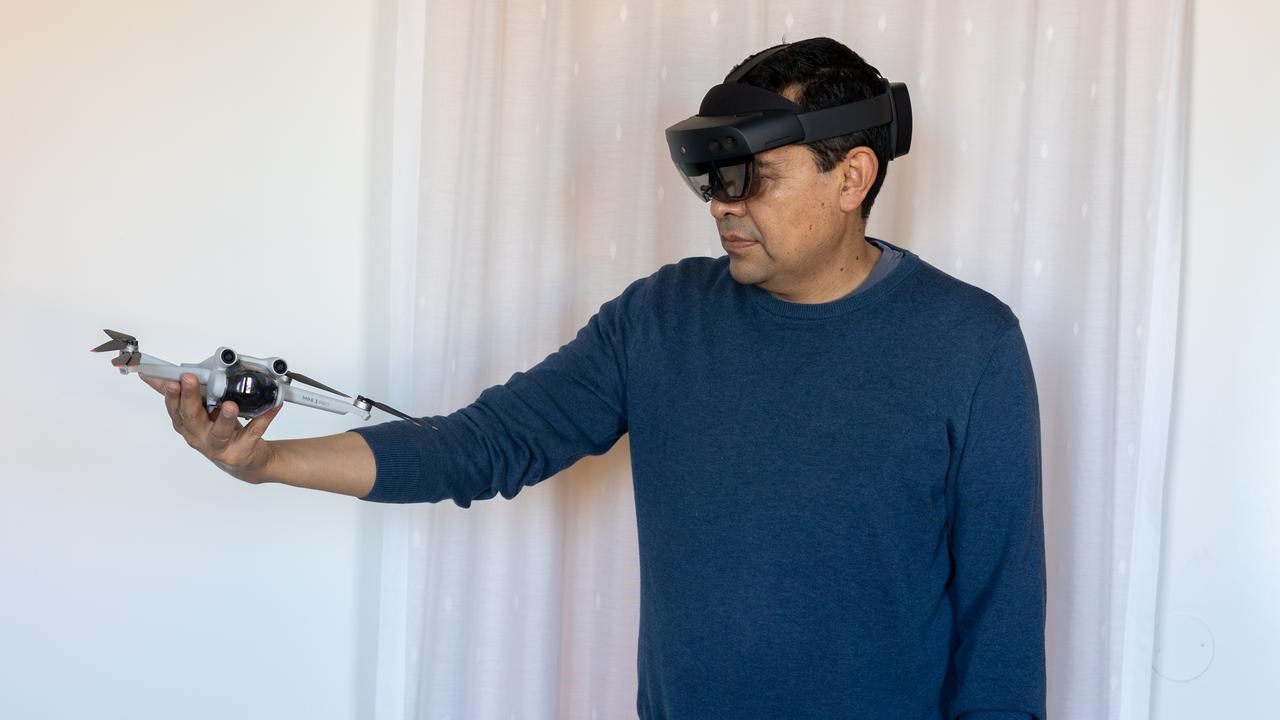
The AI-headset HoloLens was used to investigate how AI and Mixed Reality can support police decision-making in real time.
ImageJenny KarlssonThe technology offers considerable opportunities for improved decision support and increased safety during police interventions, but it also raises ethical questions. Juan-Carlos Nieves highlights the importance of ensuring that the systems are trustworthy, transparent and ethically designed to be able to be used responsibly. Potential risks include issues related to privacy, data storage and transparency, as well as the risk of algorithmic bias.
The researchers analysed the functions according to three risk levels, ranging from low to high. The study showed that as the system becomes more automated, the ethical risks related to privacy, transparency and algorithmic bias increase. A key conclusion is that the technology must never take over the police officer's own decision-making.
"It's important that this does not become fully autonomous. It should support police officers in their decision-making, but the decisions must ultimately be made by humans," says Jonas Hansson.
The researchers also conclude that simply introducing new technology is not enough. Police officers must be trained to critically assess its implications as well.
The researchers are now working on new project applications to continue exploring responsible AI, the relationship between digital and physical crime, and how future AI systems can be introduced into police operations.
In the long term, the researchers see a need to develop tools that can help decision-makers and the police assess risks when AI systems are procured and implemented. AI-based interactive systems for policing require carefully defined requirements to ensure that they can be used effectively while also adhering to the principle of ethics by design.
Jonas Hansson points out that traditional police work relies heavily on what police officers see, hear, feel and perceive in a given situation. The challenge is to find ways for digital information to complement these impressions without taking over. The researchers see considerable potential for integrating this type of technology directly into basic police training, allowing future police officers to learn at an early stage how to navigate both the opportunities and vulnerabilities associated with AI tools.
Read more about the project in the scientific article Trustworthy AI and Mixed Reality in Police Interventions: Challenges and Opportunities.
Reference:
Andreas Brännström, Eduardo García Laredo, Bernat Vivolas Jordà, Lola Valles, Jonas Hansson, Emili Martinez Cañaveras, Anders Schogster, David Martin-Moncunill, and Juan Carlos Nieves. 2026. Trustworthy AI and Mixed Reality in Police Interventions: Challenges and Opportunities. Journal of Artificial Intelligence Research 86, Article 12 (June 2026), 30 pages. doi:10.1613/jair.1.194611