

Facts
Cryogenic services is a part of Chem Store
Departments served: 7+
Average yearly supply: 60 000 litres
NEWS Understanding how plants produce oxygen and how viruses reproduce inside cells requires researchers to examine structures too small to see with an ordinary microscope. Cryogenic microscopy makes this possible. At Umeå University, a service within Chem Store supplies liquid nitrogen to 10 different departments, supporting their needs.
At the cryogenic facility, Oscar Montén works with as purchasing assistant. He is the contact for liquid nitrogen and cryogenic services at Chem Store, known in Swedish as Kemiförrådet. The store supplies university activities with laboratory materials, including liquid nitrogen and dry ice.
Each year, the cryogenic service supplies approximately 60 000 litres of liquid nitrogen to 10 different departments, centres and faculties.
– Every morning, we supply liquid nitrogen to the various departments at Umeå University, as well as to a number of external customers with links to the University. The amount required can vary considerably from day to day. Because liquid nitrogen is extremely cold (-196 °C), correct handling and appropriate protective equipment are essential. There is also a risk that, in the event of a spill, oxygen in the air can quickly be displaced. Adequate ventilation and oxygen alarms are therefore important safety measures, says Oscar Montén.
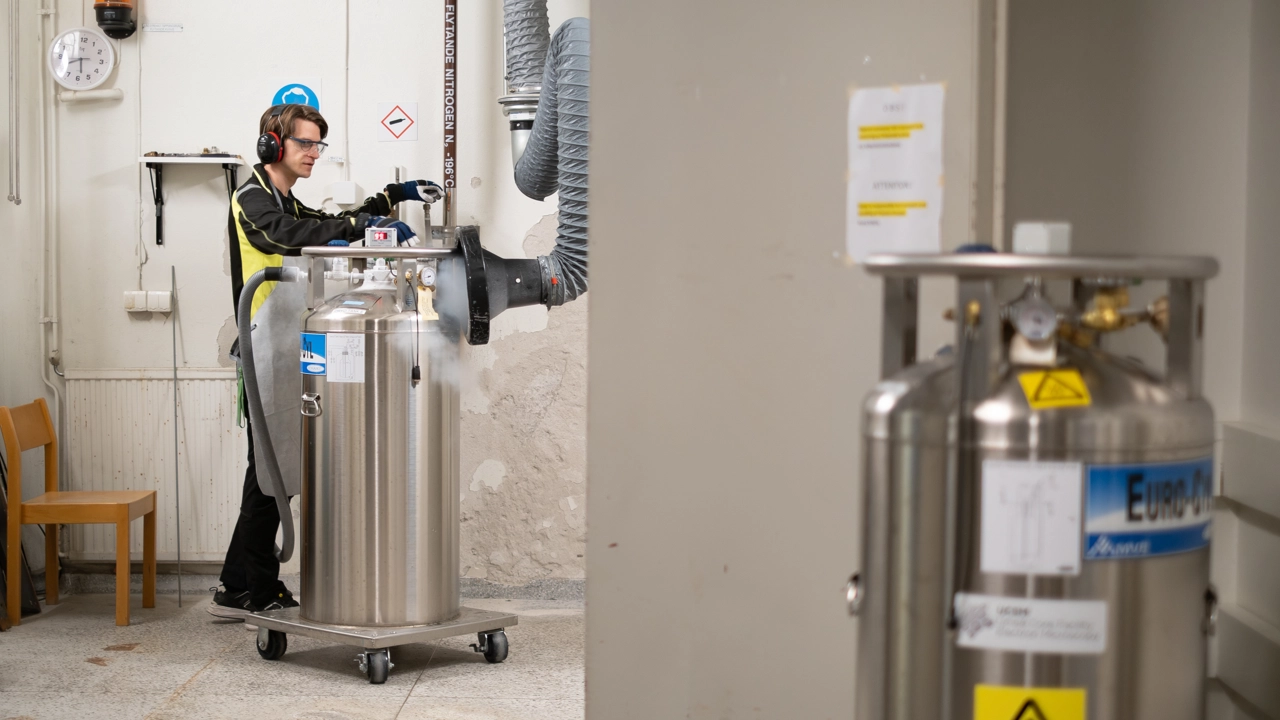
Oscar Montén filling up liquid nitrogen to the various departments and customers.
ImageSimon JönssonOne research method that relies on frozen samples is cryo-electron microscopy. At Umeå University, researchers have used it to investigate Photosystem II, the molecular machinery involved in photosynthesis. Detailed images have revealed water molecules and pathways within the structure, helping scientists understand how water reaches the site where it is split and oxygen is released.
The method also provides insight into infection. In a study of Langat virus, a less dangerous relative of the TBE virus, Umeå researchers rapidly froze infected cells and examined them using cryo-electron tomography. This allowed them to create three-dimensional images showing how the virus reorganises the inside of a cell to reproduce and form new virus particles.
The research group behind the virus study describes Umeå Centre for Electron Microscopy, UCEM, as a facility on which its cryo-electron microscopy research relies heavily on. UCEM is part of SciLifeLab’s national infrastructure for the method.
– The UCEM facility uses liquid nitrogen to freeze samples, e.g. protein or cells, mainly to analyze in our cryo-electron microscopes, Krios and Glacios. The liquid nitrogen allows us to condense ethane or ethane-propane mixture gas into a liquid form. The sample is then rapidly frozen in one of these liquids. We require this because this freezing process preserves protein and membrane structures, says Erin Schexnaydre, Staff scientist at Umeå Centre for Electron Microscopy.
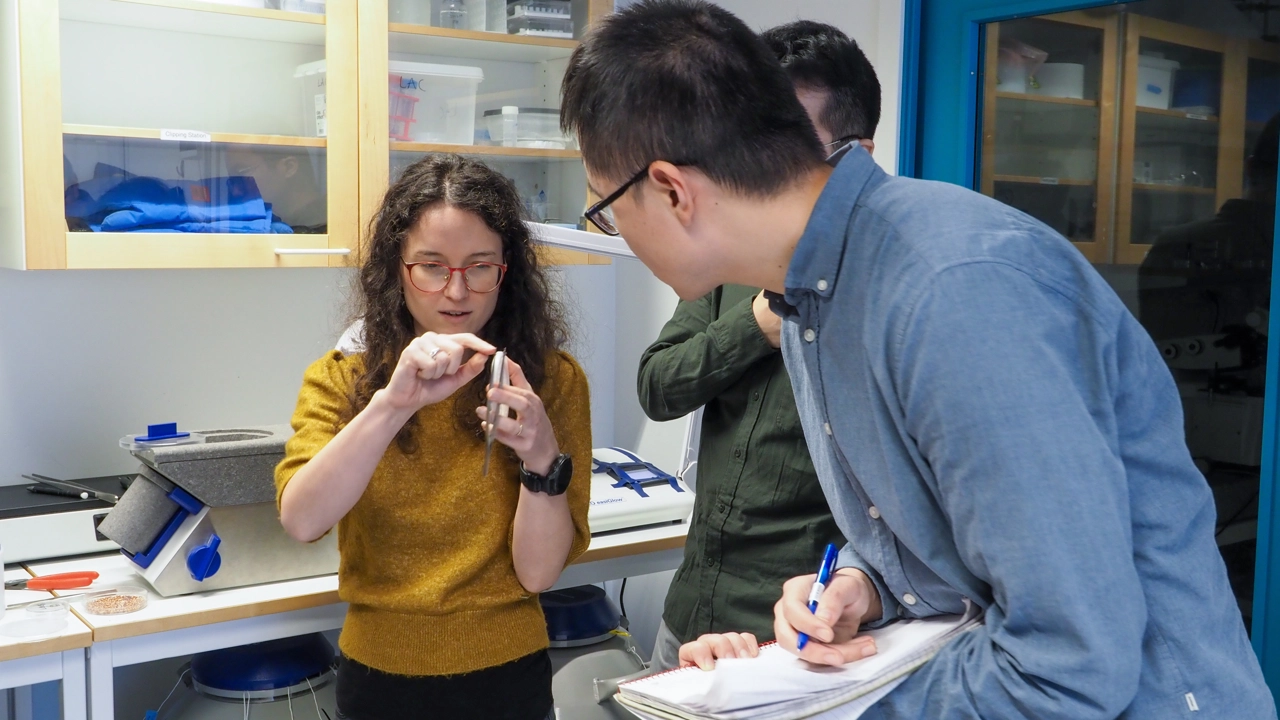
Erin Schexnaydre demonstrating sample preparation during the CryoEM sample preparation and data collection course in December 2024.
ImageRebecca Forsberg
The need for liquid nitrogen extends beyond individual research groups and even beyond Umeå University. The cryogenic service also supports research at Umeå Plant Science Centre, where it forms part of the Spruce Transformation Facility. The facility produces genetically transformed Norway spruce lines for research, a process that can take several months from transformation to plants ready for greenhouse growth. As part of the service, valuable somatic embryo cultures can be cryopreserved and stored at –150°C, allowing selected lines to be preserved for future research rather than continuously maintained as growing cultures.
– We use liquid nitrogen to preserve both research samples and embryogenic material, some of which represents many years of work. This allows us to safeguard valuable genetic resources and ensure they remain available for future research, says Sofie Johansson, coordinator for laboratory operations at Genfysl at the Swedish University of Agricultural Sciences.
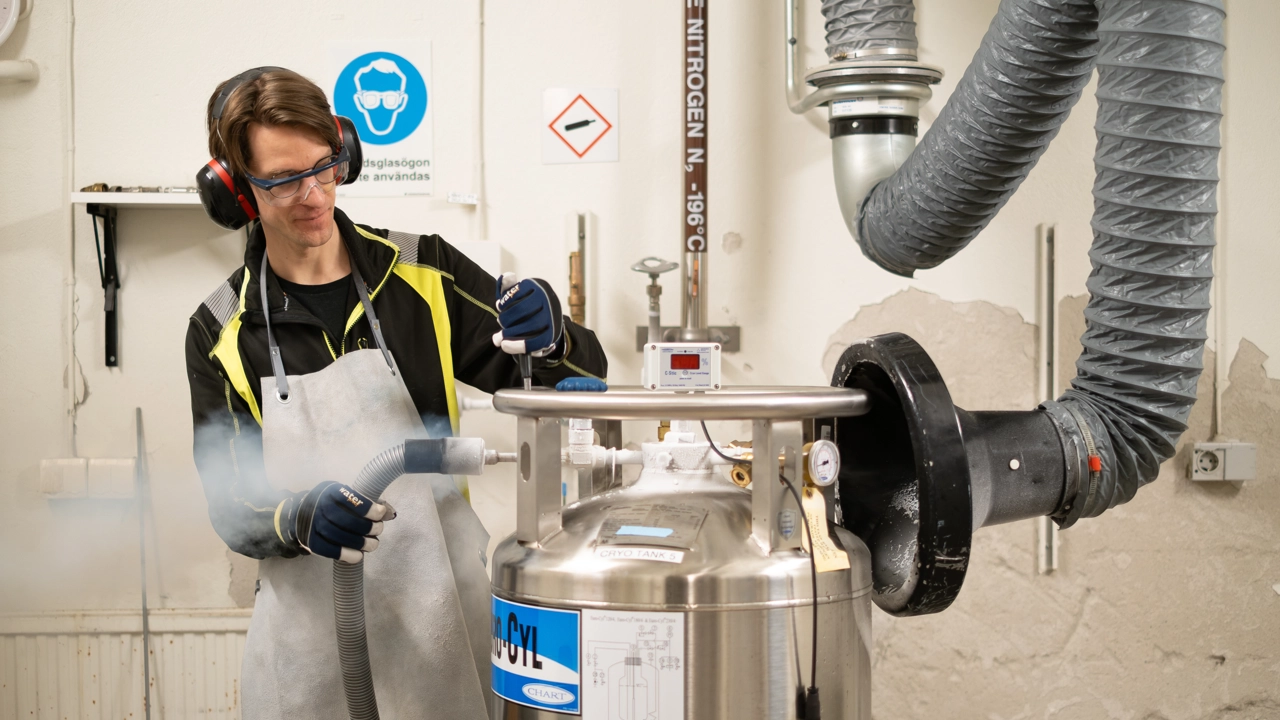
Oscar Montén keeping his gloves on at all times.
ImageSimon JönssonDemand varies considerably from day to day, but the deliveries continue every morning. Behind that routine is a considerable amount of coordination. Oscar keeps track of orders and deliveries across the different research infrastructures, helping ensure that liquid nitrogen is available when experiments, equipment and long-term sample storage depend on it.
Cryogenic services is a part of Chem Store
Departments served: 7+
Average yearly supply: 60 000 litres