
"False"
Skip to content
printicon
Main menu hidden.
Published: 2025-12-08

When Crises Amplify Each Other, Interdisciplinarity Becomes Crucial

NEWS For the second year, Umeå Transformation Research Initiative convened researchers from across disciplines for a full-day conference on sustainability and transition.This year’s theme centred on polycrises – how today’s interconnected crises influence and reinforce one another, and why interdisciplinary research is vital to addressing these global challenges.

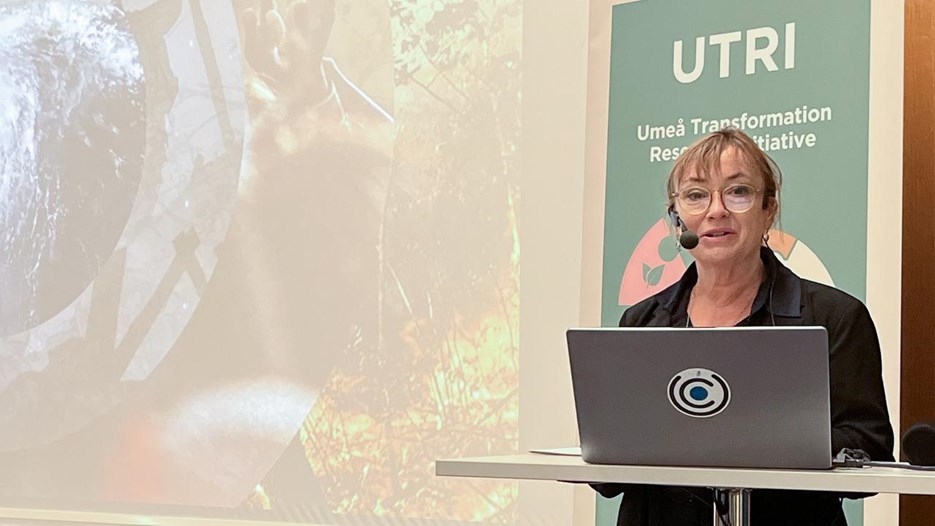
The conference began with an address by Tora Holmberg, Vice-Chancellor of Umeå University, highlighting the seriousness of a world where global warming is accelerating, wars and security crises unsettle societies, and democracy is challenged in places where it was once unquestioned.

“Academia has an important role in the complex world we inhabit. Science does not hold all the answers, but our mission is to question, develop knowledge, and contribute solutions. In times of polycrises and emergencies, we must point to new paths forward. Trust in science is high in Sweden, and we must harness that by disseminating knowledge and illuminating problems from multiple perspectives. Conferences like this are one way of doing just that,” said Tora Holmberg, Vice-Chancellor of Umeå University.

Small Changes, Big Consequences

Anne-Sophie Crépin from the Beijer Institute delivered the keynote address, stressing that we live within complex adaptive systems where changes occur at different speeds, and small shifts can have major consequences.

“The pandemic was a rapid transformation with immediate impact, but we must also remain alert to slow changes happening quietly. For example, increased precipitation in rainforests can lead to species loss and, over time, create entirely new ecosystems,” explained Crépin, further underscoring that uncertainty is a fundamental factor to consider.

“We cannot predict every change or control every process, and that is precisely why trust becomes critical. Trust between states, organisations, and individuals is key to sharing knowledge and acting swiftly and in coordination when crises arise. Without it, we risk losing sight of the bigger picture,” said Anne-Sophie Crépin.

Different Perspectives on Crises

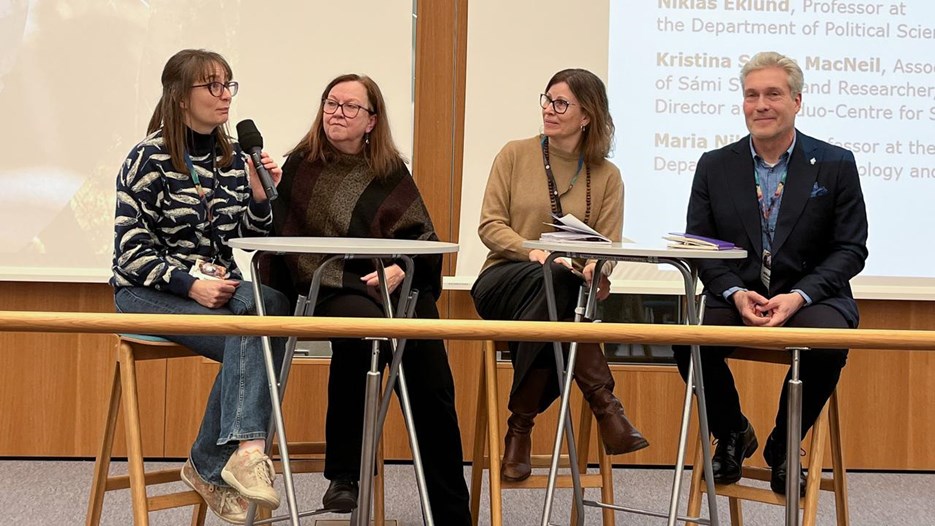
Trust also emerged as a recurring theme in the subsequent panel discussion featuring four researchers from different disciplines: Heidi Burdett, Senior Lecturer at the Department of Ecology and Environmental Science; Kristina Sehlin Macneil, Associate Professor and Deputy Director of Várdduo; Niklas Eklund, Professor at the Department of Political Science; and Maria Nilsson, Professor at the Department of Epidemiology and Global Health.

During their introductory presentations, the panellists highlighted diverse perspectives from their respective fields.

“For Indigenous peoples, crises are deeply intertwined with culture. In Australia, devastating wildfires coincided with the pandemic paralysing the country. Indigenous communities received very little support from the state, and studies have shown increased suffering and declining trust. A similar scenario is unfolding in Kiruna, where the future of reindeer herding and its cultural significance is challenged by mining interests in the name of the so-called ‘green’ transition,” said Kristina Sehlin Macneil.

Moderator Ola Nordebo posed a question about the future of academic freedom and how funding conditions affect it. Both Heidi Burdett and Maria Nilsson shared experiences of abrupt project funding cuts mid-project, a situation many colleagues have faced.

“I worry about academic freedom as much as I worry about the climate. It’s complex, and we have an increasingly centralised system that dictates what is considered important for funding and innovation. This development risks limiting diversity in research and, in the long run, undermining our ability to tackle global challenges,” explained Niklas Eklund.

A Broad Picture of the Research Landscape

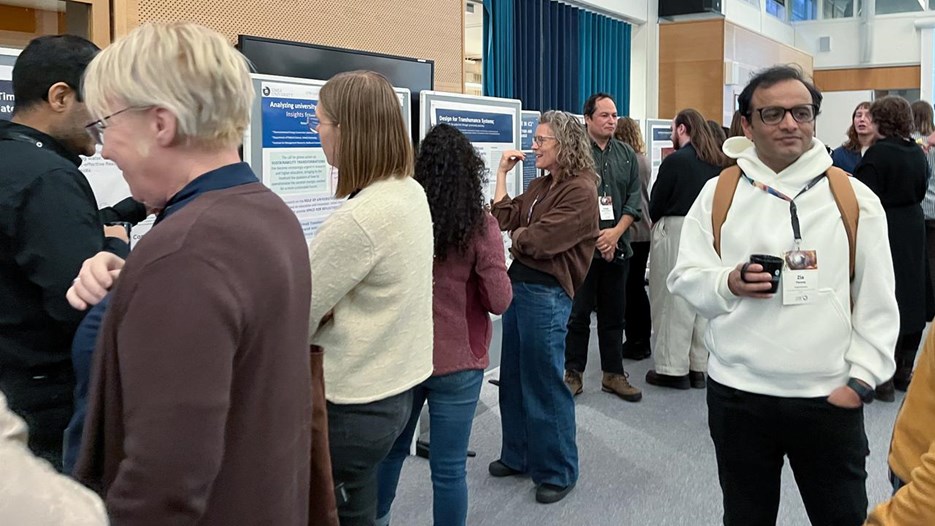
The conference also featured research posters from various disciplines. One was presented by Lieuwe Jan Hettema, a doctoral student in linguistics, who illustrated the complexity of developing language policies for Sámi in Swedish municipalities.

“I realised during the keynote how closely my work connects to the discussion on polycrises. By focusing on local language policy processes, I see that climate, language, and politics are tightly interlinked. To build resilience and social sustainability, it is crucial for municipalities to give the Sámi people influence over activities that affect them.”


The afternoon was devoted to parallel sessions where participants could choose different tracks. Topics included understanding Northvolt’s bankruptcy as a polycrisis, how climate change affects our perceptions of weather and seasons, and how disease outbreaks can be understood in relation to climate and economics.

Together, the sessions provided a broad picture of polycrises and how they are addressed from different research perspectives, spanning local societal challenges to global systemic transformations.

Save the Date for Next Year’s Conference!

Next year’s UTRI conference will take place on 26 November 2026. Mark your calendars now!

Contribute to the 2026 Conference

Would you like to help shape next year’s programme? Whether you attended this year or not, you can share your ideas on themes or formats by completing a short survey by 19 December: UTRI Conference 2025 Evaluation.