

Research group The group investigates how chemical reactions at mineral–water interfaces control key environmental processes, linking molecular-scale mechanisms to large-scale geochemical and climate phenomena. The work follows reactions from single molecules meeting mineral particles to processes spanning entire crystal surfaces.
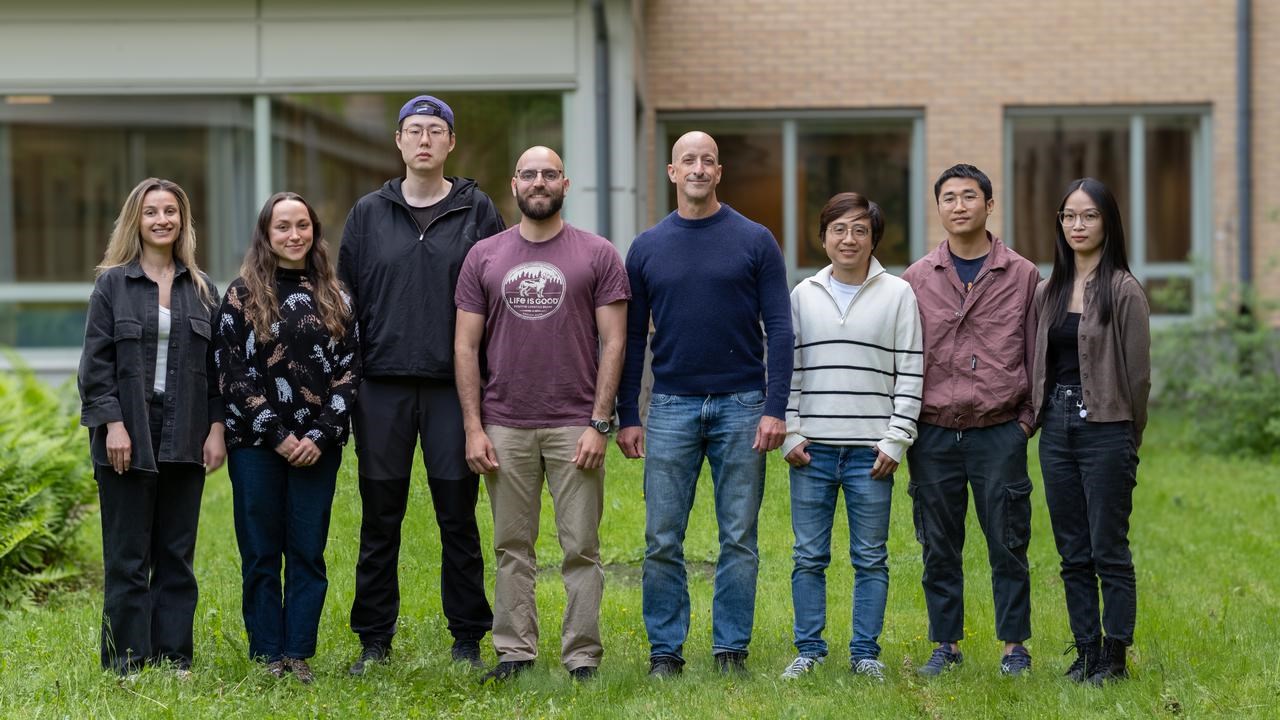
Jean-Francois Boily Lab, from left to right:
ImageSimon JönssonA central theme is the role of nanometre-thin water and ice films on mineral surfaces. This work challenges the traditional view of ice as chemically inert and shows instead that ice acts as a dynamic geochemical reactor. The group has demonstrated that ice can amplify mineral dissolution, generate reactive species such as Mn(III), and accelerate iron mineral transformations. These findings reshape understanding of weathering in cold environments, including Arctic systems and freeze–thaw cycles.
The research opens new routes for addressing climate challenges. Studies of CO₂ mineralisation in thin water films show how controlled interfacial processes, including ice formation, can enhance natural weathering and carbon capture, pointing towards scalable mineral-based mitigation strategies. In the Arctic, where rapid warming intensifies freeze–thaw cycles, the same work clarifies how minerals react in thin water and ice films. By showing that ice actively drives dissolution, redox reactions, and the movement of metals and contaminants, it strengthens predictions of effects on water quality and ecosystems in cold regions.
The group combines experimental and computational techniques to resolve interfacial processes at the molecular level. Spectroscopic tools (FTIR, Raman, sum-frequency generation, XPS) work alongside electrochemical methods (EIS, SECM) to characterise surface reactivity. Molecular simulations (molecular dynamics, density functional theory) extend these measurements into predictive understanding across scales.
Beyond fundamental discovery, the research supports functional geomaterials for environmental use, including:
By joining mechanistic insight with thermodynamic and kinetic modelling, the group turns fundamental science into predictive tools for environmental management, climate mitigation, and sustainable materials design.
Publications


Ice is not a passive freezer, it affects iron minerals in a warmer climate with frequent freeze-thaw-cycles.

Most people think of ice as frozen and lifeless, but research at Umeå University shows the opposite.

Arctic rivers are turning rusty orange as permafrost thaws.