

NEWS How do scientists study other planets? Could life exist beyond Earth? These were some of the questions explored when researchers from the Department of Chemistry took part in ForskarFredag. Part of the Europe-wide initiative European Researchers' Night, ForskarFredag brings researchers and the public together through hands-on activities, experiments and conversations that make science accessible and engaging for children and young people.

Merve, Zoe och Alef in their booth at ForskarFredag
Image Gabrielle Beans PicónThis year, researchers Merve Yeşilbaş, Alef dos Santos and Zoe Asimaki invited visitors to explore one of humanity's biggest questions: is there life on Mars?
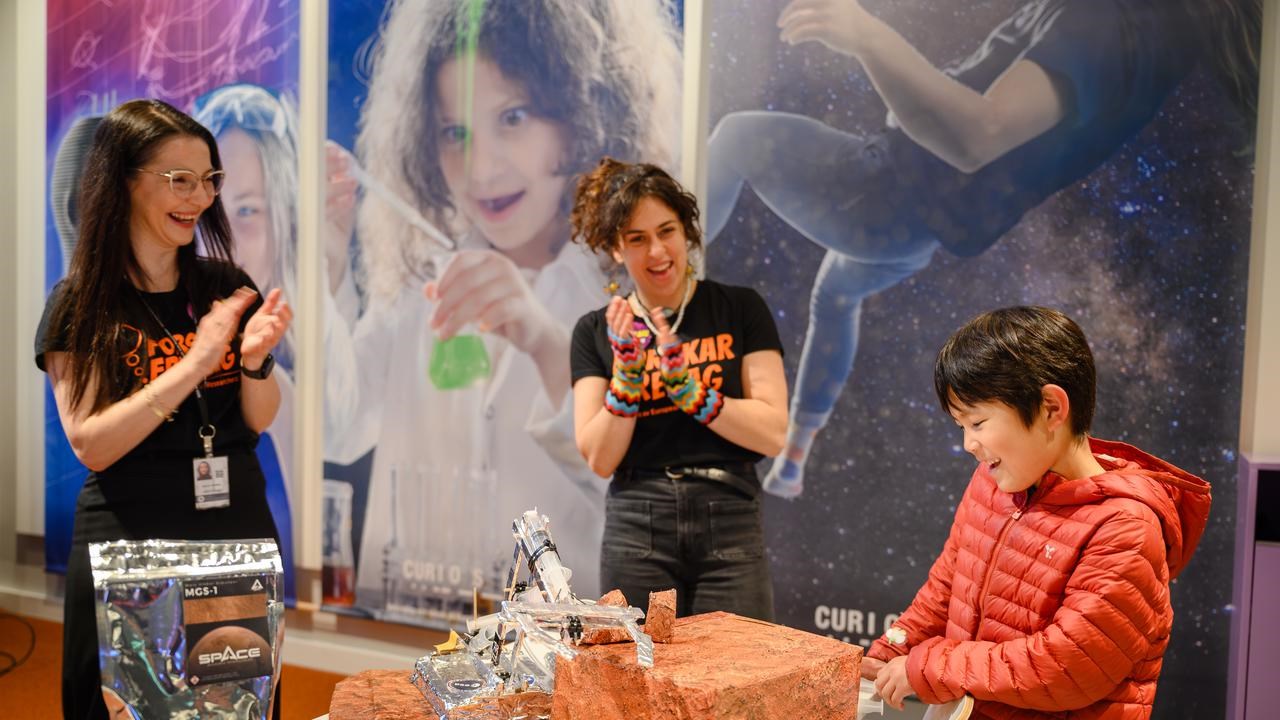
The team presented two interactive activities based on the search for life beyond Earth. In one activity, children used a hydraulic robotic arm built from syringes to simulate the work of Mars rovers. Their mission was to pick up a rock sample and move it to a designated analysis area before an incoming sandstorm could disrupt the rover's solar panels.
– The robotic arm was especially popular, says Alef dos Santos. The children had less than five minutes to complete their mission, which made the activity both challenging and fun. At the same time, we could explain how rovers collect information that scientists use to study Mars and investigate whether it supported life in the past or could support life today.
They also brought Petri dishes containing extremophilic microorganisms, organisms that can survive in some of Earth's most extreme environments. Visitors were first asked to draw what they thought extraterrestrial life might look like. After sharing their imaginative creations, they were introduced to the idea that life beyond Earth, if it exists, might be microbial rather than resemble the aliens often portrayed in films.
– Many of the children were surprised by the possibility that extraterrestrial life could be microscopic, says dos Santos. It sparked some really interesting conversations.
The activities proved highly engaging. Some visitors returned several times to attempt the robotic arm challenge again, eager to improve their performance and learn more about Mars exploration.
For dos Santos, the most rewarding part of the day was seeing the children's curiosity in action.
– The best part was seeing the children's reactions. It was fun to watch them get excited while controlling the robotic arm and then see their surprise when they learned that extraterrestrial life could be microscopic.
Participating in ForskarFredag is both rewarding and fun. By inviting young visitors to experiment, explore and imagine, researchers can help nurture curiosity and demonstrate that science is not only about finding answers, but also about asking questions.