
"False"
Skip to content
printicon
Main menu hidden.
Published: 2026-11-19

Newly discovered mechanism may help ovarian cancer cells silence tumour-suppressor genes

NEWS Researchers at Umeå University have discovered how chemical marks on RNA control a DNA methylation enzyme and contribute to the silencing of tumour-suppressor genes in ovarian cancer cells. The findings provide new insights into the disease and may, in the long term, contribute to the development of new treatment strategies for high-grade serous ovarian carcinoma.

In the new study, published in Science Advances, the researchers identify a previously unknown link between two systems that regulate gene activity in cancer cells. The study shows how METTL3, an enzyme that modifies messenger RNA, increases the production of DNMT1, an enzyme that methylates DNA and helps keep tumour-suppressor genes switched off.

Two regulatory systems are connected

Almost all cells in the body contain the same DNA, yet different cell types use different genes. Which genes are active can be regulated, among other things, through chemical modifications of DNA and RNA without altering the DNA sequence itself.

One such modification is DNA methylation, which can reduce or switch off the activity of certain genes. RNA can also be chemically modified, thereby affecting how genetic information is used to produce proteins. Both systems are important for normal cell function, but in cancer cells their regulation can change in ways that promote tumour growth.

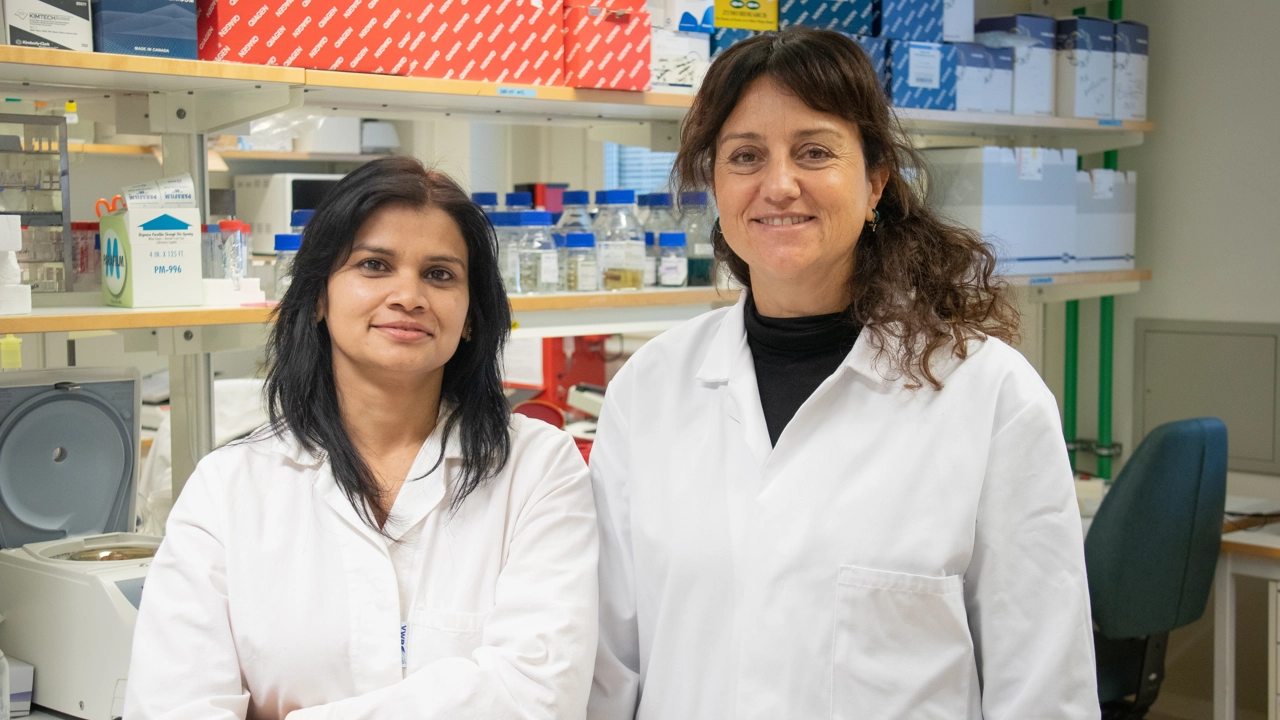
“Cancer cells can exploit processes that are normally required for cells to function properly and use them to promote uncontrolled growth and spread,” says Kanchan Kumari, postdoctoral researcher at the Department of Molecular Biology at Umeå University, the first and co-corresponding author of the study.

Until now, these two regulatory systems have largely been studied separately. The researchers have now investigated how they interact in high-grade serous ovarian carcinoma (HGSOC), the most aggressive and lethal subtype of ovarian cancer.

The researchers found that METTL3 adds a chemical modification to the messenger RNA that carries the instructions for producing DNMT1. This modification allows more DNMT1 protein to be produced without increasing the amount of messenger RNA. METTL3 therefore affects how efficiently the information in the RNA is used to produce DNMT1 protein. In this way, METTL3 also indirectly affects tumour-suppressor genes that DNMT1 helps keep switched off.

Reduced tumour growth when enzymes were inhibited

The effects were observed in both cell-based experiments and animal models. When METTL3 was inhibited, ovarian cancer cell growth and the cells’ ability to form colonies decreased. In a mouse model of ovarian cancer, reducing METTL3 delayed tumour development and reduced tumour growth.

When the researchers inhibited DNMT1, DNA methylation across the genome also decreased, while the activity of tumour-suppressor genes increased.

“Understanding the fundamental mechanisms of gene regulation is essential if we want to understand how a cell works and what goes wrong in cancer. If we do not understand the machinery, how can we hope to target it? In the long term, basic research can contribute to new treatment strategies,” says Francesca Aguilo, Associate Professor at the Department of Molecular Biology at Umeå University and principal investigator of the study.

Aggressive form of ovarian cancer

High-grade serous ovarian carcinoma is the most aggressive form of ovarian cancer and accounts for the majority of deaths from the disease. Because symptoms are often vague and there is no effective screening method, many patients are diagnosed only after the cancer has already spread. There is therefore a major need to identify new molecular targets for treatment.

The study was led by Francesca Aguilo and Kanchan Kumari at Umeå University in collaboration with international research partners, including the Hospital del Mar Medical Research Institute (HMRI) and the Josep Carreras Leukaemia Research Institute (IJC) in Barcelona, the Centro de Investigación Biomédica en Red Cáncer (CIBERONC) in Madrid, and the University of Chicago in the United States.

The research was funded by the Knut and Alice Wallenberg Foundation, the Swedish Research Council, the Swedish Cancer Society, the Kempe Foundations and the Cancer Research Foundation in Northern Sweden.

About the scientific publication:

Kanchan Kumari et al: METTL3-mediated m6A modification of DNMT1 enhances ovarian cancer progression..Sci. Adv.12,eaec2297(2026).DOI:10.1126/sciadv.aec2297

https://www.science.org/doi/10.1126/sciadv.aec2297?referrer=https%3A%2F%2Fwww.google.com%2F

For more information, please contact:

Francesca Aguilo
Associate professor
E-mail
Email
Kanchan Kumari
Postdoctoral fellow
E-mail
Email

Classification of the study

Cell model
Experimental study
Peer-reviewed