

NEWS Antibiotics are one of medicine’s greatest success stories, but they are now facing what may be their greatest threat yet. In a new book, Professor Jörgen Johansson describes how antibiotics have revolutionized health care, why resistance is spreading, and which paths may help us avoid a post-antibiotic future.
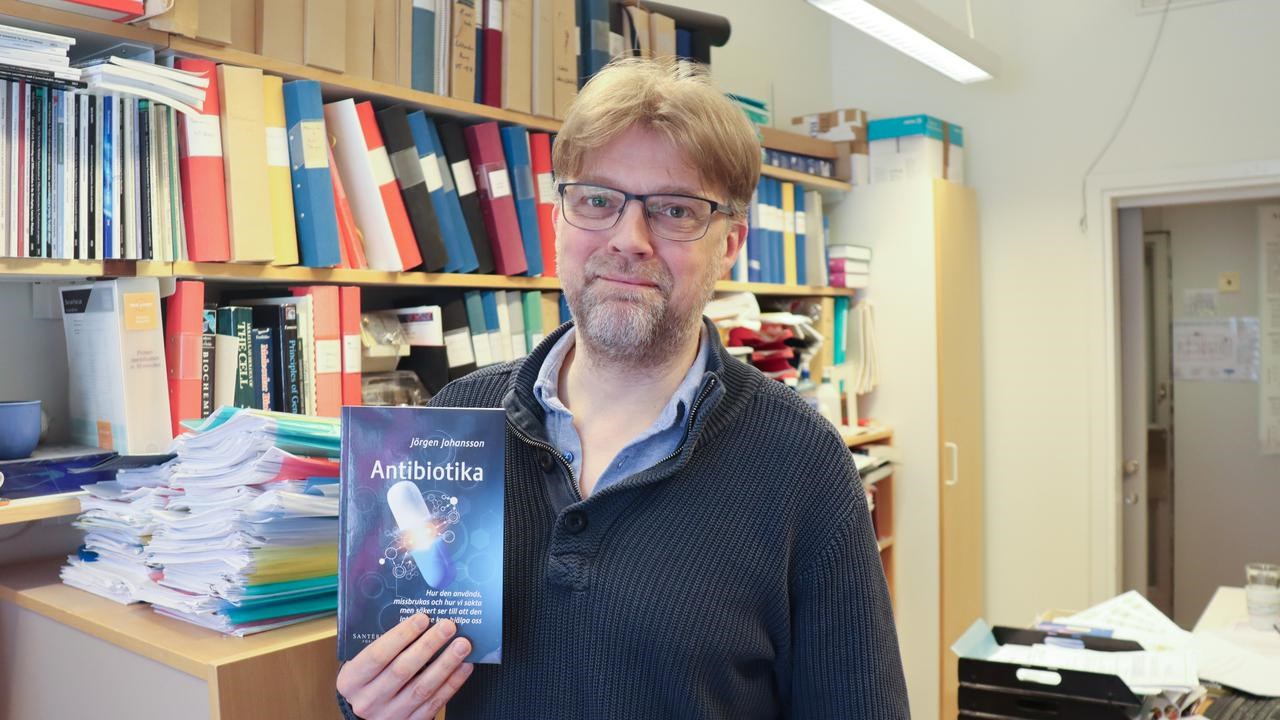
Jörgen Johansson, professor at the Department of Molecular Biology at Umeå University, began working on his book five years ago during the COVID-19 pandemic.
ImageIngrid SöderberghJörgen Johansson is Professor of Molecular Microbiology at the Department of Molecular Biology at Umeå University. His research focuses on how bacteria coordinate their ability to cause disease, using Listeria as a model system. Together with other researchers at Umeå University, he is also working to identify new types of antibiotics.
“After years of teaching at the university and giving popular science lectures, I realized that there is no comprehensive popular science book that explains antibiotics, how they work, and how bacteria develop resistance. I found that surprising, given that a new cookbook seems to be published every day in Sweden. Nothing against cookbooks, but I believe a book about antibiotics may be of real importance. Antibiotic resistance is often described as the ‘silent pandemic’ that will affect more and more people. That’s why it is crucial that the public understands what is happening and how it can be prevented.”
“My hope is that readers will gain a deeper understanding of how vital effective antibiotics are—not only for treating infectious diseases, but also for preventing infections in, for example, cancer patients undergoing treatment. Much of modern health care, including advanced surgery, organ transplantation, and cancer therapies, is critically dependent on functioning antibiotics. We therefore need antibiotics that continue to work, even here in Sweden, where people relatively rarely die from infections.”
“Since all antibiotic use ultimately contributes to increased resistance, I hope the public will become more cautious about ‘demanding’ antibiotics for minor colds. That said, Sweden – and Västerbotten in particular – is already fairly restrictive in its use of antibiotics compared with many other countries.”
“That antibiotic resistance is a real problem that must be addressed at every level. Unfortunately, many people still believe that all infections, including viral ones, can be treated with antibiotics. It is also important to emphasize that we should not be afraid of bacteria. In many ways, bacteria are our best friends: the bacteria in our gut help us absorb nutrients and protect us from harmful microbes. In short, we should only eliminate bacteria that are in the wrong place in the body. When we lose the ability to do that, problems arise very quickly.”
“The increasing development of resistance is alarming. For example, Klebsiella bacteria isolated from war-injured patients in Ukraine have been found to be resistant to all antibiotics normally used to treat infections caused by that bacterium. Unfortunately, there is a significant risk that such multi-resistant bacteria will cause increased suffering in Ukraine and neighbouring countries, and that they may eventually reach Sweden as well.”
“I think that politicians in Sweden are generally quite aware of the problem. Unfortunately, this is similar to the climate crisis: bacteria do not respect national borders, and real change requires greater international coordination. A major challenge is that far too few new antibiotics or alternative treatments are being developed, largely because the financial incentives are too weak. This is beginning to change through various initiatives, but progress is still too slow.”
“At the same time, developing new antibiotics is something of an ‘artificial respiration’ measure – we know that bacteria will eventually develop resistance even to new drugs. This means that we need continuous innovation in antibiotics and treatment strategies, while also working to limit the spread of resistance. A combination of both approaches is likely the most effective. There will probably never be a single ‘silver bullet’ that solves all the problems.”
“That’s a good question. Nothing is being done entirely wrong, but things are moving too slowly. It would be beneficial to launch more initiatives, for example at the EU level, to strengthen incentives for pharmaceutical companies to develop new antibiotics or treatment approaches. However, this will require substantial funding.”
“When it comes to new treatment alternatives, various forms of bacteriophage therapy are particularly interesting and could potentially revolutionize future health care. A bacteriophage is a virus that attacks specific bacteria, meaning that only certain disease-causing bacteria are eliminated, while beneficial bacteria are left intact. There are likely other, yet undiscovered strategies that could help remove harmful bacteria. This is why curiosity-driven basic research is so important, allowing researchers the freedom to formulate new questions.”
“My (perhaps naive) hope is that each copy of the book will be read by several people – especially those who do not normally read popular science. A request from me as an author: once you have finished reading, feel free to pass the book on to a friend, a family member, or donate it to a second-hand shop so that more people have the chance to read it. Wear it out.”
