

"False"
Skip to content
printicon
Main menu hidden.
Published: 2026-02-02

Reshaping gold leads to new electronic and optical properties

NEWS By changing the physical structure of gold at the nanoscale, researchers can drastically change how the material interacts with light – and, as a result, its electronic and optical properties. This is shown by a study from Umeå University published in Nature Communications.

Gold plays a crucial role in modern advanced technology thanks to its unique properties.

New research now demonstrates that changing the material's physical structure – its morphology – can fundamentally enhance both its electronic behaviour and its ability to interact with light.

“This might make it possible to improve the efficiency of chemical reactions such as those used in hydrogen production or carbon capture,” says Tlek Tapani, one of the leading researchers behind the study and doctoral student at the Department of Physics.

Absorbs more light energy

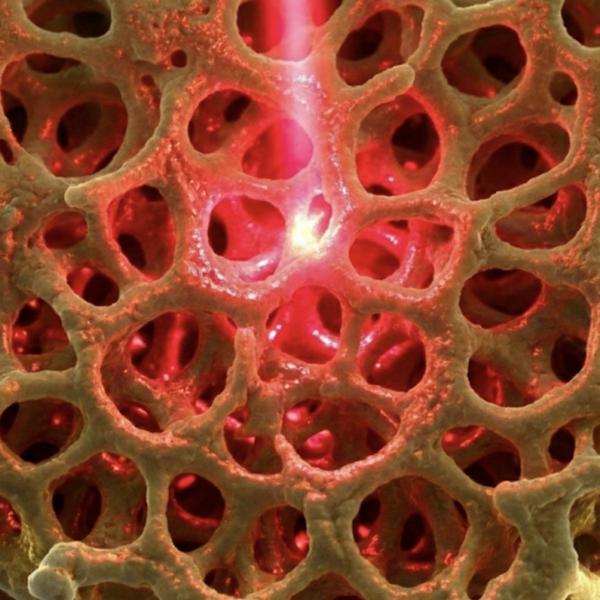
The researchers worked with nanoporous gold, a so-called metamaterial produced in a laboratory. Thanks to its sponge-like structure, nanoporous gold has even better properties for technical applications than ordinary solid gold.

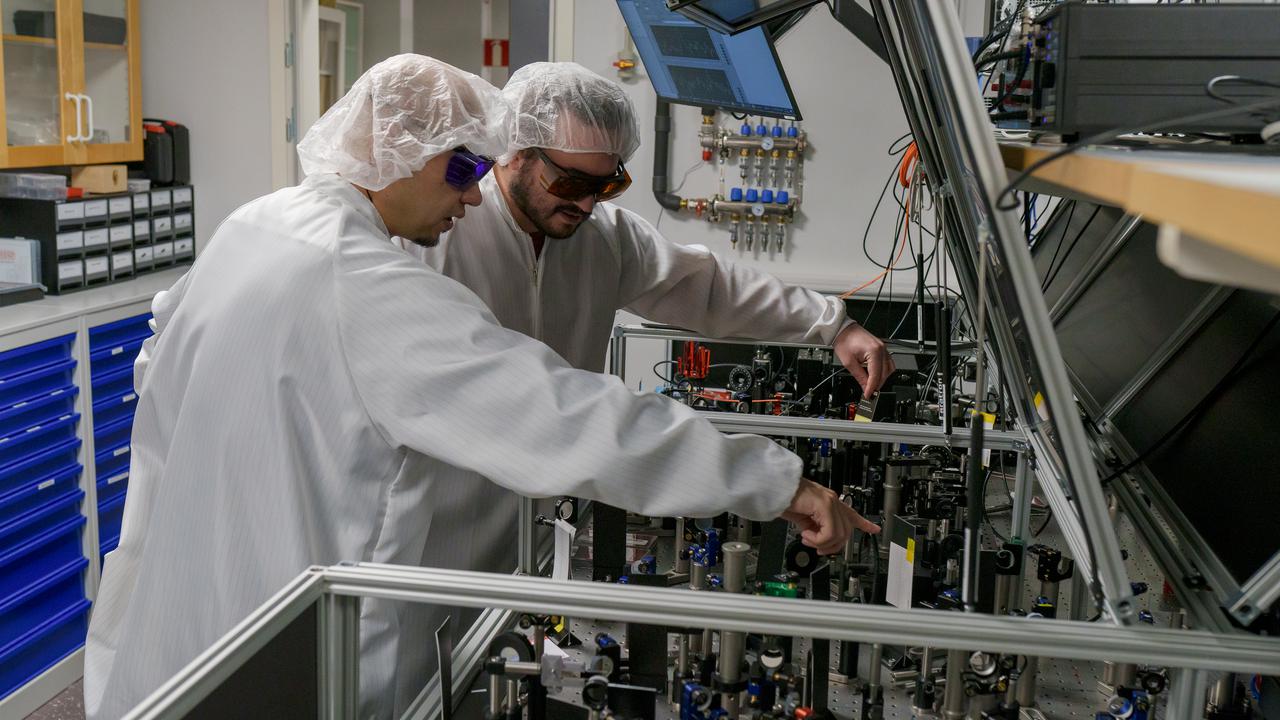
In this study, the researchers observed that a thin film of nanoporous gold interacts with light in ways that solid gold cannot. By exposing the "gold sponge" to ultrashort laser pulses, they found that the porous structure allows the material to absorb more light energy over a wider spectrum.

As a result, the electrons become considerably more energetic. The electronic temperature was estimated to reach about 3200 K (~2900 °C) in the nanoporous film, compared with just 800 K (~500 °C) in the unstructured gold film used as a reference, under the same conditions. It also takes longer for the "hot" electrons to cool down and return to their initial state at room temperature.

“Such elevated electronic temperatures enable light induced transitions that would otherwise be nearly impossible,” says Nicolò Maccaferri, leader of the Ultrafast Nanoscience Unit at the Department of Physics and senior author of the article. “Interestingly, using advanced electron microscopy and X-ray photoelectron spectroscopy experiments (XPS) here at Umeå University, we were able to confirm that these unique behaviours are driven solely by the material's physical shape and not by changes to the electronic structure of gold itself.”

Can be extended to other materials

The experiments suggest that nanoporous structure can be used as a new design parameter to engineer materials used in advanced technologies. By systematically varying the filling factor (the ratio of gold to air in the “sponge"), researchers can tune the electronic behaviour of not only gold but also other metals in a controllable way, which could improve the efficiency of chemical reactions.

“Our research shows that by manipulating a material's architecture at the nanoscale, we can use structure itself as a design parameter,” says Nicolò Maccaferri. “These results can be generalised, in principle, to every material, with implications in how we design smart materials for sustainability and technology, with applications spanning from catalysis to energy harvesting, medicine and quantum batteries.”

About the scientific study

Tlek Tapani, Jonas M. Pettersson, Nils Henriksson, Carla M. Brunner, Ann Céline Zimmermann, Erik Zäll, Nils V. Hauff, Lakshmi Das, Anastasiia Sapunova, Gianluca Balestra, Massimo Cuscunà, Aitor De Andrés, Tommaso Giovannini, Denis Garoli & Nicolò Maccaferri. Morphology-modified contributions of electronic transitions to the optical response of plasmonic nanoporous gold metamaterial. Nature Communications 17, 829 (2026). DOI: 10.1038/s41467-026-68506-0

Read the full study

On 27 February, Tlek Tapani defends his thesis entitled Fast and Furious - Ultrafast electron dynamics in disordered nanostructures

Contact

Nicolò Maccaferri
Associate professor
E-mail
Email
Tlek Tapani
Doctoral student
E-mail
Email