

NEWS When the season’s first IceLab Lunch Pitch kicked off, it was molecular biologist Johan Henriksson who took the stage. He needs collaborators who can develop algorithms capable of handling and completing millions of microbial gene sequences. In his research, a single sampling event generates such a massive amount of data that today’s analytical methods are no longer sufficient.
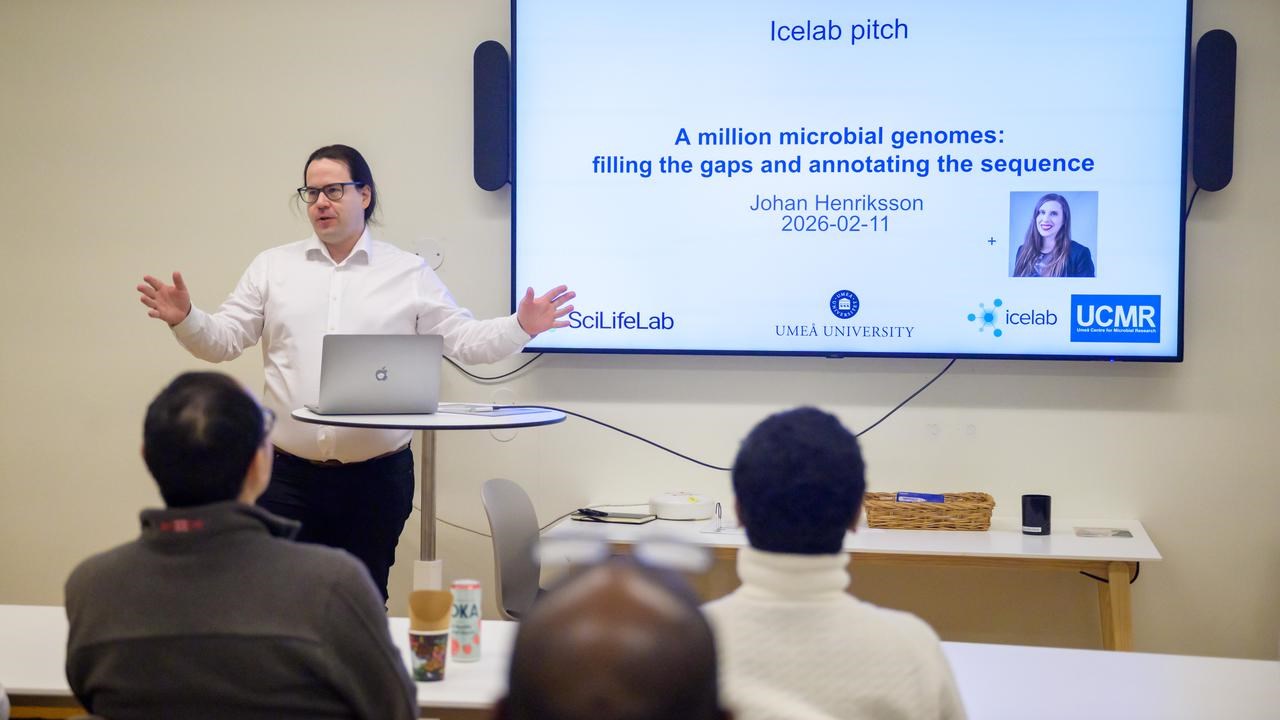
Johan Henriksson believes that the Lunch Pitch format is one of the better ways we have to create new collaborations between researchers from different disciplines.
ImageGabrielle Beanswe will become increasingly dependent on expertise from other disciplines
“Our research group is always looking for collaborations, and our problems range from quite tough mathematics to equally challenging programming. For the next generation of biology, we will become increasingly dependent on expertise from other disciplines, since we simply cannot fit all the necessary knowledge into a single lab,” says Johan Henriksson, research fellow at the Department of Molecular Biology at Umeå University.
The Lunch Pitch series, organized by IceLab at Umeå University, is designed to gather researchers from different fields during a lunch break for short, focused presentations that spark conversations and drive new collaborations.
Johan Henriksson sees the format as fully aligned with the future of biological research. He refers to sociologist Max Weber, who already in the late 19th century argued that society would become increasingly specialized – so specialized that individuals would no longer be able to grasp the bigger picture. According to Johan Henriksson, this development has only accelerated.
At the centre of Johan’s presentation was a new method developed by his team that can capture many, yet only a small subset of, up to one million bacterial genome sequences at the same time. By being able to study so many bacteria, one at a time, it becomes possible to understand, for example how antibiotic resistance develops.
“This is an absolutely insane amount of data, and we need new tools to analyse it. Right now we are studying one cell at a time, and that does not work very well when the data is so sparse.”
The goal is to develop a machine learning model, algorithm, or data structure that can represent the underlying shared genetic variation and fill in the missing information between sampled cells.
“From there, we might also be able to annotate the genetic sequence in a single step, for example identify which genes are present and what they do.”
Johan Henriksson is eager to collaborate with researchers in machine learning, sparse linear algebra, vector databases, or advanced data structures. He also sees potential within federated data processing.
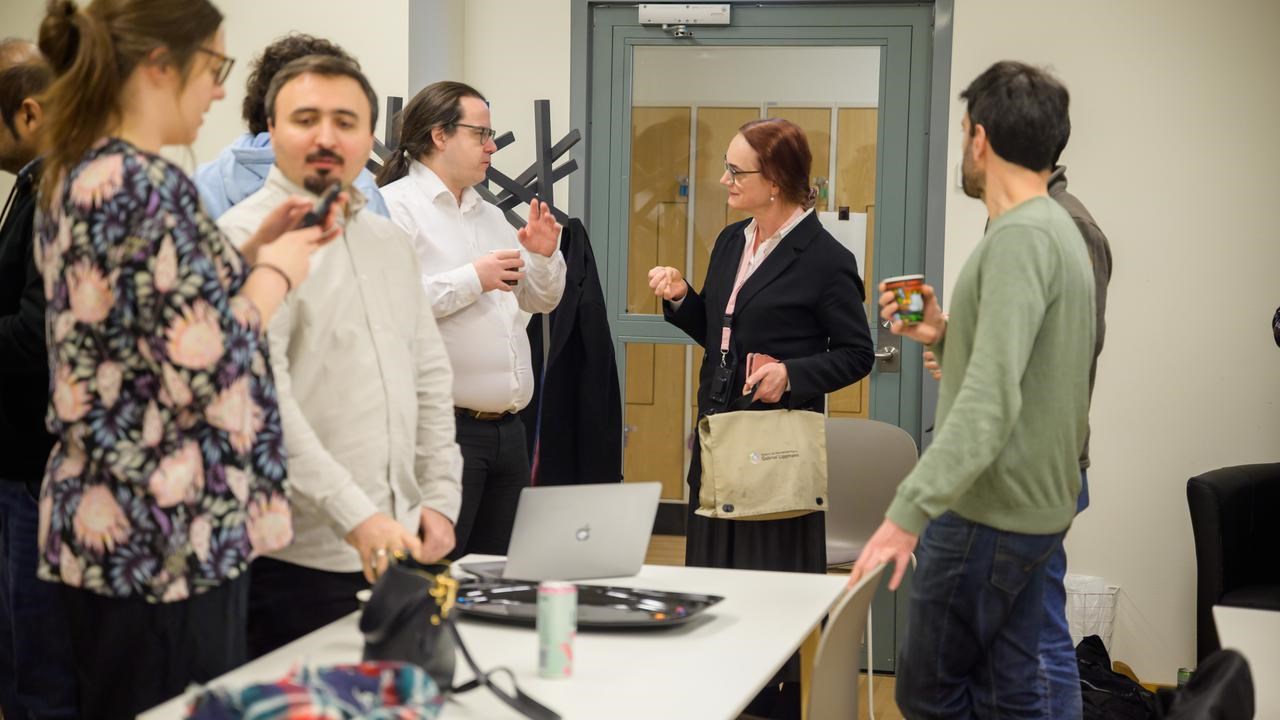
The Icelab lunch pitch is followed by lively discussions.
ImageGabrielle BeansSpeaking to a broad interdisciplinary audience is always a challenge, he notes.
“You have to distill the essence of your problem. What you find most interesting is not necessarily what captures the audience’s attention. But that is also precisely why you pitch. You present problems that others may find exciting and that require different kinds of expertise.”
He continues:
“There may even be users (biologists) who now realize the possibilities we have. This is a promising area where we have a chance to take the lead, so anyone with business sense should get on board.”
Despite the fact that creating new collaborations is never easy, Johan Henriksson believes that the Lunch Pitch format is one of the best ways to ignite the spark.
“Honestly, it is not easy, but it is probably the best we can do. A pitch is only the beginning of a conversation. Then the real work begins, when both sides must learn enough about the problem to contribute to a solution. The devil is always in the details.”
For him, the true strength of the event lies in its ability to gather open‑minded researchers in the same room.
“Now we just need to turn words into action!”
