




"False"
Skip to content
printicon
Main menu hidden.
Published: 2026-04-21

New research reveals cell proteins that drive severe viral infections

NEWS Researchers at Umeå University have identified two human cell proteins, NUP98 and NUP153, that play a crucial role in how viruses such as tick-borne encephalitis virus (TBEV), West Nile virus, and dengue virus replicate in the body. The findings challenge existing views of how these viruses exploit human cells and point to new, promising targets for future antiviral drugs.

By understanding which human proteins viruses hijack, we can identify new ways to stop infection

“Viruses have very small genomes and are completely dependent on the host cell’s machinery. By understanding which human proteins viruses hijack, we can identify new ways to stop infection,” says Anna Överby Wernstedt, Professor at the Department of Clinical Microbiology at Umeå University, who led the research project.

TBE virus, West Nile virus, and dengue virus belong to a closely related group of flaviviruses and cause illness in millions of people worldwide every year. Despite the substantial disease burden, there are still no approved antiviral drugs. One alternative strategy is therefore to target the host cell’s own proteins that viruses depend on for replication.

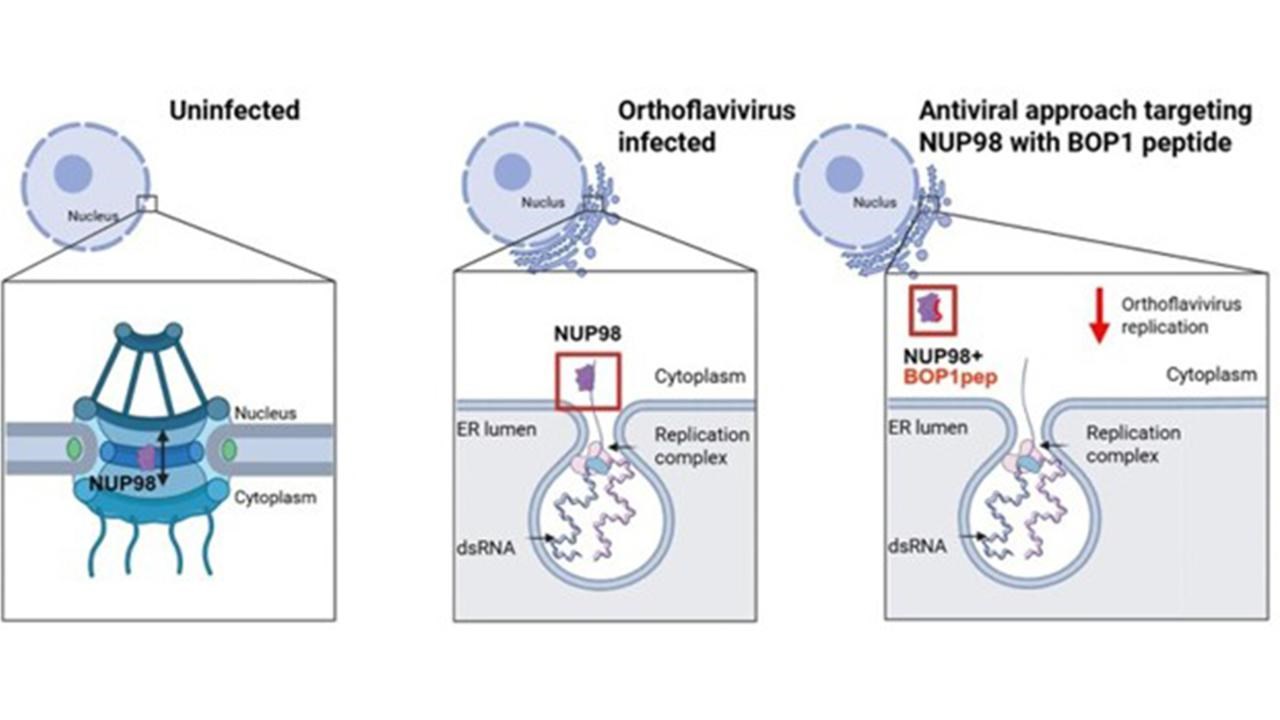
In two recently published studies by Professor Anna Överby’s research group at Umeå University, together with their collaborators, the nucleoporins NUP98 and NUP153 have been identified as key host factors in orthoflavivirus infection.

An unexpected role for nuclear pore proteins

NUP98 and NUP153 are normally part of the nuclear pore complex, which regulates the transport of proteins and RNA between the cell nucleus and the cytosol, the fluid in which the cell’s internal components are suspended. Since orthoflaviviruses copy their RNA in the cytosol, these proteins had not previously been linked to the viral life cycle.

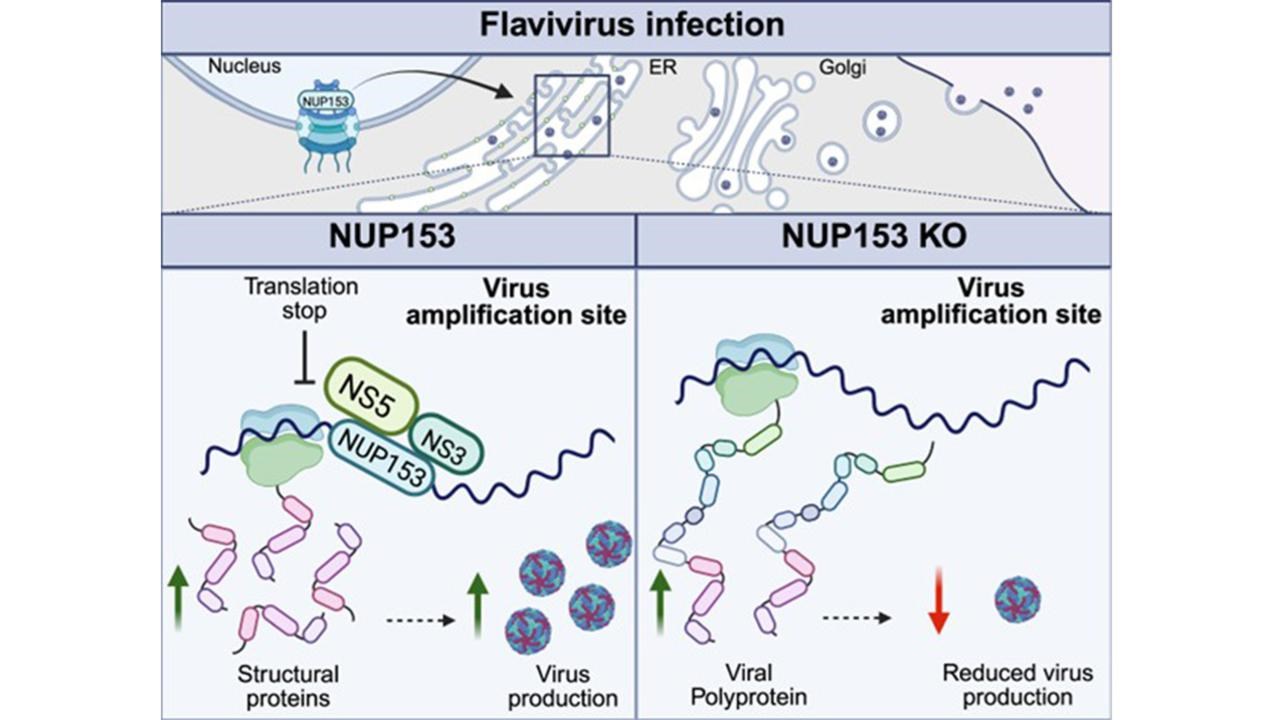
The researchers now show that during infection, both nucleoporins are recruited to viral replication sites in the cytosol, where they bind directly to viral RNA. In addition, NUP153 also interacts with viral proteins.

“It was surprising to see how proteins that normally act as ‘gatekeepers’ to the nucleus instead become active participants in the virus’s replication machinery,” says Marie Peters, a researcher who previously was a doctoral student at the Department of Clinical Microbiology and defended her PhD thesis in 2025, which included these publications.

Fine‑tuning viral protein production

The studies show that NUP98 and NUP153 have distinct roles during infection. NUP98 is required for efficient replication of viral RNA, while NUP153 influences how much of the different viral proteins are produced.

NUP153 binds to a specific region of the viral RNA located between the sequences encoding structural and non-structural proteins. Through this interaction, the balance between different viral proteins is regulated, which is critical at an early stage of infection.

“Our results challenge the established view that all viral proteins are produced in equal amounts. Instead, we see that the virus fine-tunes its protein expression with the help of the host cell’s own proteins,” says Marie Peters.

A peptide that stops the virus

In their work on NUP98, the researchers went on to identify – together with colleagues at Uppsala University – a small peptide that blocks NUP98’s binding to viral RNA. When this interaction is prevented, viral replication is dramatically reduced.

“This shows that our findings are not only biologically interesting, but can also be translated into concrete antiviral strategies,” says Anna Överby Wernstedt.

Paving the way for new antiviral drugs

Taken together, the studies provide new and deeper insights into how orthoflaviviruses exploit human cells. RNA-binding host proteins, such as nucleoporins, are highlighted as a central but previously underestimated part of the viral life cycle.

“By targeting stable host proteins rather than the virus’s rapidly mutating components, we may ultimately be able to develop broader and more resilient antiviral treatments,” says Anna Överby Wernstedt.

Facts orthoflaviviruses

Orthoflaviviruses are a genus of viruses that include several serious disease-causing pathogens transmitted by mosquitoes and ticks. Millions of people are infected each year, mainly in tropical and temperate regions. These viruses are geographically widespread and are increasing in range due to climate change and global mobility. There are no approved antiviral drugs against most orthoflaviviruses.

Examples of orthoflaviviruses: Tick-borne encephalitis virus (TBEV) – transmitted by ticks and can cause encephalitis. West Nile virus – transmitted by mosquitoes and can lead to neurological disease. Dengue virus – transmitted by mosquitoes and causes dengue fever, which can be life-threatening.

About the scientific publications

Peters MBA, Lindqvist R, Kassa E, Yau WL, Sengupta P, Niedermoser I, Gerold G, Sabouri N, Ivarsson Y, Lundmark R, Överby AK.: Proviral NUP153 binding to viral proteins and RNA regulates structural–nonstructural protein ratios in orthoflavivirus infection.
Nature Communications, April 8, 2026; 17(1):3402.
doi: 10.1038/s41467-026-71449-1.

Peters MBA, Lindqvist R, Madhu P, Lundmark R, Ivarsson Y, Överby AK.: NUP98 regulates orthoflavivirus replication through interaction with vRNA and can be targeted for antiviral purposes.
Nucleic Acids Research, January 22, 2026; 54(3):gkag027.
doi: 10.1093/nar/gkag027.

For more information, please contact:

Anna Överby Wernstedt
Professor, research fellow
E-mail
Email
Marie Peters
Doctoral student
E-mail
Email