
"False"
Skip to content
printicon
Main menu hidden.
Porträtt av några medlemmar i NOGVIS

Image: Mattis Koppang

Nordic Network on Gendered Violence in Sámi and Inuit Communities (NOGVIS)

Research network NOGVIS is a Nordic research network that includes key researchers from Sweden, Norway, Finland, Greenland and Denmark and works closely with the Saami Council and the Inuit Circumpolar Council Greenland (ICC Greenland) as central partners. Our aim is to strengthen and further develop the Nordic research community on gendered violence in Indigenous communities by establishing this network as a platform for knowledge exchange and collaboration between researchers and Indigenous representatives.

Who are we?

Central partners in the network project include key researchers within the field of Gendered violence in Sámi and Inuit communities from Sweden, Norway, Finland, Greenland and Denmark as well as Indigenous representatives from the Saami Council and the Inuit Circumpolar Council Greenland (ICC Greenland). See the full list of partners below. The network is anchored at the department of Social work at Umeå University and the research group Lávvuo.

Aim

Our aim is to strengthen and further develop the Nordic research community on gendered violence in Indigenous communities by establishing this network as a platform for knowledge exchange and collaboration between researchers and Indigenous representatives.

Central objectives

NOGVIS has three central objectives:
1. To establish a structure and network for knowledge sharing, cooperation and capacity building in research on gendered violence in Sámi and Inuit communities, involving researchers across different disciplines and central Indigenous stakeholders in the Nordic area.

2. To contribute to socially sustainable research and community development related to gendered violence in Sámi and Inuit communities through a revitalized dialogue about Indigenous and feminist research ethics and methodologies between researchers and Indigenous stakeholders.

3. To increase the impact and visibility of research on gendered violence in Sámi and Inuit communities in public policy, Indigenous communities and the academia.

By creating a platform to exchange knowledge and build capacity for collaboration - between researchers and key Indigenous representatives – we want to strengthen this field of research and contribute to an ethically sound and sustainable research and community development. Through the network's various activities including webinars, network meetings and a policy brief, we also want to develop and disseminate knowledge about research on gendered violence from Indigenous and feminist perspectives.

Would you like to subscribe to our digital newsletter and receive invitations to our events?

Send an e-mail to: nogvis@umu.se and we will add you to our mailing list.


Webinar series 2025-2027

The NOGVIS webinar series spotlights the issue of Gendered violence in Sámi and Inuit communities from different perspectives. The webinars are broadcasted digitally on zoom and are open to policymakers, professionals working with violence prevention, researchers and anyone interested in Indigenous health and equality.
 
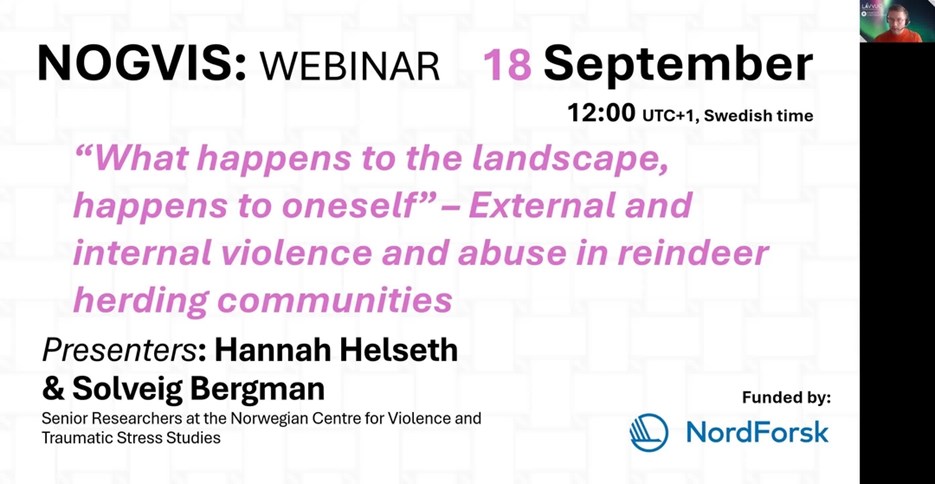
Next webinar: Friday Sept 18th, 12.00-13.00 (UTC+1, Swedish time). 


“What happens to the landscape, happens to oneself” – External and internal violence and abuse in reindeer herding communities


Presenters: Hannah Helseth, Senior Researcher and Solveig Bergman, Senior Researcher (em.), Norwegian Centre for Violence and Traumatic Stress Studies.

In a recent study we argue that to comprehend violence in Sápmi one needs to expand the concept of violence from just describing persons’ actions towards persons to include the historical context of subordination and colonialisation, present discrimination and actions towards the land. Based on individual and group interviews with persons from the Sámi reindeer herding community, the study explores how the connection between various forms of violence and abuse is understood in their context. Violent acts and sexual abuse within the community, extended family or couple relationship are tainted by the Sámi reindeer herding context but cannot be interpreted solely as being related to external pressure and subordination. Gender and gender relations are conceived of as a central dimension interacting with individual factors, kinship, economic conditions, local community norms, and historical traumas.
Structural, institutional and cultural barriers prevent Sámi victims of violence and abuse from seeking and/or receiving adequate help, and a support system designed according to a Norwegian, individualistic logic often clashes with reindeer herding as a more collective, family-based way of life. Many informants carry multiple simultaneous burdens over time, which has serious consequences for psychological and physical health, and for reindeer herding Sámi communities as a whole. This points to the need for support services capable of understanding and managing this complexity.
The stigma surrounding talking about violence and abuse that occurs internally within reindeer herding Sámi communities appears to be on the wane. All informants point to historical progress in the conversation about violence and abuse – whether it concerns violence and abuse inflicted from outside or violence occurring internally within reindeer herding Sámi communities.
The study was carried out by the Norwegian Centre for Violence and Traumatic Stress Studies (NKVTS) and the Sámi Norwegian National Advisory Unit – Mental Health and Substance Use (SANKS) in close cooperation. The research teams consisted of Hannah Helseth (project leader), Solveig Bergman, Anna Lene Turi Dimpas, Margrethe Bals Utsi, Kaisa Sofie Anti, Maria Hansen and Linn-Eirin Aronsen Haugen. The report was published as NKVTS Report no. 2/2026.
Link to the webinar on Zoom 

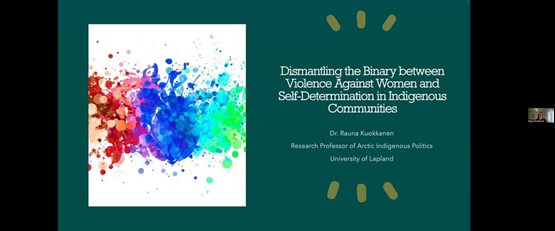
Dismantling the Binary between Violence Against Women and Self-Determination in Indigenous Communities

Rauna Kuokkanen, Research Professor of Arctic Indigenous Politics at the University of Lapland and Adjunct Professor of Political Science at the University of Toronto.

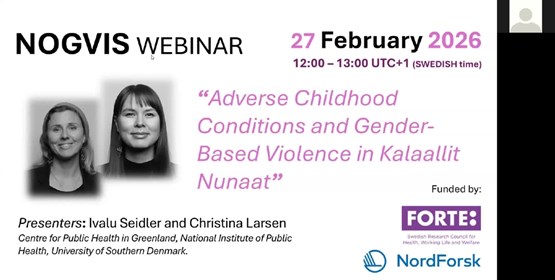
Adverse Childhood Conditions and Gender-Based Violence in Kalaallit Nunaat

Ivalu Seidler and Christina Larsen, Centre for Public Health in Greenland, National Institute of Public Health, Univeristy of Southern Denmark

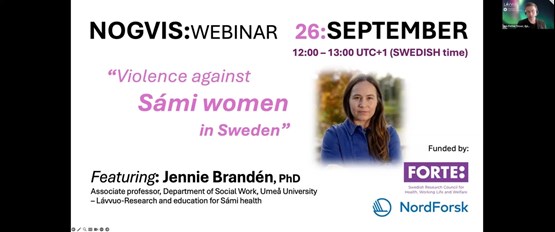
Violence against Sami women in Sweden

Jennie Brandén, Umeå University

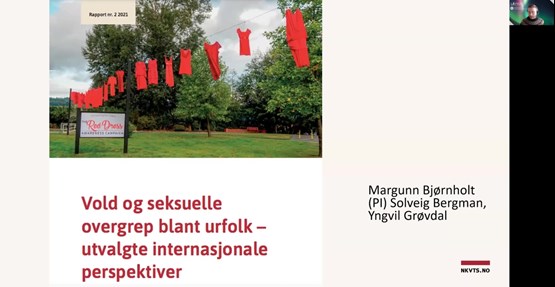
Violence and sexual abuse in Indigenous communities – international perspectives

Margunn Bjørnholt, Professor of Sociology, VID Specialized university, Oslo

Network coordinator and project manager

Jennie Brandén
Associate professor
E-mail
Email

Overview

  • Members

    Jon Petter Stoor
    Assistant professor
    E-mail
    Email

    External group members

    Arnarak Patricia Bloch Chair of the Circumpolar Inuit Health Steering Committee at the Inuit Circumpolar Council (ICC) Greenland, PhD Student at the Center for Public Health Greenland, Denmark.
    E-mail
    Email
    Christina Viskum Larsen Professor and Head of Research at the Center for Public Health in Greenland, National Institute of Public Health, University of Southern Denmark.
    E-mail
    Email
    Ivalu Katajavaara Seidler PhD Public Health, researcher at the Center for Public Health in Greenland, National Institute of Public Health, University of Southern Denmark.
    E-mail
    Email
    Rauna Kuokkanen Research Professor of Arctic Indigenous Politics at the University of Lapland and Adjunct Professor of Political Science at the University of Toronto.
    E-mail
    Email
    Solveig Bergman Senior researcher, The Norwegian Centre for Violence and Traumatic Stress Studies/Nasjonalt kunnskapssenter om vold og traumatisk stress (NKVTS).
    E-mail
    Email
    Hannah Helseth Senior researcher, The Norwegian Centre for Violence and Traumatic Stress Studies/Nasjonalt kunnskapssenter om vold og traumatisk stress (NKVTS).
    E-mail
    Email
    Tonje Margrete Winsnes Johansen Advisor and project manager, Saami Council, Norway
    E-mail
    Email
    Áile Jávo Secretary General, Saami Council, Norway
    E-mail
    Email

External funding

Latest update: 2026-05-22